
Podcast: Play in new window | Download
Subscribe: Apple Podcasts | Spotify | Android | Pandora | iHeartRadio | TuneIn | Deezer | RSS

Executive Summary: Workplace betrayal doesn't just cost you a relationship — it costs you trust in your own judgment. Dr. Debi Silber joins Sabrina Braham to unpack a stage-based path back to confidence, using real coaching stories instead of easy platitudes, so leaders can rebuild what betrayal breaks: themselves.
Quick Takeaways:
- Betrayal breaks trust in yourself, not just in the person who betrayed you
- Losing your voice in meetings is often a betrayal symptom, not a confidence problem
- Recovery moves through stages — you can't skip to "just get over it"
- Your intuition can be rebuilt with a simple daily practice
- 78% of employees say they trust their employer most of any institution (Edelman, 2026)
As an executive leadership coach with over 30 years of experience (MA, MFT, PCC), I've sat across from directors, VPs, and C-suite leaders who could run a board meeting flawlessly and still couldn't shake the feeling that they didn't trust their own read on people anymore. That's what workplace betrayal does. It doesn't announce itself as trauma — it shows up as hesitation, over-checking, and a leader who used to speak up in meetings suddenly going quiet.

In this episode of the Women's Leadership Success Podcast, I sit down with Dr. Debi Silber, a holistic psychologist and founder of the PBT Institute, for a workplace betrayal recovery conversation about what betrayal actually does to a leader's confidence, judgment, and career trajectory — and what it takes to rebuild.
Why Workplace Betrayal Hits Differently Than Other Career Setbacks
Most leadership content treats betrayal like a subcategory of stress or conflict. Dr. Silber's central point in this conversation is that it isn't. A layoff, a missed promotion, even a bad performance review — these are painful, but they don't usually make you question your own perception. Betrayal does. When someone you trusted — a boss, a peer, a mentor — acts against you, the injury isn't just what they did. It's that your internal compass, the one that told you this person was safe, was wrong. That's a different kind of damage, and it requires a different kind of recovery.
This distinction matters for women in leadership specifically. Executive presence is built on decisiveness and trust in your own judgment — the "gravitas" that research consistently identifies as the core pillar of how leaders are evaluated for advancement. When betrayal quietly erodes that self-trust, it doesn't just hurt personally. It shows up publicly, in hesitation during exactly the moments a leader is expected to be most sure of herself.
A Client Story: When Betrayal Shows Up as "Losing Your Voice"
I shared a story with Dr. Debi about a client I'll call Jenny. Jenny was sharp, capable, and well-respected — until a workplace betrayal knocked something loose. She stopped negotiating. She stopped advocating for herself in meetings where she used to be the first voice in the room. From the outside, it looked like a confidence problem. It wasn't. It was betrayal doing exactly what it does: convincing a capable leader that her own instincts couldn't be trusted anymore.
The Real Cost: What Betrayal Quietly Takes From Leaders
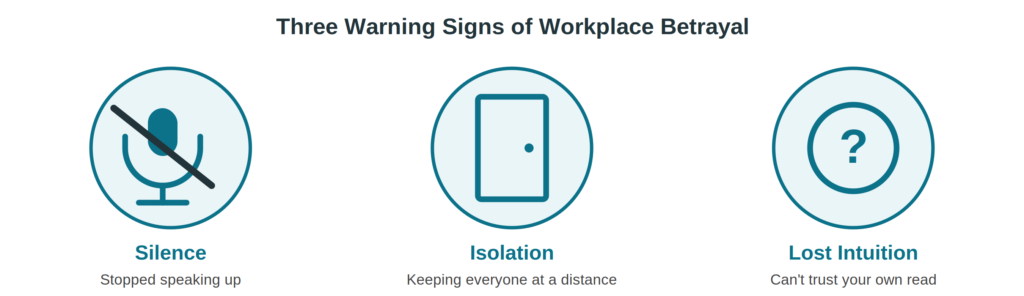
Left unaddressed, workplace betrayal tends to produce three patterns in otherwise strong leaders:
- Loss of personal power. Leaders stop negotiating for themselves — raises, promotions, credit for their work — because some part of them no longer trusts that speaking up is safe.
- Self-protective isolation. As Dr. Debi put it in our conversation, many people conclude it's "better to keep everyone at a distance than risk that chance that someone may get close to us again." It feels like self-protection. It functions like a ceiling on your influence.
- Eroded intuition. The instinct that once flagged red flags in coworkers or bosses goes quiet, because the last time it "worked," it still let you get hurt.
Ready to rebuild the confidence workplace betrayal quietly took from you? Download our FREE Leading Before You're Ready playbook and get:

? A framework for rebuilding executive presence when your confidence has taken a hit
? Practical language for reclaiming your voice in meetings within days, not months
? The mindset shift that lets you lead before you feel "fully ready" again
? Tools used with clients who've gone on to earn promotions and six-figure roles
Get the Leading Before You're Ready Playbook ?
How to Notice You're Still Carrying It
One of the most useful moments in this conversation is Dr. Debi's answer to a simple question: how does someone even realize betrayal is still affecting them? Her answer wasn't a checklist of symptoms — it was three places to look: your health, your work, and your relationships. If any of those three areas feels "off" in a way you can't quite explain, unresolved betrayal is worth considering as a root cause, not just stress or burnout.
Workplace Betrayal Recovery: Why You Can't Skip to "Just Move On"
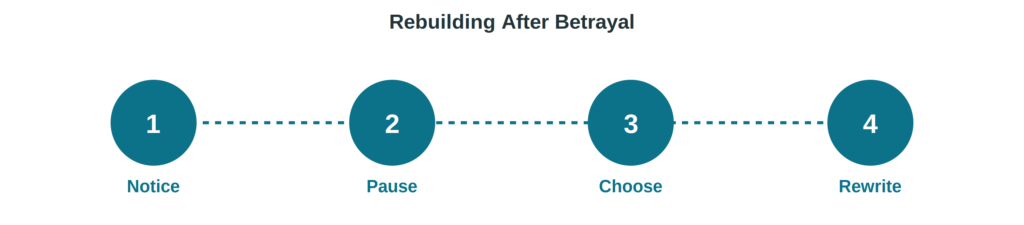
A recurring frustration Dr. Debi and I discussed is how often people are told to "just get over it" — as though healing from betrayal were a decision instead of a process. In her framework, recovery moves through stages, not a single leap. You can't talk yourself into Stage Four while you're still standing in Stage One. Trying to skip ahead is exactly why so many leaders feel stuck: they've done the mental work of "deciding to move on" without doing the deeper work each stage requires.
The practical implication for leaders: if you've told yourself to "get over" a workplace betrayal and it hasn't stuck, that's not a willpower failure. It's a sign you skipped a stage.
Rebuilding Trust in Your Intuition
Dr. Debi was direct about this: "we have to rebuild trust in our intuition, in our wise inner guide, whatever you want to call it." The practice she described is simple — the next time something feels off with a coworker or a boss, a small signal that something "feels shady," pause and name it instead of dismissing it. Every time you notice the signal and honor it, even in a small, low-stakes way, you rebuild the muscle betrayal weakened.
Rebuilding Identity: Keep What You Love, Release the Rest
The second piece of the framework is about identity, not just instinct. As Dr. Debi framed it: figure out "what are all the parts you love" about who you are — those come with you into the next chapter. The rest doesn't have to. This isn't about becoming a different person. It's about consciously choosing which parts of your pre-betrayal self are worth rebuilding and which parts were never serving you anyway.
That reframe — "you're rewriting a new script" — is the shift from surviving betrayal to authoring what comes after it. A useful self-check Dr. Debi offered: picture the version of you on the other side of this, fully rebuilt. Would she do the things you're currently doing and saying? If not, that gap is exactly where to start.
Implement This Week: A 4-Step Action Plan
- Step 1 (15 minutes): Run the three-area check. Write down one honest observation each about your health, your work, and your relationships right now. Look for the thread connecting them.
- Step 2 (10 minutes/day): Practice the intuition pause. Once a day, when something feels slightly off in an interaction, pause and name it silently instead of dismissing it. Track how often your read turns out to be accurate.
- Step 3 (30 minutes): Do the "parts you love" inventory. List the traits, habits, and strengths you want to carry forward. Separately, list what you're willing to release. Keep the first list somewhere visible.
- Step 4 (ongoing): Use the future-self test. Before a hard conversation or decision this week, ask: would my fully rebuilt self do this? Let the answer guide you, not the fear in the moment.
Success metric: By the end of one week, aim to catch and honor your intuition at least five times — even in small moments. That's the rebuild in motion.
Common Mistakes Leaders Make After a Workplace Betrayal
- Mistake 1: Treating it as a confidence problem instead of a trust problem. Confidence-building tactics (power poses, affirmations) don't address a broken intuition. They mask the symptom while the root cause stays untouched.
- Mistake 2: Trying to "just get over it" without moving through the stages. Deciding to move on isn't the same as doing the work each stage requires. This is why the same hurt tends to resurface in new relationships and new roles.
- Mistake 3: Isolating as a permanent strategy. Keeping everyone at a distance feels protective short-term. Long-term, it caps your influence, your network, and your visibility for the next promotion.
- Mistake 4: Trying to heal alone. You don't have to do this without support — a coach, a trusted peer, or a mentor can see the gap between where you are and your future self faster than you can see it yourself.
People Also Ask
What is workplace betrayal, exactly?
Workplace betrayal happens when someone you trusted at work — a manager, peer, or mentor — acts against your interests in a way that violates that trust. It's distinct from ordinary workplace conflict because it damages your trust in your own judgment, not just your view of the other person.
How is betrayal different from burnout?
Burnout is typically caused by chronic overwork or lack of resources. Betrayal is caused by a specific breach of trust and often produces symptoms — hesitation, isolation, eroded intuition — that can look like burnout but require a different kind of recovery.
Can you really rebuild trust in your own intuition?
Yes. Dr. Debi Silber describes it as a practice, not an event: consistently noticing and honoring small intuitive signals rebuilds the confidence in your own perception that betrayal damaged.
How do I know if I'm still carrying an old workplace betrayal?
Look at three areas: your health, your work, and your relationships. Unexplained tension in any of them can be a sign that an old betrayal hasn't fully been processed.
Why can't I just decide to move on from a betrayal?
Recovery happens in stages, and deciding to move on only addresses the final stage. Skipping the earlier stages is one of the most common reasons people feel "stuck" even after genuinely trying to let go.
Does workplace betrayal actually affect career advancement?
It can. Executive presence depends heavily on gravitas — decisiveness and composure under pressure — and unresolved betrayal tends to erode exactly those qualities, often in visible moments like meetings and negotiations.
Old Thinking vs. What Actually Rebuilds Trust
| Old Approach | What Actually Rebuilds Trust |
|---|---|
| "Just get over it" | Move through the stages in order |
| Build confidence with tactics | Rebuild trust in your own intuition |
| Keep everyone at a distance | Selectively re-engage while checking in with intuition |
| Try to go back to who you were | Keep the parts you love, release the rest |
| Heal privately and alone | Get support from a coach, mentor, or trusted peer |
| Wait to feel ready to lead again | Ask what your rebuilt self would do, then do it |
What's New in 2026: Trust Is the Leadership Issue of the Moment
Workplace betrayal recovery isn't just a personal issue in 2026 — it's playing out at scale. According to the 2026 Edelman Trust Barometer, "my employer" is now the single most trusted institution people have, with 78% of employees saying they trust their employer to do the right thing — ahead of business in general, media, and government. But that trust is fragile: 75% of employees say leaders are obligated to help bridge divides inside their organizations, while only 44% say leaders actually do it well — a 29-point credibility gap between what leaders are expected to do and what employees see them doing.
Meanwhile, Gallup's 2026 State of the Global Workplace report found that manager engagement dropped sharply — from 27% to 22% between 2024 and 2025 — the steepest single-year decline Gallup has recorded, wiping out the "engagement premium" managers used to have over the employees they lead. Since managers account for roughly 70% of the variance in team engagement, a manager who is quietly disengaged — or quietly working through their own workplace betrayal recovery — has an outsized ripple effect on everyone reporting to them.
The takeaway for leaders: rebuilding your own trust and presence after betrayal isn't just personal healing. In 2026's climate, it's a direct lever on your team's engagement and your organization's ability to function as the "trust broker" employees are counting on it to be.
The Bottom Line
Workplace betrayal doesn't just cost you a relationship with one person — it can quietly cost you your voice, your network, and your trust in your own judgment. But it moves in stages, it can be tracked through your health, your work, and your relationships, and it can be rebuilt. Real workplace betrayal recovery happens through small, repeated practice trusting your intuition again, and through consciously choosing which parts of yourself to carry forward. As Dr. Debi put it, this isn't just about recovering. There's so much more available to you on the other side.
Ready to reclaim the confidence and voice that betrayal quietly took from you? Download our FREE Leading Before You're Ready playbook and get:
- A step-by-step approach to rebuilding executive presence after a setback
- Real scripts for speaking up again in meetings and negotiations
- A mindset shift that helps you lead before you feel fully "ready"
- The same framework used with clients who've gone on to earn promotions to VP and SVP
Download the Leading Before You're Ready Playbook
Enjoyed this episode? Subscribe to the Women's Leadership Success Podcast wherever you listen, leave a rating and review, and share this episode with a leader in your network who needs to hear it.
Want personalized support?
About Our Guest

Dr. Debi Silber, PhD is a holistic psychologist and founder of the PBT Institute, focused on betrayal recovery research and education. She is the author of several books, including Trust Again, and hosts the podcast From Betrayal to Breakthrough. She has spoken at TEDx and appeared on national media outlets discussing trust, betrayal, and recovery.
About Sabrina Braham

Sabrina Braham, MA, MFT, PCC is an executive leadership coach with over 30 years of experience helping senior managers, directors, VPs, and C-suite leaders build executive presence and advance their careers. She is the founder of Women's Leadership Success and host of the Women's Leadership Success Podcast, ranked in the top 1.5% of podcasts worldwide, with clients including Stanford University, Ernst & Young, Autodesk, and MGM Grand Resorts.