Welcome to the Women’s Leadership Podcast
Do you want to expand your potential and achieve great success? You have come to the right place. The Women’s Leadership podcast was created to help you. For over 30 years, I have been involved in research & cutting-edge practices that have helped thousands of people get promoted and become top leaders.
In this one-of-a-kind women’s leadership podcast, you will get actionable advice and tips and hear stories from over 164 top female (and men) thought leaders to help you be a better leader, advance your career, increase your income, help you have more influence and have a better quality of life in work and play.
This Women’s Leadership podcast is ideal for you if you are a new supervisor, manager, existing C-Suite, seasoned entrepreneur leader, or aspire to be one.
How to Use Women’s Leadership Podcast to Excel in Your Leadership, Career, and Income

Executive Leadership Coach Sabrina Braham MA MFT PCC
To find a specific topic to help you succeed, use the Women’s Leadership Podcast “Topics” category search on the right-hand sidebar, or the search magnifying glass on the top navigation bar. Also, on the lower right-hand sidebar, check out some of the “Most Popular Shows” of the Women’s Leadership Success podcasts, where we are some of the most popular authors, entrepreneurs, and thought leaders dedicated to helping you enhance your leadership.
The results I have had with my clients inspired me to launch and develop this Women’s Leadership podcast to give you that same opportunity to excel in your leadership & career by sharing my expertise and interviewing top leaders in business to discover the secrets to their great success.
We have produced this Women’s Leadership Podcast since 2007, have had almost 900,000 downloads, and have ranked in the top 1.5% of podcasts worldwide. We are so happy and excited to hear from many listeners that this podcast for women has helped them.
We know the advice and wisdom in this Women’s Leadership Podcast will change you…if you listen and implement the actions that are suggested in these programs.
May I Ask You a Favor?

Women’s Leadership Executive Coach Sabrina Braham MA MFT PCC
Thank you for listening to one of the first women’s leadership podcasts ever. May I ask you a favor?
Please give us a quick rating and review in Apple Podcasts or your favorite podcast platform and share this special leadership podcast for women with others so that we can help more women succeed together.
I want to hear from you too. Please post your thoughts and questions in the “Leave a Comment” box below each show.
Wishing you great success, Sabrina Braham MA MFT PCC
Signs of Manager Burnout: 10-Minute Fix for Leaders 2026
Podcast: Play in new window | Download
Subscribe: Apple Podcasts | Spotify | Android | Pandora | iHeartRadio | TuneIn | Deezer | RSS
Signs of Manager Burnout: How One Leader of 18 Got Her Energy Back — and the 10-Minute Meeting That Helped
Last updated: October 16, 2026
Trusted by leaders at Stanford University, Ernst & Young, Autodesk, MGM Grand Resorts, and Farmers Insurance
Executive Summary: Managers keep hitting deadlines while quietly running on empty. Gallup reports manager engagement fell to 22% in 2025. In WLS 170, Sabrina Braham shares the signs of manager burnout, how Martha recovered after suddenly leading two teams of nine, and a 10-minute Monday meeting any leader can start this week.
Quick Takeaways:
- Manager engagement dropped from 27% to 22% in 2025 alone (Gallup, 2026).
- Strong results can hide the signs of manager burnout — watch for postponed one-on-ones.
- Ask a stretched manager: “What’s become harder, and what support are you missing?”
- A 10-minute Monday meeting — wins, roadblocks, ideas, recognition — re-energized two teams.
- Coaching changes how you lead; organizations must still fix the conditions you lead in.
Jump to:
Why It’s Missed · 6 Signs · Martha’s Story · The 10-Minute Meeting · The Results · For Senior Leaders · Action Plan · Mistakes · FAQ · 2026 Trends
As an executive leadership coach with more than 30 years of experience (MA, MFT, PCC) and host of the Women’s Leadership Success Podcast — on air since 2007, ranked in the top 1.5% of podcasts worldwide, with 57,000+ monthly downloads — I see the signs of manager burnout long before most companies do. The deadlines still get met. The problems still get solved. But listening, developing people, and thinking ahead quietly disappear.
The numbers explain why this matters now. Global manager engagement fell from 27% to 22% in 2025, and managers are now no more engaged than the people they lead (Gallup, 2026). Meanwhile, the average U.S. manager now leads 12.1 direct reports, up from 10.9 a year earlier (Gallup, 2026).
When I posted an infographic on the signs of manager burnout on LinkedIn, it drew more than 40,000 impressions. So in Episode 170, my co-founder Tim Warren interviewed me about Martha — a director moved to manager in a downsizing and handed two teams — and the 10-minute meeting that helped her lead again.
Key moments in this episode
- 00:00 — When managers run out of energy to lead
- 02:30 — Why results hide the signs of manager burnout
- 03:00 — What senior leaders should notice
- 04:10 — Martha’s story: director to manager of two teams
- 06:30 — Where coaching began: listening and strengths
- 09:00 — The 10-minute Monday meeting
- 12:25 — The agenda and “How can we help you?”
- 16:50 — What companies must change after downsizing
- 20:55 — One conversation to have this week
- 22:10 — Where Martha landed

Why the Signs of Manager Burnout Are So Easy to Miss in 2026
Managers are expected to deliver results, solve problems, develop people, and keep morale up — all at once. Many keep meeting deadlines while exhausted. As I told Tim, the results can hide how much they’re struggling.
Manager engagement is falling fastest
Gallup’s latest State of the Global Workplace report shows manager engagement has dropped nine points since 2022. In the prior year’s report, female manager engagement fell by seven points (Gallup, 2025). That matters because Gallup attributes about 70% of the variance in team engagement to the manager. When managers run on empty, their teams follow.
The “Great Flattening” is stretching managers thin
Companies are cutting management layers. The leaders who remain absorb larger teams and more work. Gallup finds 97% of managers also carry individual contributor work, and more managers now report burnout, stress, and job-seeking than a few years ago. Martha’s 18 direct reports were triple Gallup’s median of five to six.
Senior women are feeling it most
About 60% of senior-level women report frequent burnout, compared with 50% of senior-level men — the highest level in five years. Among senior women with five or fewer years at their company, it’s 70% (McKinsey & LeanIn.Org, 2025).
The cost of missing the signs of manager burnout
Ignored, the signs of manager burnout become a team that disconnects and a high performer who quietly starts job-hunting. For you, it can mean losing the energy and visibility that get leaders promoted.
Running on empty — and worried it’s showing up in how leaders see you?
Send Sabrina a direct  message on LinkedIn. Tell her what’s become harder, and she’ll point you to your next best step.
- Name what’s draining your capacity to lead
- Find one change to propose to your leader this week
- Protect the energy and visibility that get leaders promoted
6 Signs of Manager Burnout Senior Leaders Should Notice
Just like success leaves clues, so does struggle. Here are the six signs of manager burnout from the infographic that sparked this episode.
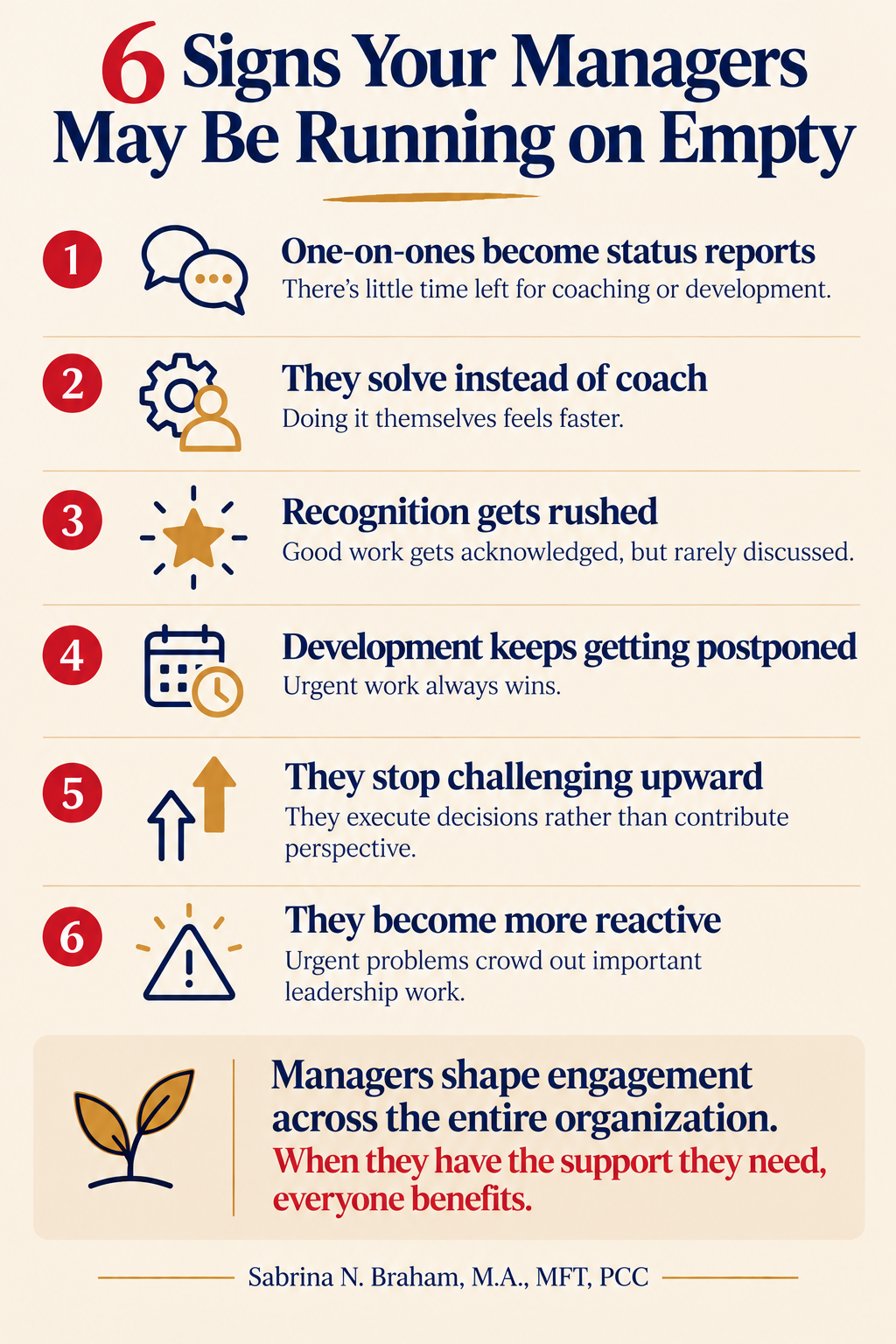
The infographic that drew 40,000+ impressions on LinkedIn.
- One-on-ones become status reports. Or they get postponed entirely. There’s little time left for coaching.
- They solve instead of coach. Doing it themselves feels faster — so fewer employees get development conversations.
- Recognition gets rushed. Good work gets a quick thanks but rarely a real conversation.
- Development keeps getting postponed. Urgent work always wins.
- They stop challenging upward. They execute decisions rather than contribute perspective.
- They become more reactive. Meetings focus only on deadlines and immediate problems. The manager seems less curious and less enthusiastic.
Here’s the important part: these signs of manager burnout are reasons to start a conversation, not proof of disengagement. Ask two questions: “What’s become harder? And what support are you missing?”
Martha’s Story: From Director to Manager of Two Teams
I’ll call my client Martha. She had been a director at her company. Then the company downsized, and she became a manager.
After the restructuring, she was responsible for two teams of nine employees each. A manager there would normally lead one team of nine. The two teams also had very different tasks and responsibilities. Martha was working long hours, she was exhausted, and she was losing interest in her job. That’s when she called me.
The title change mattered. But so did the workload and the organizational disruption. Martha showed nearly every one of the signs of manager burnout above.
Where coaching started: listening first
When someone has just been hit by a truck, you don’t tell them what to do differently. You help them function again. So I listened — to her discouragement and to what had changed in her role, workload, and support. As a former psychotherapist, I always start with the full picture.
The strengths question that changed everything
Once we understood the problem, one pattern stood out. Martha was doing a huge amount of the work herself, without really including her teams. So I asked her:
- What are your employees good at?
- What strengths aren’t they getting to use right now?
- What responsibilities could they take on, with the right support?
She hadn’t given this much thought — and she became very excited. She saw ways to take things off her plate and develop her people. That’s the shift from expert to architect.
The 10-Minute Monday Meeting: A Simple Fix for the Signs of Manager Burnout
We worked on several changes. The one that made the biggest visible difference was a 10-minute all-hands meeting held once a week, on Monday. It gave Martha a regular way to hear from both teams and to notice contributions she might otherwise have missed.

The agenda: five prompts, ten minutes
- One success worth sharing — a win, big or small.
- One roadblock that needs help — named, not solved, in the meeting.
- One improvement suggestion — a better way to do something.
- One colleague to recognize — for exceptional work.
- Milestones — birthdays, work anniversaries, a child graduating.
The ground rules that keep it useful
- Protect the scope. This is not a planning meeting or a deep problem-solving session. Schedule those separately.
- The leader goes first. Martha led off by sharing, which set the tone and the format.
- Not everyone speaks every week. Participation, not performance.
- Close the loop. Come back to what people raised: what helped, and what didn’t.
How employees responded
At first, the teams were less than enthusiastic. But the format created a rhythm. Over time, people became friendlier, shared more ideas, and recognized colleagues on their own. The two teams even found ways to help with each other’s work. Martha spotted chances to improve systems and morale from what people said.
The question that changed the culture: “How can we help you?”
Soon, people started asking each other: How can we help you? Sometimes the answer was simple — like honoring a “do not disturb, 2 to 4” sign so a colleague could finish a Friday report. Think how good it feels when someone asks how they can help.
Try This Now (5 minutes): Put a recurring 10-minute meeting on your team’s calendar for Monday morning. Paste the five prompts above into the invite. Next Monday, go first with one success of your own.
Want help launching your own 10-Minute Monday Meeting?
Message Sabrina on  LinkedIn with your team size and biggest roadblock. She helps leaders like Martha go from overloaded to leading again.
- Tailor the five prompts to your team
- Spot which work to delegate first
- Turn people-development wins into promotion-ready stories
What Changed for Martha — and Why She Ultimately Moved On
Here’s the part that made me smile. Martha’s team began asking her, “How can we help you?” They weren’t waiting to be delegated to. They looked for ways to take work off her plate.
- She became more enthusiastic about leading.
- She started thinking creatively about systems and team morale.
- She took more breaks and reduced working hours — for herself and her employees.
- She saw more chances to develop people instead of handling everything herself.
The meetings were one part of the change; coaching and adjusting how work was handled also contributed.
Did she stay? Ultimately, no. I helped her land a better job at a company with a good culture. Our work helped her lead better — and recognize the environment she needed to do her best work.
How this applies to your career
- The tech director after a reorg. Her span doubled overnight. She launches the Monday meeting and delegates two recurring reports.
- The VP who leads managers. She notices two managers postponing one-on-ones — classic signs of manager burnout — and asks each what has become harder.
- The laid-off leader interviewing in 2026. She tells a Martha-style story in interviews: inherited an overloaded team, developed people, reduced hours, kept results. That story signals she can lead at scale.
Spotting the Signs of Manager Burnout After Downsizing: What Senior Leaders Must Change
I’ve seen very few companies stay mindful of what a downsizing or merger does to their people. Coaching can change how someone leads, but the organization still has to address the conditions they’re leading in — or the signs of manager burnout return.
If you’ve restructured — or you’re about to — ask:
- Whose workload increased, and by how much?
- What work will stop?
- Which deadlines will move?
- What decisions can be delegated?
- Where are additional resources needed?
- Do managers’ authority and resources match their responsibilities?
Don’t leave managers to absorb every competing priority. Delegation helps, but it doesn’t solve every staffing gap. Ideally, this starts with the CEO, so developing people isn’t one more task on an impossible workload.
Implement This Week: Your Action Plan
- (10 min) Scan for the signs of manager burnout. Review the six signs for yourself or each manager you lead. Metric: note any sign present for two weeks or more.
- (15 min) Have the energy conversation. If you lead managers, ask: “What’s taking the most energy right now, and what could we remove or change?” Metric: one specific answer captured.
- (15 min) Bring a proposal upward. If you’re the manager, raise the same question with your leader — plus one concrete proposal. Metric: one change agreed.
- (20 min) Map unused strengths. List each team member’s strengths and one responsibility they could take on with support. Metric: two delegation opportunities named.
- (5 min) Schedule the 10-Minute Monday Meeting. Metric: first meeting held within 7 days.
- (10 min, after 30 days) Review what helped. Implement one change, then check whether it worked. Metric: hours worked and one-on-ones held, before vs. after.
The goal is to create enough capacity to lead — not simply to get through the day.
Common Mistakes When You See the Signs of Manager Burnout
- Judging managers by results alone. Deadlines can be met while engagement collapses. Watch the leading indicators — one-on-ones, development, curiosity.
- Treating the signs of manager burnout as proof of a bad attitude. They’re signals to start a conversation. Lead with “What’s become harder?”
- Adding development expectations without removing work. “Spend more time coaching” on top of an impossible workload backfires. Decide what stops.
- Turning the 10-minute meeting into a 60-minute one. Once it becomes a planning session, people disengage. Protect the scope.
- Expecting coaching to fix structural gaps. If a manager has double the team and no new resources, the organization must act too.
Old Approach vs. the Capacity-First Approach
| Old Approach | Capacity-First Approach |
|---|---|
| Judge managers by deadlines met | Watch one-on-ones, coaching, and curiosity too |
| Assume disengagement means low commitment | Ask what has become harder |
| Manager solves every problem personally | Manager taps team strengths and delegates |
| Recognition happens at annual reviews | Peer recognition happens every Monday |
| Restructure, then expect managers to absorb it | Decide what work stops and what moves |
| Add “develop people” to the to-do list | Remove work to make room for development |
People Also Ask
What are the signs of manager burnout?
Common signs of manager burnout include one-on-ones turning into status reports or getting postponed, solving instead of coaching, rushed recognition, delayed development conversations, less pushback upward, and more reactive, deadline-only meetings. Results often stay strong, which is why the signs get missed.
How do I talk to a manager I think is burned out?
Treat the signs as a reason to start a conversation, not as proof of disengagement. Ask, “What’s become harder, and what support are you missing?” Then agree on one thing to remove or change.
How many direct reports is too many for a manager?
Gallup reports the average U.S. manager led 12.1 direct reports in 2025, while the median is five to six. Gallup’s research suggests manager talent and workload design matter more than a fixed number.
What is a 10-minute all-hands meeting?
It’s a short weekly team meeting — Sabrina recommends Monday — where people share one success, one roadblock, one improvement idea, and one colleague to recognize. It’s not a planning meeting, and not everyone speaks every week.
How can companies prevent manager burnout after layoffs or a merger?
Ask which managers’ workloads grew, decide what work will stop and which deadlines will move, delegate decisions, and add resources where needed. Make sure managers’ authority and resources match their new responsibilities.
Should I leave my job if I’m a burned-out manager?
Start by changing what you can control: delegate, develop your team, and propose one specific change to your leader. If the culture won’t support you, a move can be the right step — Sabrina’s client Martha landed a better job at a company with a healthier culture.
What’s New in 2026: Why the Signs of Manager Burnout Are Rising
- The rise of the “supermanager.” Flatter org charts, layoffs, and AI tools are pushing spans of control higher — a trend often called the Great Flattening.
- Managers have lost their engagement edge. Gallup says managers are now no more engaged than individual contributors.
- “Quiet cracking” has a name. 54% of U.S. employees report some level of persistent workplace unhappiness, and 29% call their workload unmanageable (TalentLMS, 2025).
- Senior women’s burnout is at a five-year high. Newer senior women are hit hardest (McKinsey & LeanIn.Org, 2025).
Looking ahead
As AI absorbs routine work, managers who build capacity in others will stand out. Organizations that redesign the manager role — not just widen it — will keep their best leaders. And leaders who can show they developed people under pressure will be the standout candidates for the next role.
Summary: Create Capacity to Lead, Not Just to Survive
The signs of manager burnout hide behind good results. Manager engagement fell to 22% in 2025, and spans of control keep growing. Martha’s recovery started with listening, a strengths question, and a 10-minute Monday meeting — and it ended with a better job at a company that valued her. More than relief from exhaustion, you gain proof that you can lead at scale.
If you lead managers, ask yourself one question this week: Am I helping them succeed — or relying on them to keep absorbing more?
Turn your recovery into your next career move.
Whether you’re rebuilding  your energy, aiming for promotion, or interviewing after a layoff, DM Sabrina on LinkedIn for help.
- Get clear on the support you need now
- Decide whether to grow where you are — or move on
- Position yourself as the standout candidate in 2026
Questions? DM Sabrina on LinkedIn. Please subscribe, rate, and review us on Apple Podcasts.
Which of the six signs of manager burnout have you seen most in your workplace — and what’s one thing your organization could stop doing to make room for leadership? Tell us in the comments.
About Sabrina Braham
 Sabrina Braham, MA, MFT, PCC, is an executive leadership coach with 30+ years of experience serving Fortune 50–1000 companies including Stanford University, Ernst & Young, and Autodesk. A former psychotherapist, she hosts the Women’s Leadership Success Podcast, on air since 2007 and ranked in the top 1.5% worldwide.
About the Interviewer
 Tim Warren is co-founder and executive producer of the Women’s Leadership Success Podcast, founder of Adventure Business Consultants, and author of Tourism Marketing Success.
Continue Your Journey
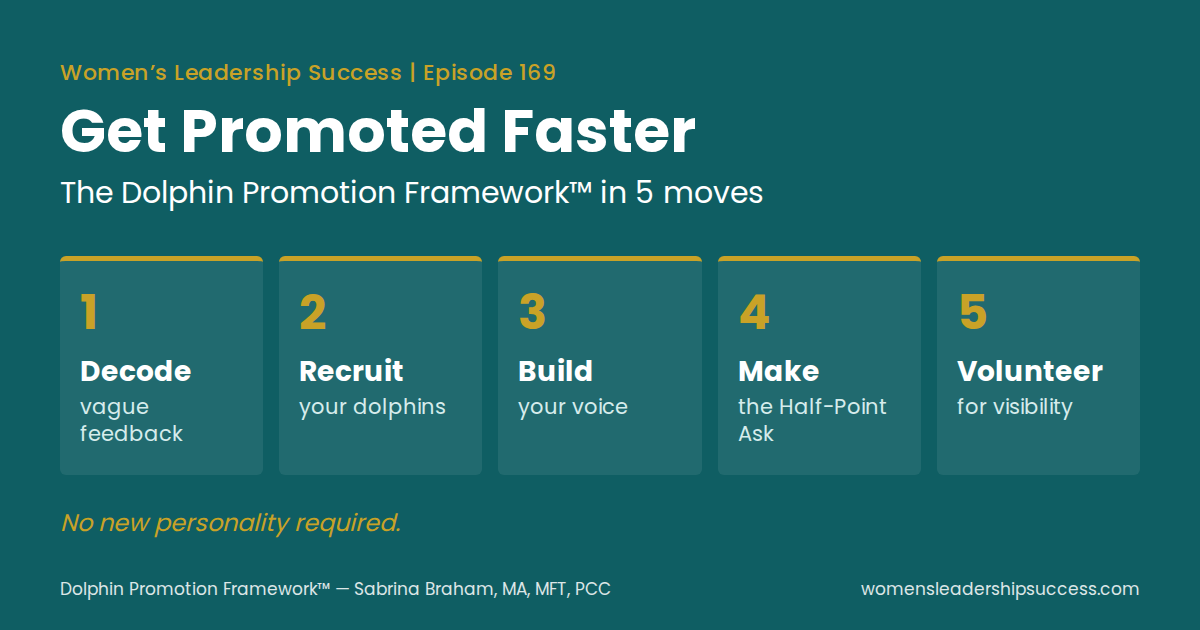
- Get Promoted Faster with the Dolphin Strategy (WLS 169)
- Women Leaders and Psychological Safety (WLS 168)
- Leading Before You’re Ready (WLS 161)
- Executive Coaching for Women
© 2026 Sabrina Braham. All rights reserved.




Women’s Leadership Podcast & Blog

Signs of Manager Burnout: 10-Minute Fix for Leaders 2026
Signs of Manager Burnout: How One Leader of 18 Got Her Energy Back — and the 10-Minute Meeting That Helped Last updated: October 16, 2026 Trusted by leaders at Stanford University, Ernst & Young, […]
Get Promoted Faster: Dolphin Strategy Guide 2026 | WLS 169
Get Promoted Faster: How the Dolphin Strategy Took One Stuck Supervisor to VP — and What It Means for Women Leaders Last updated: September 26, 2026 Trusted by leaders at Stanford University, Ernst & […]
Women Leaders Psychological Safety: Real Feedback Guide
Women Leaders Psychological Safety: How Kerry Siggins Turned “You’re Erratic” Into Her Best Leadership LessonLast updated: September 3, 2026Trusted by leaders at Stanford University, Ernst & Young, Autodesk, MGM Grand Resorts, and Farmers InsuranceExecutive Summary: […]
 Women Leaders Difficult Conversations: The SHARES Framework Kerry Siggins Uses to Build Trust Gallery
Women Leaders Difficult Conversations: The SHARES Framework Kerry Siggins Uses to Build Trust
Communications, Confidence, Continuous Improvement, Culture, How to Get Promoted, Leadership, Mindset, Negotiation, Podcast
Women Leaders Difficult Conversations: The SHARES Framework Kerry Siggins Uses to Build Trust
Last updated: August 27, 2026 Trusted by leaders at Stanford University, Ernst & Young, Autodesk, MGM Grand Resorts, and Farmers Insurance Executive Summary: Most women leaders avoid difficult conversations to protect relationships — and […]
 Workplace Betrayal Recovery: A Leadership Guide 2026 Gallery
Workplace Betrayal Recovery: A Leadership Guide 2026
branding, Career, Career Development, Communications, Confidence, How to Get Promoted, Leadership, Leadership & Women, Life Balance, Management, Mindset, Negotiation, Podcast, Stress Reduction
Workplace Betrayal Recovery: A Leadership Guide 2026
Executive Summary: Workplace betrayal doesn’t just cost you a relationship — it costs you trust in your own judgment. Dr. Debi Silber joins Sabrina Braham to unpack a stage-based path back to confidence, using […]