Welcome to the Women’s Leadership Podcast
Do you want to expand your potential and achieve great success? You have come to the right place. The Women’s Leadership podcast was created to help you. For over 30 years, I have been involved in research & cutting-edge practices that have helped thousands of people get promoted and become top leaders.
In this one-of-a-kind women’s leadership podcast, you will get actionable advice and tips and hear stories from over 164 top female (and men) thought leaders to help you be a better leader, advance your career, increase your income, help you have more influence and have a better quality of life in work and play.
This Women’s Leadership podcast is ideal for you if you are a new supervisor, manager, existing C-Suite, seasoned entrepreneur leader, or aspire to be one.
How to Use Women’s Leadership Podcast to Excel in Your Leadership, Career, and Income

Executive Leadership Coach Sabrina Braham MA MFT PCC
To find a specific topic to help you succeed, use the Women’s Leadership Podcast “Topics” category search on the right-hand sidebar, or the search magnifying glass on the top navigation bar. Also, on the lower right-hand sidebar, check out some of the “Most Popular Shows” of the Women’s Leadership Success podcasts, where we are some of the most popular authors, entrepreneurs, and thought leaders dedicated to helping you enhance your leadership.
The results I have had with my clients inspired me to launch and develop this Women’s Leadership podcast to give you that same opportunity to excel in your leadership & career by sharing my expertise and interviewing top leaders in business to discover the secrets to their great success.
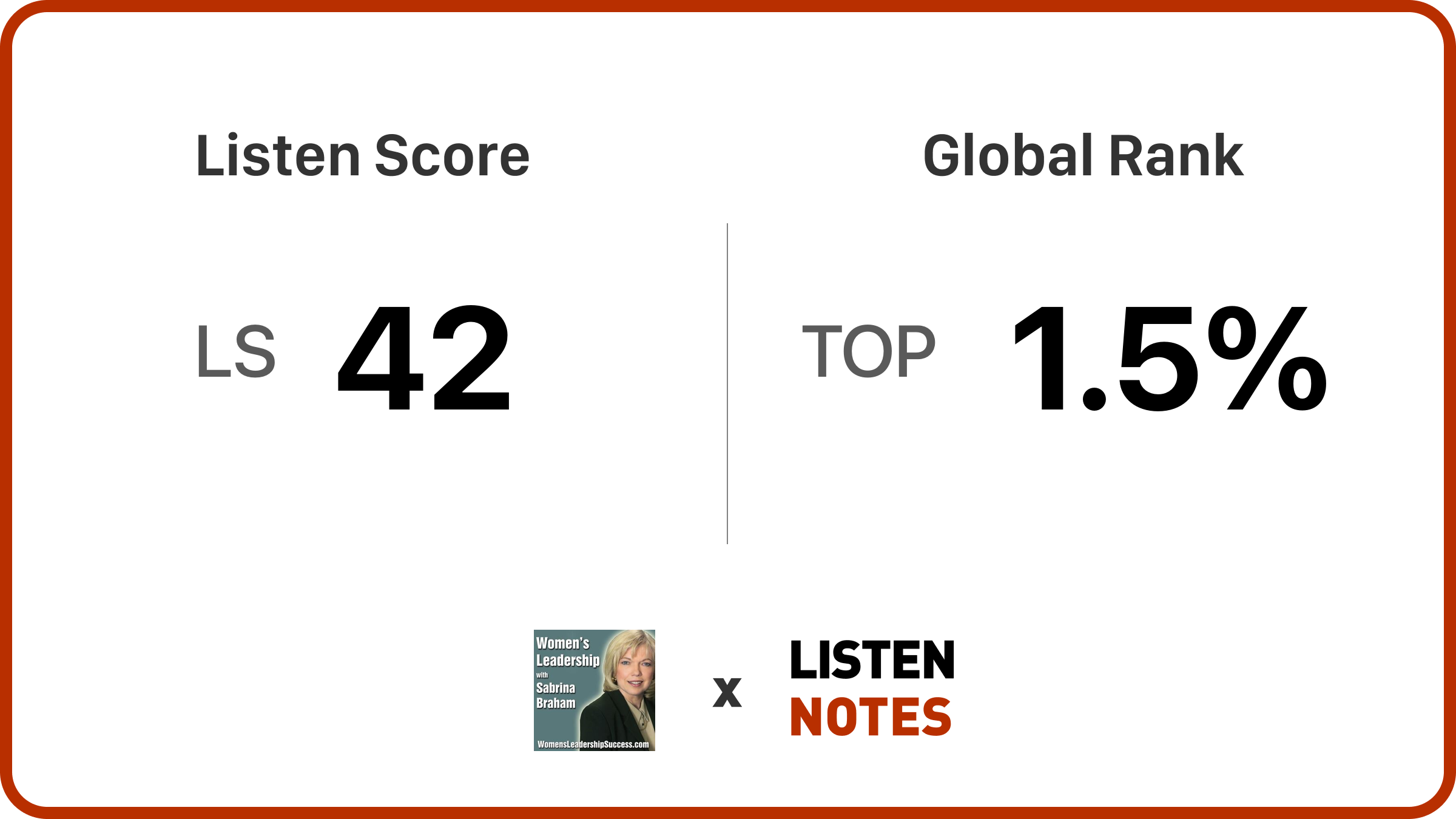
We have produced this Women’s Leadership Podcast since 2007, have had almost 900,000 downloads, and have ranked in the top 1.5% of podcasts worldwide. We are so happy and excited to hear from many listeners that this podcast for women has helped them.
We know the advice and wisdom in this Women’s Leadership Podcast will change you…if you listen and implement the actions that are suggested in these programs.
May I Ask You a Favor?

Women’s Leadership Executive Coach Sabrina Braham MA MFT PCC
Thank you for listening to one of the first women’s leadership podcasts ever. May I ask you a favor?
Please give us a quick rating and review in Apple Podcasts or your favorite podcast platform and share this special leadership podcast for women with others so that we can help more women succeed together.
I want to hear from you too. Please post your thoughts and questions in the “Leave a Comment” box below each show.
Wishing you great success, Sabrina Braham MA MFT PCC
Get Promoted Faster: Dolphin Strategy Guide 2026 | WLS 169
Podcast: Play in new window | Download
Subscribe: Apple Podcasts | Spotify | Android | Pandora | iHeartRadio | TuneIn | Deezer | RSS
Get Promoted Faster: How the Dolphin Strategy Took One Stuck Supervisor to VP — and What It Means for Women Leaders
Last updated: September 26, 2026
Trusted by leaders at Stanford University, Ernst & Young, Autodesk, MGM Grand Resorts, and Farmers Insurance
Executive Summary: Have you been told you “don’t have the personality” for promotion? Sabrina Braham shares how her coaching client Martin, stuck five years as supervisor, reached VP using five moves: decode feedback, recruit dolphins, build your voice, make the Half-Point Ask, and volunteer for visibility. Use them to get promoted faster.
Quick Takeaways:
- Vague feedback like “personality” isn’t a verdict — translate it into observable behaviors.
- Recruit “dolphins”: allies in the room who back your ideas when you speak.
- Employees with sponsors are twice as likely to be promoted (McKinsey & LeanIn.Org, 2025).
- Ask your manager for a 1–10 rating, then ask what earns one more half point.
- Martin: five stuck years, then manager in six months — then director and VP.
Jump to:
Martin’s Story · Why You’re Stuck · The 5 Moves · The Results · Action Plan · Mistakes to Avoid · FAQ · 2026 Trends
As an executive leadership coach with over 30 years of experience (MA, MFT, PCC) and host of the Women’s Leadership Success Podcast — on air since 2007 and ranked in the top 1.5% of podcasts worldwide — I hear one question more than any other: how do I get promoted faster when I’m already doing a great job?
The question is urgent. By September 10, layoffs.fyi counted more than 128,000 tech layoffs in 2026 — already more than all of 2025. And McKinsey and LeanIn.Org’s Women in the Workplace 2025 found only about half of companies still prioritize women’s advancement. Good work alone won’t help you get promoted faster.
In Episode 169, the tables turned. My co-founder and executive producer, Tim Warren, interviewed me about Martin — a Fortune 500 supervisor told he “didn’t have the personality” to be a manager. He believed it. Then, step by step, he proved it wrong. His story is the clearest map I know to get promoted faster, especially if you’re the only one like you in the room.
The Feedback That Kept Martin Stuck for Five Years
At Martin’s company, supervisors usually became managers within a year. Martin had been a supervisor for five. His numbers were strong, his people loved him, and his leaders said he was doing a great job. Then came the “but”: he just didn’t have the personality to be a manager.
Martin grew up speaking English as a second language, was the first in his family to attend college, and graduated with honors. None of that protected him. When someone with authority labels you, you tend to believe it.
I know that feeling. I was raised in a blue-collar family, and when someone with authority said I had a flaw, I assumed it was true. It took me years to unlearn. If you’ve absorbed a label like Martin’s, take this from his story: the label can be wrong, and you can change the evidence behind it.
His question to me was painful: could he change his personality to move up?
Why Talented Leaders Don’t Get Promoted Faster in 2026
Martin’s situation isn’t rare. A strong performer gets fuzzy feedback, loses confidence, goes quiet in the rooms where promotions are shaped — and stalls. Here’s why that pattern makes it harder to get promoted faster right now.
The “broken rung” is still broken
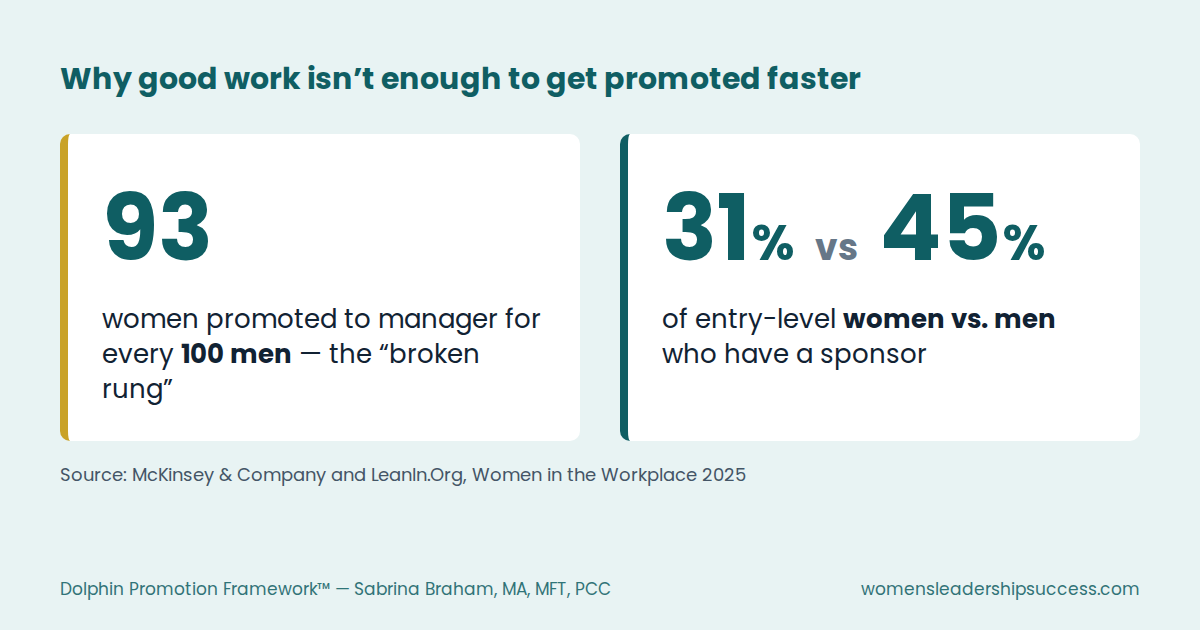
For every 100 men promoted to first-level manager, only 93 women are promoted (McKinsey & LeanIn.Org, 2025). That first step — the one Martin was stuck on — shapes every level above it.
The sponsorship gap is real
At entry level, 31% of women have a sponsor versus 45% of men, and employees with sponsors are about twice as likely to be promoted. The finding that matters most: when women and men get equal career support, the gap in promotion ambition disappears. The problem isn’t drive. It’s backing.
Being “the only” changes how you’re heard
Roughly one in five women are often the only woman in the room, more for senior and technical women (LeanIn.Org). Being “the only” tends to make people cautious about sharing ideas — less visibility when you need more.
The cost of waiting
In 2026’s market, “I’ll speak up once I feel confident” is a risky plan. To get promoted faster — or stand out after a layoff — treat visibility as a skill you practice.
The Dolphin Promotion Framework™: 5 Moves to Get Promoted Faster
Here’s exactly what Martin and I worked on. None of it required a new personality — just consistent, specific action. Each move helps you get promoted faster on its own; together they compound.
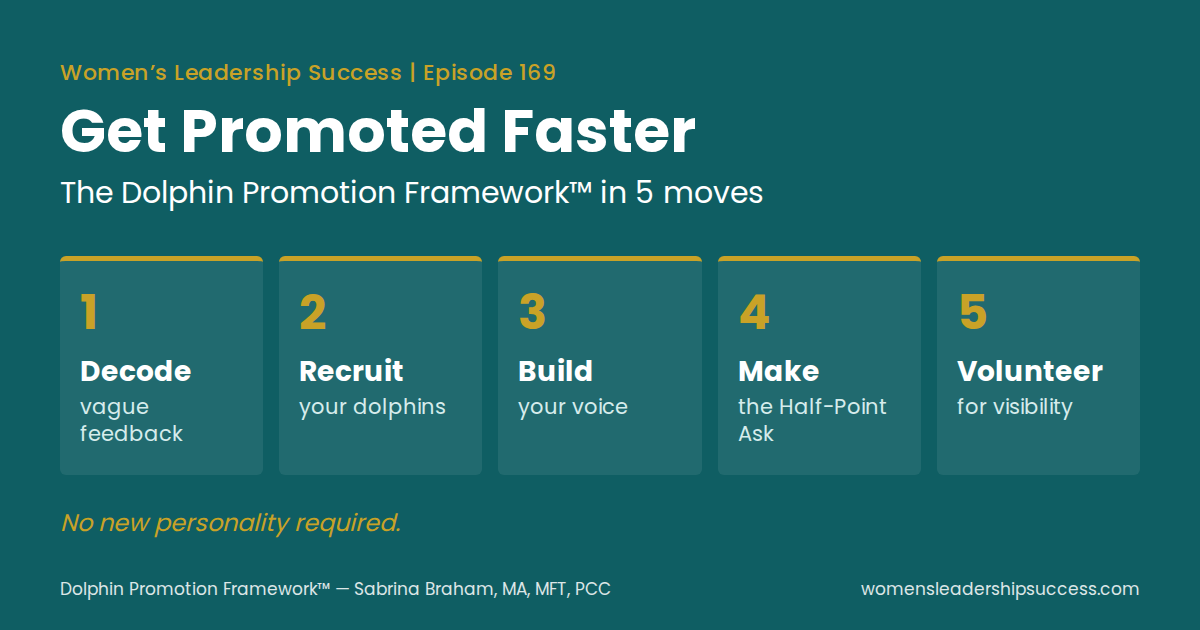
Move 1: Decode the vague feedback
“Personality” is nearly useless feedback. What does it even mean? So we started at ground zero: what would Martin need to do differently to be seen as a manager?
The answer was concrete. In meetings with peers or senior leaders, Martin went quiet. That silence, and the confidence gap behind it, was what his leaders called “personality.” Once we named the behavior, we could change it.
Success metric: The feedback becomes two or three observable behaviors — your first step to get promoted faster.
Move 2: Recruit your dolphins
Picture a shipwreck survivor clinging to boards while a shark circles. When dolphins surround a person in the water, sharks tend to stay away — and dolphins have been reported guiding swimmers to shore.
A dolphin at work is someone in the room who has your back, believes you’re capable, and supports you when you speak up:
- A mentor shares knowledge and advice, often in private.
- A sponsor uses their power and influence to advocate for you — often when you’re not in the room.
- A dolphin is in the meeting with you, backing your idea in real time.
Far fewer leaders have dolphins than mentors. Lean In reports that high-potential women often have more mentors than men, yet mentorship didn’t correlate with promotion. If you want to get promoted faster, real-time backing does what advice can’t.
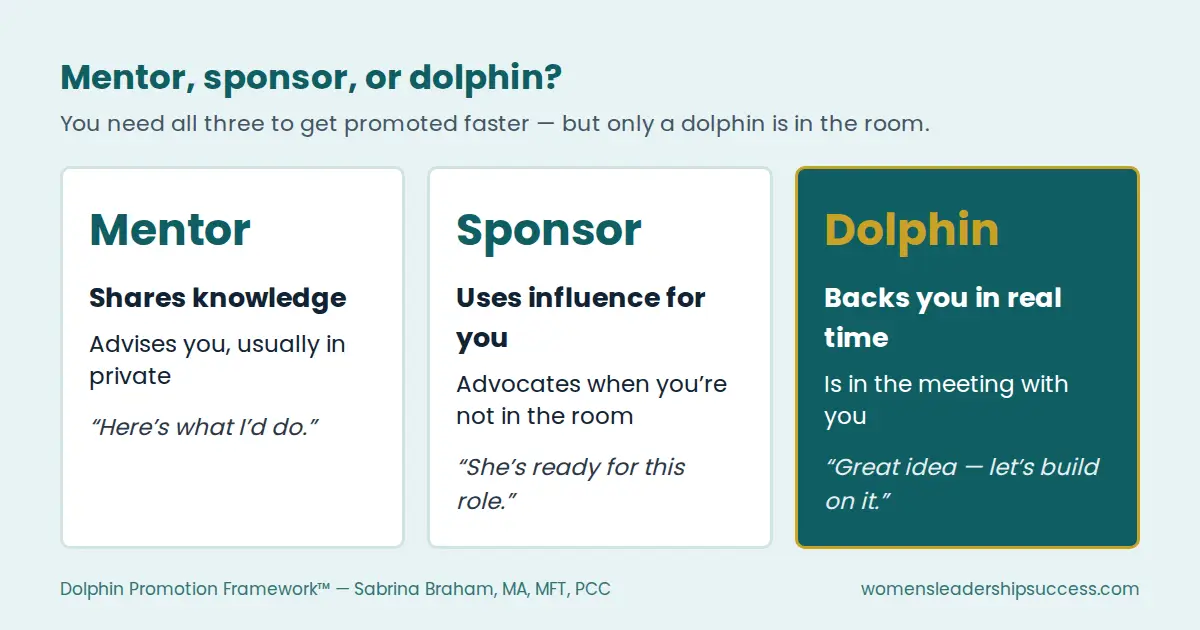
How to find your dolphins: Look for a friend in your key meetings, or someone who often shares your viewpoint. If no one comes to mind, hold one-on-ones, share the idea you want to raise, and see who’s aligned. Then make a simple ask.
Try This Now (3 minutes): Pick the idea you most want to raise next meeting, then send one colleague: “Here’s an idea I’d like to share Thursday. Would you be willing to support it when I bring it up?” That’s the whole ask.
Move 3: Build your speaking muscle — and rehearse your one main point
The most cost-effective confidence builder I know is Toastmasters. Clubs are in nearly every U.S. city, dues are modest (often around $20 a month), and the program works. At a district meeting years ago, I was struck by the room: real confidence and presence, built through structured practice. Martin joined, and it helped him learn to speak up.
The second half is rehearsal. You usually know the agenda and what would help your team. Pick your main point and practice it out loud. What surprises people: the CEOs I work with still rehearse their main points before meetings.
Success metric: One prepared point, delivered weekly. Small reps like this are how you get promoted faster.
Move 4: Make the Half-Point Ask
With practice behind him, Martin went directly to the leaders who had formed the wrong impression. Most people skip this step, yet it’s the move that helps you get promoted faster than any other. Here’s the conversation:
- State the goal. “I’d like to be promoted to manager. What’s helping, and what do I need to do differently?”
- Ask for a number. “On leading my team, from 1 to 10, what would you give me?”
- Ask for the half point. If it’s a 7: “What would I need to do to be a 7.5?” Always just a half point.
- Schedule the follow-up. “Could I check back in a few weeks?”
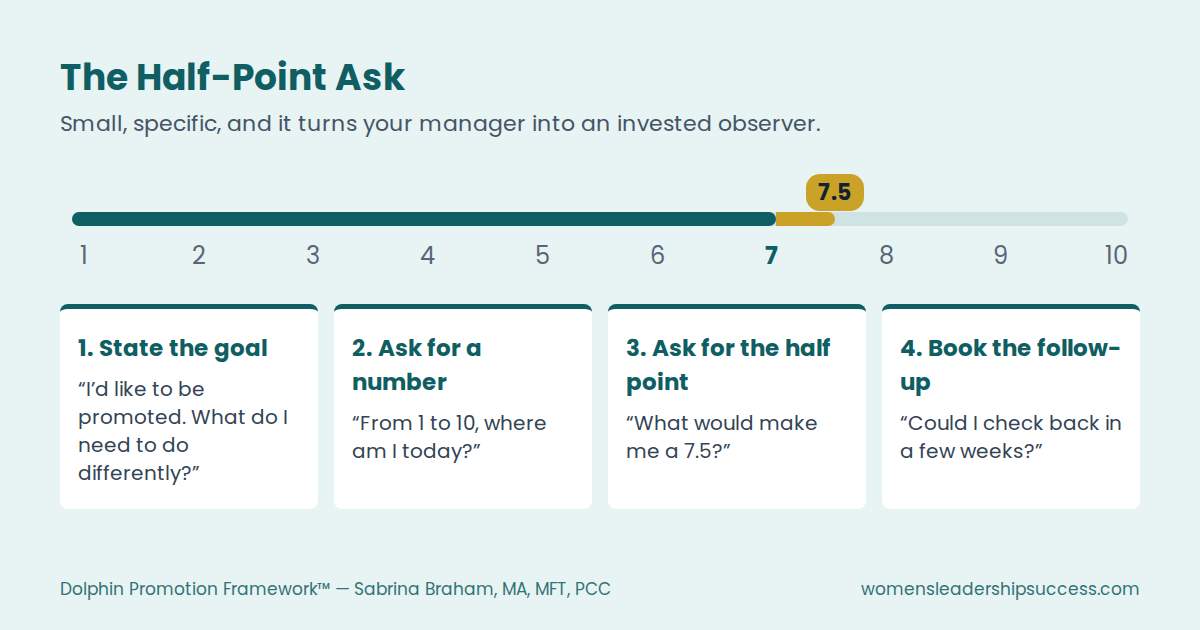
Why a half point? It’s achievable, and it pulls your manager into problem-solving mode. Once they give a number, they become invested in your progress.
There’s a psychological bonus. It’s why you notice red cars everywhere after buying one: the brain’s attention filter, the reticular activating system, scans for what it’s primed to find. After the Half-Point Ask, your manager watches for your improvement.
Success metric: You have a baseline number from at least one decision-maker and a follow-up date on the calendar.
Move 5: Volunteer for visibility
Martin also began joining committees. On one sat five vice presidents — and Martin, a newly promoted manager. He practiced his idea for turning a project around. In the meeting, the VPs talked over him toward a decision. So Martin said, “I have an idea.”
The room stopped. The lead VP asked to hear it. Martin explained it in detail. When he finished, the room went silent. His heart sank. I blew it, he thought.
Then the senior vice president said: “Good idea, Martin. Let’s do that.”
That was the game changer. Rehearsal plus visibility had become executive presence — and the surest way to get promoted faster is to be seen doing the next job.
What Happened Next: From Supervisor to VP
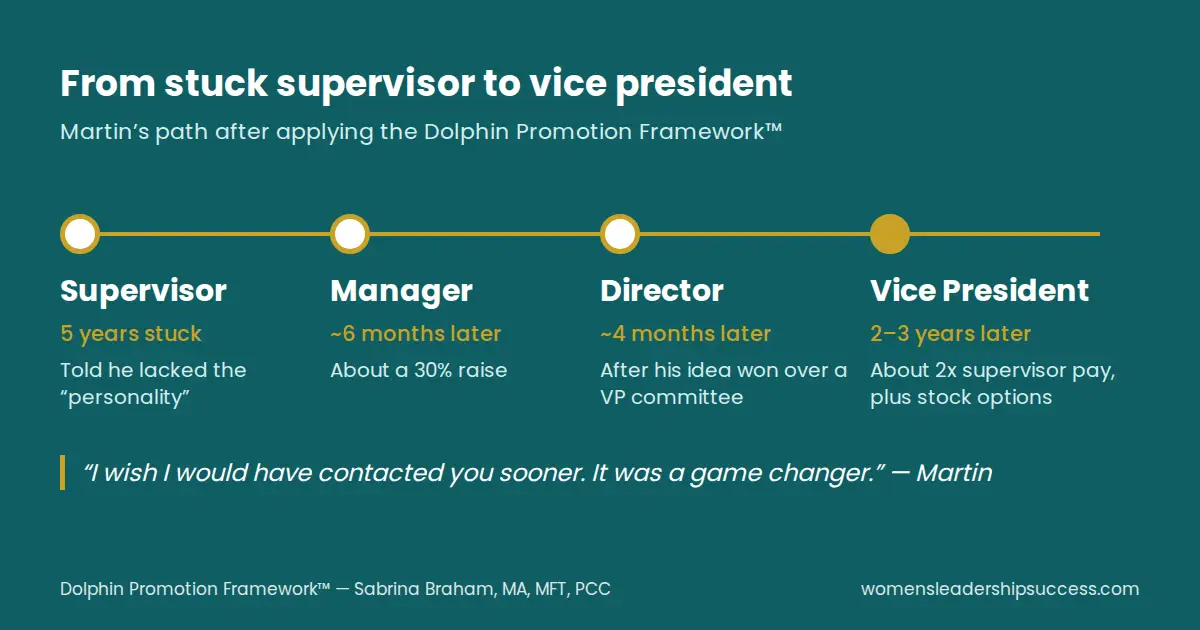
After five stuck years, here’s how Martin’s trajectory changed:
- About 6 months: promoted to manager — roughly a 30% raise.
- About 4 months after that meeting: director.
- Two to three years later: promoted to vice president, with stock options, earning roughly double his supervisor pay.
What moves me most is what didn’t change: Martin kept his kindness and has mentored many others to promotion. His words: “I wish I would have contacted you sooner. It was a game changer. It changed my life.” His shift was a career change and a life change — and it’s available to you.
How this applies to women leaders
As Tim said on the episode, we all have confidence issues. But these tools matter even more for women facing the broken rung, the sponsorship gap, and the “only one” effect. Three coaching situations:
- The director who’s the only woman on the leadership team. She recruits two dolphins before quarterly planning, rehearses one point, and asks a dolphin to build on it. Her idea stays attached to her name.
- The tech manager told she’s “not strategic enough.” She decodes it with her VP — “strategic” means connecting her team’s work to revenue — then makes the Half-Point Ask on that one skill.
- The laid-off VP job-searching in 2026. She asks two former executives to rate how clearly she communicates her impact, then asks for the half point. Those leaders become her dolphins as references and referrals.
Implement This Week: Your Get Promoted Faster Action Plan
- (15 min) Decode your feedback into two or three observable behaviors. Metric: a list you could show your manager.
- (20 min) Map your dolphins across your two key recurring meetings. Metric: two candidates named.
- (15 min) Make one dolphin ask. Metric: one confirmed dolphin before your next meeting.
- (10 min/day) Rehearse your main point out loud until it runs under 60 seconds. Metric: one point delivered this week.
- (30 min) Make the Half-Point Ask. Metric: a baseline rating and a follow-up date.
- (10 min) Find a Toastmasters club or committee. Metric: one visit or sign-up within 30 days.
Common Mistakes That Slow Your Promotion
- Treating vague feedback as a verdict. Martin nearly tried to change his personality. Ask what the feedback looks like in behavior first.
- Collecting mentors but no dolphins. A mentor usually isn’t in the room when your idea needs backing. Line up one ally per high-stakes meeting.
- Winging your main point. Improvising in front of executives runs long and unclear. Even CEOs rehearse.
- Asking for feedback once and disappearing. The follow-up primes your manager to notice change. Book it before you leave.
- Waiting until you feel confident. Confidence follows action. Martin was nervous in that VP meeting — and spoke anyway. That’s how you get promoted faster.
Old Approach vs. the Dolphin Strategy
| Old Approach | Dolphin Strategy |
|---|---|
| Accept “personality” feedback as fixed | Decode it into specific, changeable behaviors |
| Let great work speak for itself | Make your work visible in the right rooms |
| Speak up alone and hope | Line up dolphins before the meeting |
| Improvise in high-stakes meetings | Rehearse one main point out loud |
| Ask “How am I doing?” | Ask for a number, then the half point |
| Wait for the annual review | Book follow-ups every few weeks |
| Wait to feel ready | Act first; confidence follows practice |
People Also Ask
How can I get promoted faster when my manager says I’m doing a great job?
Ask your manager what stands between you and the next role, request a 1–10 rating on the key skill, and ask what would earn a half point more. Then schedule a follow-up in a few weeks.
What is a dolphin at work?
A dolphin is a colleague in the room who has your back, believes you’re capable, and supports your ideas when you speak up. Unlike a mentor, who advises privately, or a sponsor, who advocates behind closed doors, a dolphin backs you in real time.
What should I do if I’m told I don’t have the personality to be a manager?
Treat it as incomplete feedback, not a verdict. Ask for specific examples, translate them into observable behaviors like speaking up in meetings, and practice those behaviors deliberately.
What’s the difference between a mentor, a sponsor, and an ally?
A mentor shares knowledge and guidance. A sponsor uses their influence to advocate for your advancement. An in-the-room ally — what Sabrina Braham calls a dolphin — supports you publicly in meetings when you share an idea.
Does Toastmasters really help you get promoted?
It can, because it builds the speaking confidence promotion decisions often hinge on. Clubs are in most U.S. cities, and dues are modest.
How long does it take to get promoted after working with an executive coach?
It varies by person and organization. Martin, stuck five years as a supervisor, became a manager in about six months, a director months later, and a vice president within a few years.
What’s New in 2026: Promotion and Visibility Trends
- AI tops the reasons for tech cuts — cited in 116,000+ U.S. tech job cuts through August (Challenger, Gray & Christmas). Influence and judgment are the differentiator.
- Formal sponsorship is shrinking. Some companies have scaled back sponsorship programs (McKinsey & LeanIn.Org, 2025), so building your own dolphins is how you get promoted faster.
Looking ahead
As AI absorbs routine work, promotions will lean harder on visible influence. Leaders who rally allies and show measurable growth will get promoted faster — and both are learnable.
Summary: You Don’t Need a New Personality
Martin didn’t change who he was. He changed what his leaders could see — decoding feedback, recruiting dolphins, building his voice, making the Half-Point Ask, and volunteering for visibility. Five stuck years gave way to manager, director, and VP.
With the broken rung and the sponsorship gap still in place, you can’t count on being noticed. But you can get promoted faster by making your growth visible, specific, and backed in the room. More than a promotion, you gain proof that the label was never the truth.
Questions? Message me on LinkedIn. Please subscribe, rate, and share this episode.
Who is one dolphin you could recruit before your next big meeting — and what idea will you ask them to back? Tell us in the comments.
About Sabrina Braham

Sabrina Braham, MA, MFT, PCC, is an executive leadership coach with 30+ years of experience serving Fortune 50–1000 companies including Stanford University, Ernst & Young, and Autodesk. She hosts the Women’s Leadership Success Podcast, on air since 2007 and ranked in the top 1.5% of podcasts worldwide with 57,000+ monthly downloads. Her clients include leaders who have advanced from Director to VP to SVP.
About Co-Founder
 Tim Warren is co-founder and executive producer of the Women’s Leadership Success Podcast. Known as “Tourism Tim,” he founded Adventure Business Consultants in 1994 and hosts the Travel Business Success podcast, helping tourism businesses worldwide grow bookings and profits. He is the author of Tourism Marketing Success and a graduate of Leadership Santa Rosa and Outward Bound. Tim also raises funds to fight multiple sclerosis by riding the 150-mile Waves to Wine Bike MS ride.
Continue Your Journey
- Leading Before You’re Ready (WLS 161) — stepping up before you feel ready.
- Women Leaders Psychological Safety (WLS 168) — telling real feedback from noise.
- Reputation Management for Women (WLS 150) — shaping how decision-makers see you.
- All “How to Get Promoted” episodes
© 2026 Sabrina Braham. All rights reserved. Dolphin Promotion Framework™ is a trademark of Sabrina Braham.




Women’s Leadership Podcast & Blog
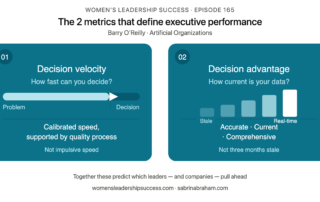
AI Strategic Thinking Women Executives: 2026 Guide | WLS 165
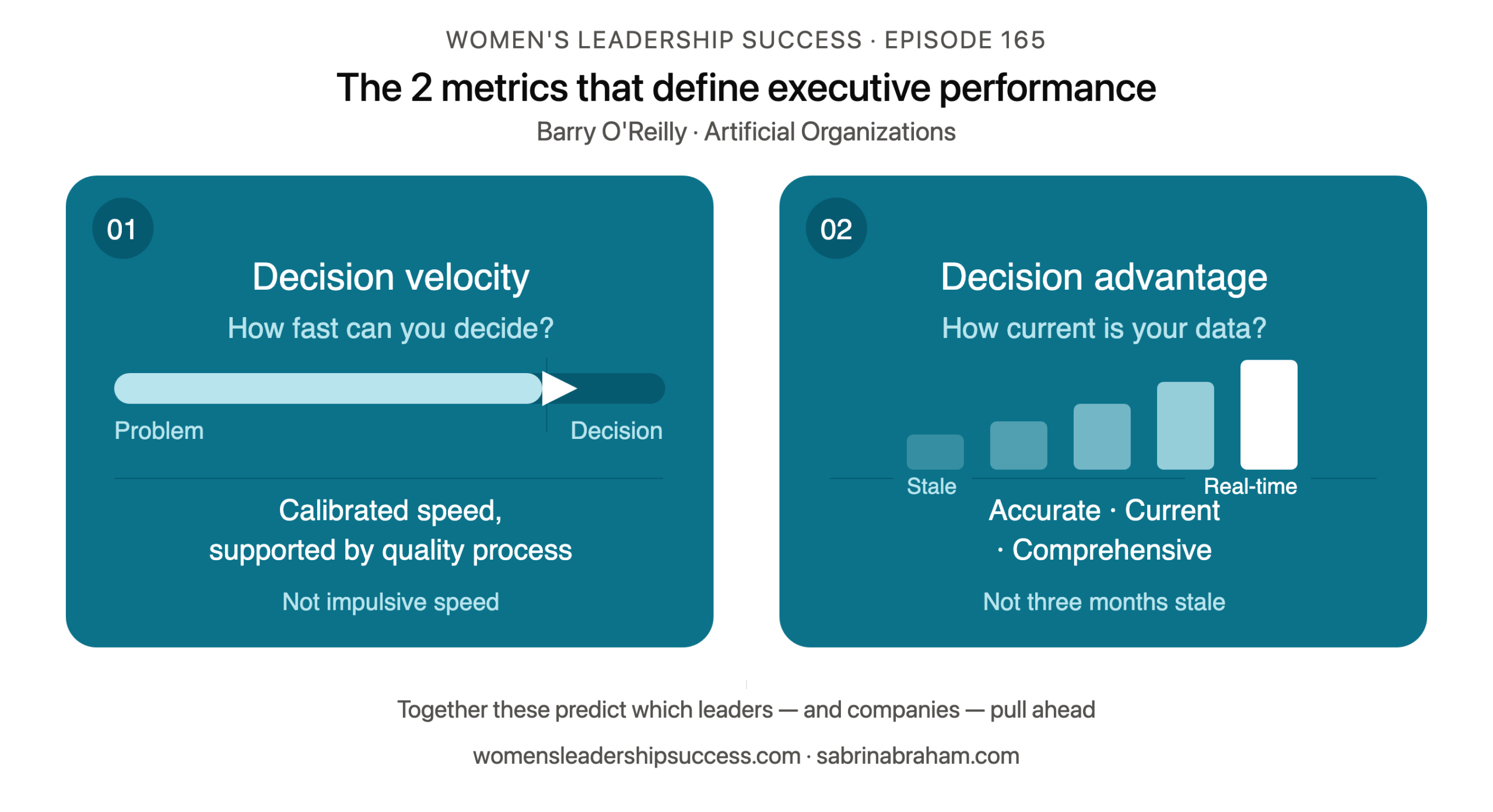
Executive Summary AI strategic thinking for women executives is no longer optional — it’s the dividing line between leaders who get exposed and those who get elevated. Executive coach Sabrina Braham and author Barry O’Reilly […]
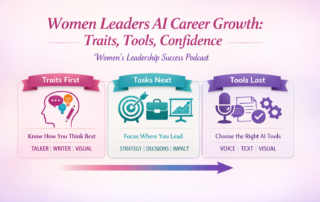
Women Leaders AI Career Growth: Traits, Tools, Confidence | WLS 164 Sabrina Braham & Barry O’Reilly
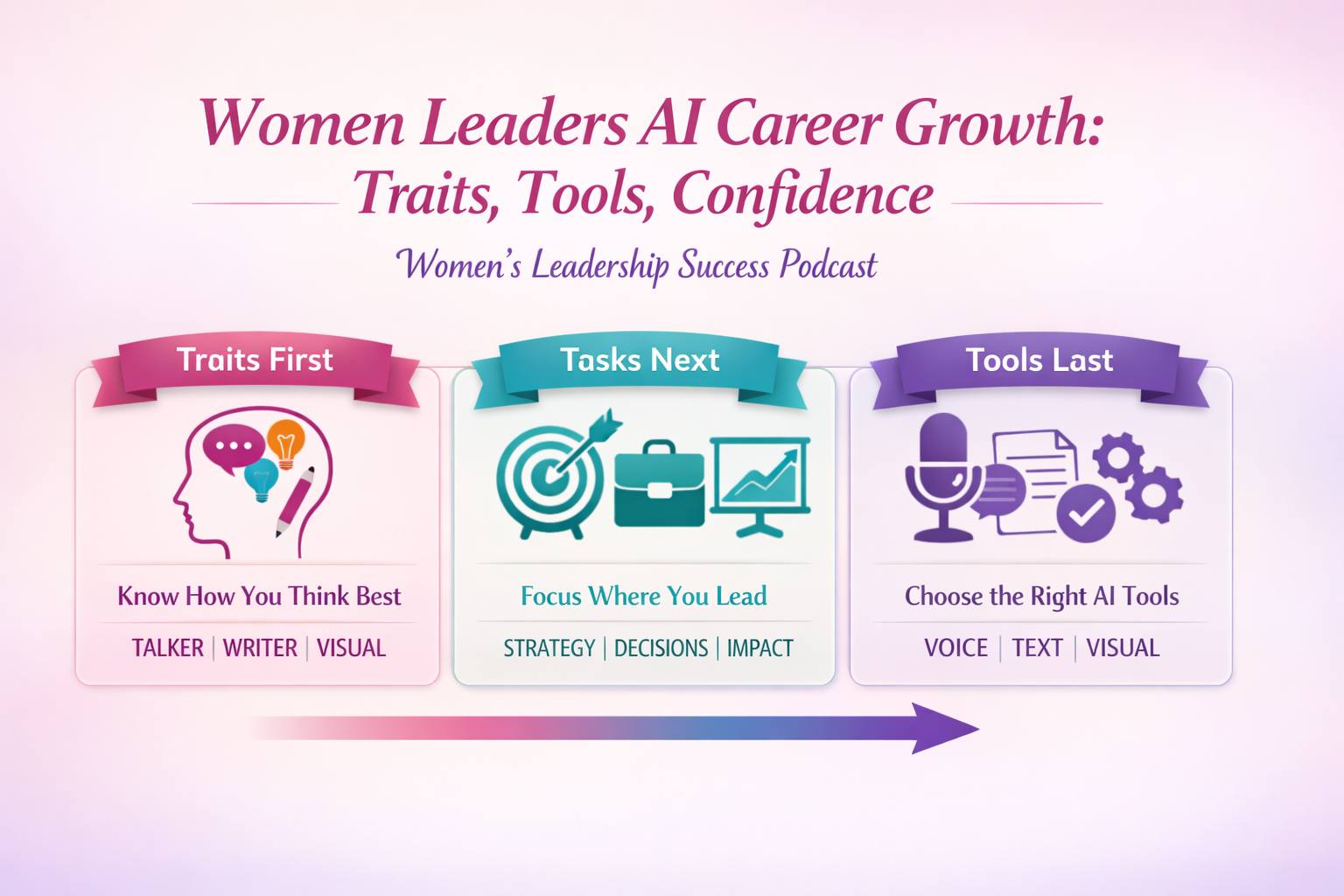
Executive Summary: Most women leaders know AI could accelerate their careers—but don’t know where to start. Executive coach Sabrina Braham and author Barry O’Reilly reveal the Traits, Tasks, and Tools framework that eliminates AI paralysis, […]

Women Leaders Career Advancement: The 4-Relationship Guide | Women’s Leadership Success 163
Women Leaders Career Advancement: The 4-Relationship Framework and Personal Success Plan (2026)Executive Summary: Women leaders career advancement stalls most often at the relationship level, not the skill level. Women hold only 29% of C-suite roles […]
 Women Leaders Overcome Self-Doubt: The Power Quotient Framework That Changes Everything (2026) WLS 162 Gallery
Women Leaders Overcome Self-Doubt: The Power Quotient Framework That Changes Everything (2026) WLS 162
branding, Career Development, Communications, Confidence, Equality & Equity, How to Get Promoted, Leadership & Women, Mindset, Podcast
Women Leaders Overcome Self-Doubt: The Power Quotient Framework That Changes Everything (2026) WLS 162
Women Leaders Overcome Self-Doubt: The Power Quotient Framework That Changes Everything (2026)Executive Summary: 68% of women in tech experience imposter syndrome, yet most have never been taught to fight it strategically. Former IBM VP Shelmina […]

Leading Before You’re Ready: Women Leaders Guide 2026
Women’s Leadership Success Podcast — Episode 161Executive Summary: In 2026’s era of mass layoffs and rapid restructuring, talented women leaders are being thrust into expanded roles before they feel ready. Executive […]