

Podcast: Play in new window | Download
Subscribe: Apple Podcasts | Spotify | Android | Pandora | iHeartRadio | TuneIn | Deezer | RSS
Successful but Unfulfilled? 5 Hidden Forces Keeping High Achievers Stuck, and How to Break Free
Last updated: October 27, 2026
Trusted by leaders at Stanford University, Ernst & Young, Autodesk, MGM Grand Resorts, and Farmers Insurance
Executive Summary
If you feel successful but unfulfilled, you are not alone: 60% of senior women report frequent burnout (Women in the Workplace, 2025). Former McKinsey partner Ashish Kothari reveals five hidden forces that keep high achievers stuck and shares three practical steps to find more meaning in your success.
Quick Takeaways
- Feeling successful but unfulfilled is a signal, not a personal failure or weakness.
- Five hidden forces hold you in place: identity, worthiness, routines, relationships, and expertise.
- Your body often registers misalignment before your mind can explain it.
- A one-week "field diary" reveals what energizes and drains you, hour by hour.
- Ten to twenty people can show you strengths you cannot see yourself.
In This Article
- The Hidden Cost of Success
- "Perfection Is the Price": How the Climb Begins
- The 5 Hidden Forces That Keep You Successful but Unfulfilled
- It Wasn't Courage. It Was a Calling.
- 3 Steps to Find Your Authentic Path
- Your 7-Day Action Plan
- Common Mistakes to Avoid
- Unfulfilled vs. Fulfilled Success
- What's New in 2026
- People Also Ask
The Hidden Cost of Success: Why High Achievers Feel Successful but Unfulfilled
As an executive leadership coach with more than 30 years of experience (MA, MFT, PCC) and host of the Women's Leadership Success Podcast, ranked in the top 1.5% of podcasts worldwide with 57,000+ monthly downloads, I hear one quiet confession more than almost any other: "I have everything I worked for. So why do I feel successful but unfulfilled?"
This is not a private problem. In the most recent Women in the Workplace report (McKinsey & LeanIn.Org, 2025), about 60% of senior-level women said they frequently felt burned out, compared with 50% of senior men. That is the highest level in five years, and many are recalculating whether the climb is worth it.
My own story started in a very different place. I grew up poor, with food insecurity, and nobody expected much of me. I still ended up with anxiety after I "made it." That taught me something I now share with every client: achievement cannot fill an emptiness that only meaning can fill. When you understand that, you stop chasing the next title to fix how you feel, and you start building a career that actually feeds you.
That is why I invited Ashish Kothari to the show. Ashish spent 17 years at McKinsey & Company, made partner in six years, and walked away from a seven-figure role to found Happiness Squad. He is the author of Hardwired for Happiness: 9 Proven Practices to Overcome Stress and Live Your Best Life and host of the Flourishing Edge podcast. In Part 1 of our conversation, he explains why so many high achievers feel successful but unfulfilled, and exactly how to change it.
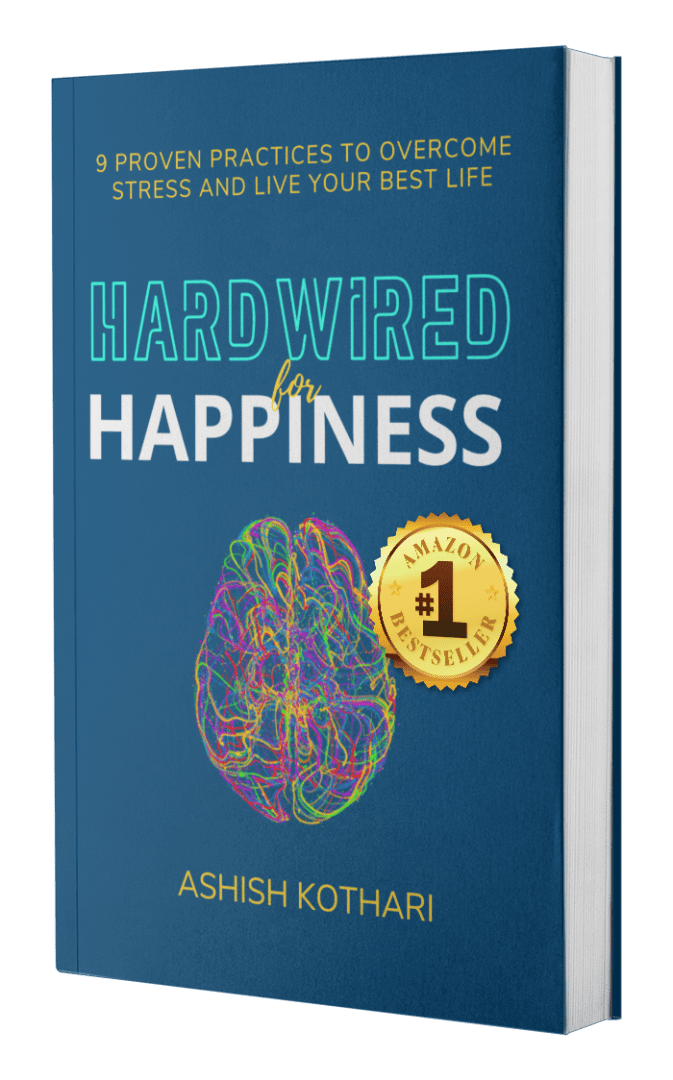
When I asked Ashish what listeners could expect if they applied his advice, he did not hesitate:
"I think they can go from being miserably successful to joyfully significant." — Ashish Kothari
"Perfection Is the Price": How the Climb Begins
Ashish's drive started with a story he told himself at age seven. He came home with 97 out of 100 on a math test. His mother, a PhD gold medalist in calculus, praised him and then pointed out the three questions she knew he could have answered. Next time, she said, check your work so you can get to 100.
Her love never depended on his grades. But the seven-year-old inside him concluded something else.
"The story was: perfection is the price I had to pay to be loved." — Ashish Kothari
That story fueled him through IBM and a McKinsey partnership. Then, at 42, he began waking up anxious, though his health, marriage, and finances were fine. "My body knew it before my head knew it," he told me. The work mattered to clients, but not to what he personally cared about.
He wasn't burned out in the classic sense. He rarely worked weekends and took real vacations. That's the part high achievers miss: you can have a balanced calendar and still feel successful but unfulfilled, because balanced hours are not aligned purpose.
Coach's Note
Many clients name their own "seven-year-old story" early, such as "I have to be the one who never drops the ball." Naming it lets you choose whether it still serves you. If anxiety persists, please also talk with a licensed health professional.
The 5 Hidden Forces That Keep You Successful but Unfulfilled
Ashish is building a nine-month fellowship called Escape Velocity for leaders in their 40s and 50s who have reached the top and cannot break away. The name comes from his framework: five forces, or "gravities," that hold high achievers in place long after the work stops feeding them.
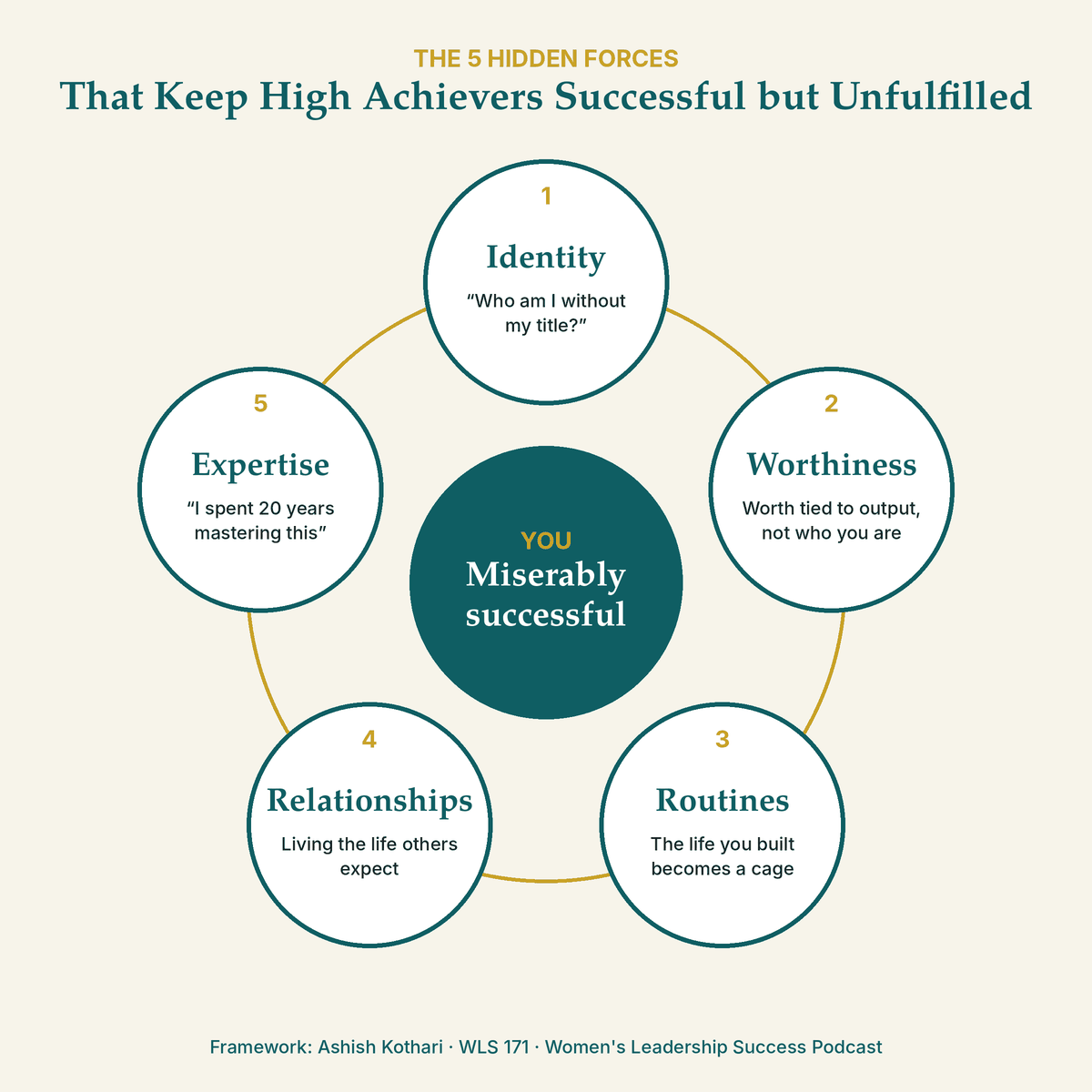
1. The Gravity of Identity
"If I'm not a partner, if I'm not a CFO, who am I?" When your title becomes your identity, you cannot imagine anything else. Ashish's reminder is simple: you were not born a CFO, marketer, or banker. You chose that path in your early 20s. Just because it defined who you are today does not have to define who you become.
2. The Gravity of Worthiness
Our culture ties worth to output. Step back, and you worry what others, and you, will think. It's especially strong for women taught to over-deliver to be taken seriously.
3. The Gravity of Routines
The house, the school tuition, the club, the vacations. Everything you built to set you free can quietly become a prison. You get through each week instead of enjoying it.
4. The Gravity of Relationships
We have real commitments to family, colleagues, and clients. Yet, as Bronnie Ware found in her work with the dying, the top regret is not living a life true to oneself.
5. The Gravity of Expertise
"I've spent 20 years mastering this." Expertise feels too valuable to leave, even when you no longer enjoy it. Yet you spend most of your waking hours at work. As Ashish asks, why would you not want to flourish there?
Most people only escape these gravities after a disruption: a layoff, a divorce, an illness, a loss. Ashish's invitation is to stop waiting for a crisis to give you permission. If you feel successful but unfulfilled right now, that feeling is your early warning system.

Successful but unfulfilled? You don't have to map your next chapter alone.
I coach executives and leadership teams to turn hard-won success into work that feels meaningful again, and gets noticed at the highest levels.
Individual Executive Coaching
- Name what's holding you in place and loosen its grip
- Clarify the strengths others already see in you
- Build a clear plan for your next role or chapter
Leadership Team Coaching
- Align your leaders around shared purpose and strengths
- Reduce quiet cracking before it costs you top talent
- Build a culture where high performers stay and thrive
Ready to go deeper? Book a 1-hour coaching and discovery session on Zoom ($499, 100% credited toward coaching if we're a fit).
Trusted by leaders at Stanford University, Ernst & Young, Autodesk, and Farmers Insurance.
It Wasn't Courage. It Was a Calling.
When Ashish left McKinsey, he was working about 36 hours a week, traveling one night a week, and earning seven figures. People called him courageous. He corrects them.
"It wasn't courage that set me free. It was my calling." — Ashish Kothari
His calling, helping people flourish at work, had more pull than all five gravities combined. As Viktor Frankl taught, life asks us what it means. You find the answer by creating space to listen.
The Retreat That Changed Everything
For Ashish, the space came in 2016 at a week-long leadership retreat in a centuries-old Portuguese monastery, run in partnership with Mobius. Phones off. Families told not to call. Three things happened:
- He found his essence. Relationships. He sent 850 handwritten holiday cards a year and assumed everyone did, so he couldn't see his own gift.
- His anxiety lifted. On day three, after 18 months of anxious mornings, he woke up calm. His body had resolved the gap between what he cared about and what he was doing.
- He saw he wasn't alone. Thirty accomplished leaders were all carrying private struggles.
As Ashish reframes it, a retreat is not retreating from life. It is "re-treating" yourself.
3 Steps to Find Your Authentic Path (Even If You Feel Successful but Unfulfilled)
I asked Ashish what listeners can start doing right now. He gave three steps. I have added the coaching lens I use with clients who feel successful but unfulfilled.

Step 1: Write Your Story as a Timeline
Draw a line from your birth to today. Mark your high points and low points. Then ask of each one: how did this shape who I am now? Patterns appear quickly. You will often find the same strengths showing up in your hardest moments and your proudest ones.
Step 2: Become an Anthropologist of Your Own Life
For one week, set a 30-minute alarm. Each time it goes off, jot down what you are doing, your mood, and your energy. Note what you learned, what drained you, and which relationships drew you in. Even the first thing you do on waking counts. If you reach for your phone, what does that do to you?
This "field diary" turns vague dissatisfaction into data.
Step 3: Ask 10 to 20 People What You're Like at Your Best
Ask colleagues, friends, and former teammates: What am I like at my best? What do you value most about working with me? How do I enrich your life? Ashish recommends the Reflected Best Self Exercise from the University of Michigan's Center for Positive Organizations, which collects these as stories.
As a CliftonStrengths coach, I love assessments like CliftonStrengths and the VIA Character Strengths survey. But stories show you what shines through to other people, which no assessment can fully capture.
Try This Now (5 Minutes)
Text three people you trust: "Quick question for a project I'm doing: when have you seen me at my absolute best?" Save every answer in one note. You now have the start of your Reflected Best Self file.
Put It Together: Your Personal Ikigai
With your timeline, field diary, and feedback in hand, Ashish suggests mapping a version of ikigai, the Japanese concept that combines what you love, what you're good at, what the world needs, and what it will pay for. That is where your next chapter starts to take shape.
Ashish's ideal is a weekend away to reflect. For busy leaders, I suggest starting with 5 to 15 minutes a day, and Ashish added a smart refinement: use your field diary to find your most creative window and protect it. Reflection at 9 p.m., when you're depleted, won't give you the gold.
Your 7-Day Action Plan
| Day | Action | Time | Success Metric |
|---|---|---|---|
| 1 | Name your "seven-year-old story" in one sentence | 15 min | One written belief you can examine |
| 1 | Send Reflected Best Self requests to 10–20 people | 30 min | At least 8 responses by Day 7 |
| 1–7 | Keep a 30-minute field diary | 1 min, every 30 min | Top 3 energizers and drainers identified |
| 3 | Draw your life timeline with highs and lows | 45 min | Two recurring strengths spotted |
| 5 | Rate each of the 5 forces (1–10) for how hard it holds you | 15 min | Your strongest force named |
| 7 | Reflect in your creative window and draft an ikigai map | 60 min | Three possible next-chapter ideas |
Common Mistakes to Avoid
Mistake 1: Assuming Another Promotion Will Fix It
If you feel successful but unfulfilled, a bigger title usually amplifies the gap. Ashish climbed the mountain and found "no gold" at the top. Clarify what you care about first, then pursue roles that fit it.
Mistake 2: Copying Someone Else's Path
Other leaders' pivots inspire, but their life is not yours. Discover your own path and experiment your way into it.
Mistake 3: Going It Alone
Don't do this alone. Find a group on a similar path who will play back your greatness.
Mistake 4: Waiting for a Crisis
Answer the question on your own terms, while you still have options.
Ready to define who you are beyond your title?
Download the complimentary Leadership Branding Blueprint Accelerator and discover:
- How to articulate a leadership brand that isn't tied to one role
- The strengths story that positions you for your next chapter
- A simple plan to raise your visibility with decision-makers
Unfulfilled vs. Fulfilled Success
| Successful but Unfulfilled | Successful and Fulfilled |
|---|---|
| My title defines who I am | My strengths and values define who I am |
| Worth equals output | Worth is inherent; output is a contribution |
| Execute someone else's script | Write your own script for the next 25 years |
| Wait for a crisis to change | Choose change while you have options |
| Ignore what the body signals | Treat anxiety as data worth exploring |
| Self-assess in isolation | Ask 10–20 people to mirror your best self |
| Courage required to leave | A clear calling makes the move natural |
What's New in 2026: Why This Conversation Matters Now
"Quiet Cracking" Has Replaced Quiet Quitting
The newest workplace term describes people who keep performing while quietly losing purpose. The Change Lab found 55% of workers reported it. High performers are most at risk because their output masks the problem: the successful but unfulfilled pattern.
The Midlife "Second Act" Is Going Mainstream
Leaders in their 40s and 50s may have 25 to 30 working years ahead. As Ashish puts it, that is at least half of your race left.
Engagement Keeps Falling
Gallup's State of the Global Workplace 2026 report found global engagement fell to 20%, the lowest since 2020. Meaning at work has become a competitive advantage for the leaders who find it.
People Also Ask
Why do I feel successful but unfulfilled at work?
Usually because your achievements are disconnected from what you personally care about. Ashish Kothari calls this being "miserably successful." Your role may be impactful for others while giving you little meaning, and your body often notices before your mind does.
What are the 5 forces that keep high achievers stuck?
Ashish Kothari identifies identity, worthiness, routines, relationships, and expertise. Each one makes leaving a familiar path feel risky, even when the path no longer fits.
How do I find my purpose in my 40s or 50s?
Start with three steps: map your life timeline, keep a one-week field diary of your energy, and ask 10 to 20 people what you're like at your best. Then combine the patterns into an ikigai map of possible next chapters.
What is the Reflected Best Self Exercise?
It's a feedback tool from the University of Michigan's Center for Positive Organizations. You ask people who know you to share stories of you at your best, then look for themes that reveal strengths you may not see yourself.
Can high achievers have anxiety without burnout?
Yes. Ashish worked reasonable hours and still woke up anxious for 18 months. Anxiety can signal a gap between your work and your values, not just overwork. Persistent anxiety is also worth discussing with a licensed professional.
The Bottom Line
Feeling successful but unfulfilled is not a sign you chose wrong. It's a sign you're ready to choose again. Name the five forces, gather your data, ask the people who know you, and give yourself space to listen. As Ashish reminded us, you may have half your race still ahead of you. Run your own race.
Coming next: In Part 2 (WLS 172), Ashish shares his PEARL model for building high-performing teams that thrive without burning out.
Ready to enjoy the success you've worked so hard for?
Let's talk about what's next for you, or for your leadership team.
Individual Executive Coaching
- Turn feedback from the people who know you best into a career strategy
- Get honest, expert support through a major transition
Leadership Team Coaching
- Run a strengths-based team session led by a CliftonStrengths coach
- Give your leaders a shared language for purpose and growth
Ready to go deeper? Book a 1-hour coaching and discovery session on Zoom ($499, 100% credited toward coaching if we're a fit).
Trusted by leaders at Stanford University, Ernst & Young, Autodesk, and Farmers Insurance.
Join the conversation: Which of the five forces (identity, worthiness, routines, relationships, or expertise) has the strongest hold on you right now? Share in the comments below.
About the Expert

Ashish Kothari is the founder and CEO of Happiness Squad and a former McKinsey & Company partner with 17 years at the firm. He is the author of Hardwired for Happiness: 9 Proven Practices to Overcome Stress and Live Your Best Life and host of the Flourishing Edge podcast. A certified ontological coach, he helps leaders and organizations make flourishing a competitive edge. Learn more at HappinessSquad.com.
About Sabrina Braham
Sabrina Braham, MA, MFT, PCC, is an executive leadership coach and CliftonStrengths coach with 30+ years of experience. She hosts the Women's Leadership Success Podcast, on air for 19 years and ranked in the top 1.5% worldwide with 57,000+ monthly downloads. Her clients include leaders at Stanford University, Ernst & Young, Autodesk, and Farmers Insurance, with results ranging from three promotions in nine months to Director-to-VP advancement.


















Leave A Comment