
Podcast: Play in new window | Download
Subscribe: Apple Podcasts | Spotify | Android | Pandora | iHeartRadio | TuneIn | Deezer | RSS
Executive Summary
AI strategic thinking for women executives is no longer optional — it’s the dividing line between leaders who get exposed and those who get elevated. Executive coach Sabrina Braham and author Barry O’Reilly reveal how to build your judgment system, accelerate decisions, and think strategically at the highest level.
Quick Takeaways
- Barry O’Reilly’s defining insight: “AI is not going to replace leaders — it’s going to expose them.”
- Most executives have never documented their judgment system — and AI makes this gap impossible to hide.
- Decision velocity + decision advantage are the two metrics separating leaders who accelerate from those who stall.
- Misty Schaefer, VP at American Airlines, uses AI voice notes and scenario planning for orders-of-magnitude better decisions.
- The biggest missed opportunity in AI leadership is not learning together — yet the fastest learners do exactly that.
There’s a line on the back of Barry O’Reilly’s new book that every woman executive needs to sit with:
“AI is not going to replace leaders. It’s going to expose them.”
AI strategic thinking for women executives is no longer a competitive edge — it’s fast becoming the baseline expectation at the director, VP, and C-suite level. I’m Sabrina Braham, executive leadership coach (MA, MFT, PCC) with 30+ years of experience, and host of the Women’s Leadership Success Podcast — top 1.5% globally with almost 900,000 downloads. My clients include leaders at Stanford University, Ernst & Young, and Autodesk. And what I see in my coaching practice right now is a clear divide emerging: women executives who are building AI-enhanced judgment, and those who are still relying on invisible, inarticulate intuition they’ve never made explicit.
AI is about to make that gap impossible to hide.
This is Part 2 of my conversation with Barry O’Reilly — author of Artificial Organizations: Build Better Judgment, Speed, and Results with Machine and Human Intelligence, keynote speaker at Gartner’s CFO Conference, and one of the most sought-after AI leadership advisors in the world. In Part 1, we covered how women leaders can use AI to build personal career confidence and grow into bigger roles. Here, we go deeper — into the strategic leadership capabilities that will define who rises at the executive level in 2026 and beyond.
New research from Chief and The Harris Poll (2026) confirms that 85% of senior women leaders are now active players in their organization’s AI strategy — and 68% are focused on using AI to amplify human talent, not replace it. The leaders pulling ahead are those who’ve moved beyond productivity tools into something more fundamental: AI-enhanced judgment systems.
The Uncomfortable Truth: AI Will Expose Leaders Without a Judgment System
When Barry walks into executive rooms around the world, he asks a deceptively simple question: “Show me your system for making this decision.”
The silence that follows is telling.
“Often, a lot of the time, they just don’t have a system,” he explains. “They’ve never systematically written down all the steps they’re going to go through to make an actual decision.” For most leaders, the judgment system — the internal algorithm for weighing options, prioritizing inputs, and reaching decisions — has never been made explicit. It works. But it has four critical limitations:
- It’s not visible — others can’t observe or learn from it.
- It’s not repeatable — it can’t be consistently applied by or handed off to others.
- It’s not challengeable — if it’s in your head, no one can push back on its blind spots.
- It’s not improvable — you can’t deliberately tune what you can’t see.
In my 30+ years of executive coaching, this is one of the most consistent patterns I see in women leaders who are passed over for promotion despite exceptional performance: their judgment is excellent — but it’s invisible. They can’t teach it, transfer it, or demonstrate it in the way boards and senior leaders need to see. AI strategic thinking for women executives forces this reckoning, and the leaders who embrace it rather than resist it will define the next decade of leadership.
Here’s what my Leading Before You’re Ready playbook addresses directly: building the judgment, presence, and strategic clarity that precedes you into every room — before you hold the formal title. AI doesn’t change that mission. It accelerates it.
What Is a Judgment System — and Do You Have One?
A judgment system is the explicit process and criteria you use to make leadership decisions: the information you seek first, the variables you weigh, the sequence you follow, and the principles that guide your final choice.
For most leaders, this system exists — but it lives entirely in their heads, accumulated through years of experience and pattern recognition. It works. But it has critical limitations that AI strategic thinking for women executives can directly address.
The Judgment System Exercise Barry Uses With Executive Teams
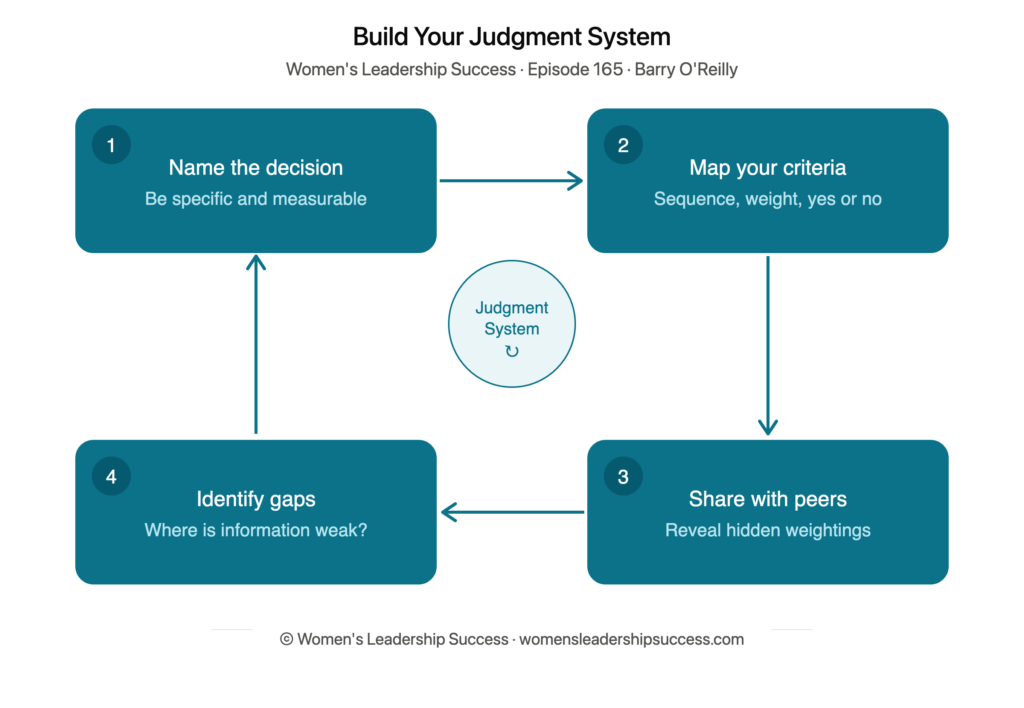
Here’s the exercise Barry runs at the opening of his executive engagements — and one I now recommend for every leader I coach:
- Name a key decision coming up for your team. Be specific: a resource allocation decision, a product investment, a market expansion choice.
- Draw out your judgment system for making that decision. What information do you look for first? What criteria matter most? What’s your sequence of evaluation? What would make you say yes — or no?
- Share your judgment system with your peers. This is where the transformation happens. A VP of Marketing and a VP of Finance, both making the same type of decision, suddenly realize they weight customer behavior and market size differently — and neither has ever made that explicit in shared decision-making.
- Identify the gaps. Where is your information current and reliable? Where is it outdated, incomplete, or missing entirely? What would better information change?
“Suddenly you have groups of people sitting around going, ‘I’ve never done this before,'” Barry explains. “And they’re right. Most executive teams have never made their collective judgment infrastructure explicit.”
From a coaching perspective, I want to highlight what this exercise does beyond improving decision quality: when you can articulate how you make decisions — not just what decisions you make — you demonstrate the executive presence that earns trust and bigger responsibilities. This is exactly what I teach in the Leading Before You’re Ready playbook.
Judgment Infrastructure: The Data Ecosystem That Feeds Your Decisions
Once leaders map their judgment systems, Barry introduces a second connected concept: judgment infrastructure — the data ecosystem that feeds your decision-making algorithm.
Barry asks leaders: “Across your company, how are you getting the information you need to run your judgment system?” The answers reveal how fragile most leadership data environments actually are.
“I have a spreadsheet I get once a month.” “Our customer records are three months out of date.” “I usually get that information from a conversation with someone else, so it depends on who I ask.”
The principle is clear: the output of any system is determined by the quality of its inputs. Poor-quality, delayed, or incomplete information fed into even an excellent judgment system produces poor decisions. For women executives in tech leading AI-adjacent organizations, understanding how to design and govern your information ecosystem — not just receive reports — is a defining capability for 2026.
Decision Velocity + Decision Advantage: The Two Metrics That Define Executive Performance
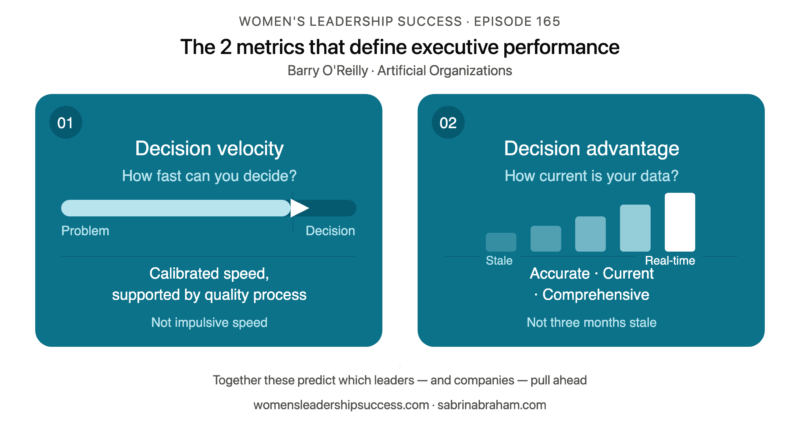
Barry’s work with high-performing organizations has surfaced two metrics that consistently predict which leaders — and companies — pull ahead:
- Decision velocity: How fast can you move from problem identification to a well-reasoned decision? Not impulsive speed — calibrated speed supported by quality process.
- Decision advantage: How current, accurate, and comprehensive is the information available to you when you need to decide? Real-time — or three months stale?
“That is how companies, startups, businesses power ahead,” Barry explains. “They learn faster, they make decisions at a high velocity, and the information to support those decisions is to hand in real time.”
AI dramatically accelerates both metrics. A meeting co-pilot that captures and synthesizes every conversation means you’re never walking into a decision without full context. Barry describes his own routine: “I run a process either the day before, the morning of, or even five minutes before I meet someone. It runs all the last conversations we’ve had against my judgment system for the meeting I’m about to have.” He shows up to every conversation with full context, clear priorities, and the calm that comes from genuine preparation.
That calm is not incidental. As I always tell the executives I coach: your cognitive and emotional state in high-stakes situations is a performance variable. Anything that reduces cognitive load — like AI capturing your meeting context — directly improves your effectiveness in those moments. AI strategic thinking for women executives isn’t just a professional tool. It’s a confidence tool.
Case Study: How Misty Schaefer Uses AI to Lead American Airlines Strategically
The most vivid example Barry shared of AI strategic thinking in action involves Misty Schaefer Sern, VP of Consumer Technology at American Airlines — responsible for AA.com, the mobile app, and every digital touch point the world’s largest airline uses to serve customers.
Misty’s natural trait: she has her best ideas on the move — walking the terminal, talking to ground staff, observing what’s happening at the gate. The traditional problem: those ideas used to evaporate between the inspiration and the desk.
Her AI-enabled solution is elegant. She captures ideas as voice notes in real time. Example: “Just spoke to the ground staff. One of the reasons planes are delayed during turnaround is that the canteen vendor is slow getting napkins onto the plane — costing us 7 minutes. Here are four ideas that could improve that.”
At end of day, she returns to those raw voice notes and prompts AI to generate strategic scenarios — varying key inputs. “Give me four different options for improving napkin delivery speed. And show me whether napkin cost is correlated to petroleum pricing — with petroleum at $1, $10, $15, $20 per unit.”
Barry’s analysis: “Misty’s quality of strategic thinking is now orders of magnitude ahead of what it could ever be if she was just trying to process this in her head. The leaders who do this are just powering ahead — because the machine and them are collaborating to pressure-test thinking, look at scenarios, play out options, and explore variables.”
This is AI strategic thinking for women executives not as a theoretical concept, but as a daily leadership practice that compounds over weeks and months into decisive strategic advantage.
How I Used AI to Find Blind Spots in My Own Work
I want to share a specific moment from my own AI practice that illustrates one of Barry’s most important principles about AI strategic thinking for women executives.
When I finished writing my Leading Before You’re Ready playbook, I ran it through AI and asked a simple question: “Did I miss anything?” AI identified two or three areas I knew about but had forgotten to include — content that genuinely made the final playbook better.
Barry’s response: “What a healthy collaboration to have with anyone. That’s why we ask for feedback — is there something I’m missing? And the quality of your output gets better.”
The key distinction, though, is one Barry makes consistently: “You’re not asking the machine for the answer. You’ve asked the question and invited new information — ‘What are the potential blind spots? What could I have missed?’ Judgment still lands with you.”
AI flags what you might have overlooked. You decide what to include, what to discard, and what to evolve. That’s not deferring to the machine — that’s using the machine to sharpen your thinking while keeping human agency exactly where it belongs. This is the practice I coach women executives to build for any high-stakes career moment: promotion preparation, board presentations, strategic proposals.
What AI Strategic Thinking Can Never Replace in a Great Leader
Barry’s answer to “What capabilities will AI never replace?” is one of the most valuable frameworks in this conversation.
Technically, machines operate by prediction: given a set of inputs, they generate a probabilistic output. They also have context window limitations — there’s only so much information they can hold and consider simultaneously. Philosophically, Barry believes two capabilities remain uniquely human:
- Creative problem solving: The ability to see patterns that appear non-obvious, to make intuitive leaps that go beyond probability, to imagine possibilities that don’t yet exist in any dataset.
- Judgment under pressure with limited context: “The last and most scarce skill on Earth,” in Barry’s words. “Our ability to make decisions under pressure, with limited context — that’s uniquely human. That’s what gives us agency.”
Barry is emphatic: “If you are constantly deferring to the machines, you’re giving up your agency. You’re creating atrophy in your decision-making capability.” Every time you hand a judgment call to AI rather than using AI to inform your judgment, you’re weakening the muscle that makes you irreplaceable.
The leaders who thrive aren’t those who use AI the most. They’re those who use AI to sharpen what only a human can do: create, judge, connect, inspire, and decide with wisdom under pressure.
The Biggest Missed Opportunity: Learning AI Strategic Thinking in Community
When I asked Barry what the biggest opportunity leaders are missing right now, his answer was immediate: “People aren’t learning together.”
“Like anything in life, nobody knows all the answers. One of the best things you can do — and I think you actually taught me this, Sabrina — is to be in a mastermind-type experience with other people.”
Barry practices this. He partnered with Slack’s CIO to create a mastermind group of CIOs, CTOs, and CPOs across North America — leaders who share use cases, compare what’s working, and build AI fluency collectively. “You just get smarter, faster. I’ve tried this, here’s what worked — you share that, and it compounds across the whole group.”
The women who accelerate fastest in my executive coaching practice almost always have a community — peers who see them clearly, challenge them honestly, and celebrate their wins without ambivalence. Solo learning is the slowest path. Peer learning, in a structured context with women at similar leadership levels navigating similar challenges, compounds your growth in ways that self-study never can.
This is the design philosophy behind Sabrina’s Impact Executive Leadership Mastermind — a community of senior women leaders built specifically for this kind of accelerated, shared learning.
Your AI Strategic Thinking Action Plan: 5 Steps for Women Executives This Week
People Also Ask: AI Strategic Thinking for Women Executives
How does AI strategic thinking help women executives make better decisions?
AI strategic thinking improves executive decision making by making your judgment system explicit so it can be tuned and improved, accelerating access to relevant information to increase decision advantage, and enabling scenario planning at a scope that would be impossible manually. The critical principle: use AI to pressure-test your thinking — not to replace your judgment.
What is a leadership judgment system and how do I build one?
A judgment system is the explicit process and criteria you use to make leadership decisions. To build one: pick a recurring type of decision, write out every step you go through to make it, identify what information you need and where it comes from, and note the criteria that determine your final choice. Share it with a trusted colleague for challenge and refinement — then use AI to help you codify and automate parts of the process.
How can women executives use AI to think more strategically?
The most powerful approach — modeled by leaders like Misty Schaefer at American Airlines — is to capture raw ideas and observations in real time via voice notes, then use AI to generate multiple strategic scenarios by varying key assumptions. Ask AI “give me four different approaches to this problem, varying these three assumptions” rather than “what should I do?” Your judgment selects and refines; AI amplifies the scope of what you consider.
What leadership skills will AI never replace in women executives?
Creative problem solving — seeing non-obvious patterns and making intuitive leaps — and judgment under pressure with limited context are uniquely human capabilities. Barry O’Reilly identifies judgment as “the last and most scarce skill on Earth.” Leaders who continuously defer to AI rather than using it to sharpen their own judgment will create decision atrophy — making themselves, not AI, the limitation.
Why should women executives learn AI strategic thinking in a peer community?
Peer communities accelerate AI learning because they multiply real-world use cases. Instead of discovering what works through solo trial and error, you benefit from every member’s experiments simultaneously. A mastermind of 8 executives produces 8x the insights and significantly faster fluency than learning alone — which is why the fastest-moving leaders are in structured learning groups, not going it solo.
How do I stay relevant as a senior leader in 2026 as AI changes everything?
Adopt what Barry calls a “beginner’s mind” — a genuine willingness to release what made you successful in the past to develop new skills, even when uncomfortable. Pair this with deliberate practice: identify the specific AI strategic thinking skills that matter most for your next role and practice them consistently. The leaders falling behind are those holding on to past success patterns. Those accelerating get comfortable being uncomfortable — and learn by doing.
AI Strategic Thinking for Women Executives: Reactive vs. Strategic Leadership
What’s New in 2026: The AI Strategic Thinking Frontier for Women Executives
- Agentic AI moving into executive workflows: AI agents that take autonomous multi-step actions are no longer experimental in enterprise environments. Leaders who understand how to direct, govern, and evaluate AI agents will hold significant organizational leverage that was unavailable even 12 months ago.
- Human-agentic workforce design as a leadership skill: The next frontier is designing how human judgment and AI agents work together at scale. Leaders who can architect these human-AI systems will define organizational performance in 2026.
- Decision infrastructure as a boardroom metric: Boards are beginning to evaluate leadership candidates not just on functional expertise but on their ability to build organizations that make high-quality decisions at speed. Decision velocity and decision advantage are becoming C-suite evaluation criteria.
- Deliberate practice as the new competitive advantage: In a landscape where AI can generate answers, the differentiator is judgment refined through intentional repetition. Leaders who review decisions systematically — identifying what they got right, adjusting their criteria — will compound advantage over those who simply react.
Common Mistakes Women Executives Make With AI Strategic Thinking
- Treating AI as a search engine for answers. Asking AI “what should my strategy be?” produces generic output. Asking “here’s my current strategic thinking — what am I missing, what scenarios haven’t I considered, what would a skeptical CFO challenge?” produces refinement. The quality of your AI output is determined by the quality of your judgment before you prompt.
- Never mapping your judgment system. If you can’t articulate how you make decisions, you can’t improve it, delegate it, or scale it. This is foundational — not optional — for any executive aiming for C-suite or board-level influence.
- Learning AI alone. The fastest learners are in peer communities. If you’re learning AI strategic thinking in isolation, you’re working at a fraction of the speed possible with a well-structured peer group.
- Building AI fluency at the productivity level and stopping there. Most leaders stop at Level 1 — AI that makes emails faster. The real competitive advantage is at Level 3: AI that enables you to show up to every high-stakes situation with greater calm, preparation, and strategic clarity than you could achieve without it.
Download Your Free Leading Before You’re Ready Playbook
The leaders who get promoted aren’t always the most experienced — they’re the ones who act before they feel ready. Sabrina’s free playbook gives you the exact framework to close that gap.
- Build confidence to step into roles before you feel fully qualified
- Close knowledge gaps fast with proven leadership frameworks
- Trusted by directors, VPs, and C-suite leaders across tech, finance & healthcare
Get Your Free Leading Before You’re Ready Playbook
Or listen to the full episode on the Women’s Leadership Success Podcast wherever you get your podcasts.
Lead with AI — Before You’re Exposed Without It
Barry closed our conversation with a principle I want every woman executive reading this to carry forward: “The leaders who are doing well are getting comfortable with being uncomfortable. That’s something you can practice by doing it.”
This is the central insight of my Leading Before You’re Ready framework applied to the AI era: readiness is not a feeling you wait for. It’s a capacity you build through deliberate, repeated action — mapping your judgment system, building your decision infrastructure, practicing in community, capturing insights before they evaporate, and staying in learning mode even when it’s uncomfortable.
The women executives who will define leadership in 2026 and beyond are those who treat AI not as a threat, not as a novelty, and not as a shortcut — but as the thinking partner, the scenario planner, and the judgment sharpener that makes them genuinely, irreplaceably better.
That starts with one judgment system exercise. One voice note. One peer conversation. This week.
If you haven’t yet listened to Part 1 of this conversation, I recommend going back. Together, these two episodes offer a complete picture of how AI can transform both your personal leadership growth and your strategic leadership impact.
About Barry O’Reilly
Barry O’Reilly is the author of Artificial Organizations: Build Better Judgment, Speed, and Results with Machine and Human Intelligence (2026), available on Amazon. A globally recognized executive advisor and keynote speaker, he has worked with Fortune 500 leadership teams worldwide and keynoted Gartner’s CFO Conference. Barry is the co-founder of ExecCamp and the bestselling author of Unlearn. Connect at barryoreilly.com.
About Sabrina Braham, MA, MFT, PCC

Sabrina Braham MA MFT PCC
Sabrina Braham is an executive leadership coach with 30+ years of experience and the host of the Women’s Leadership Success Podcast — top 1.5% globally with almost 900,000 downloads. Her clients include Stanford University, Ernst & Young, and Autodesk. She is the author of the Leading Before You’re Ready playbook and creator of the Leadership Branding Blueprint Accelerator and the Impact Executive Leadership Mastermind. Learn more about Sabrina.
Continue Your Leadership Journey
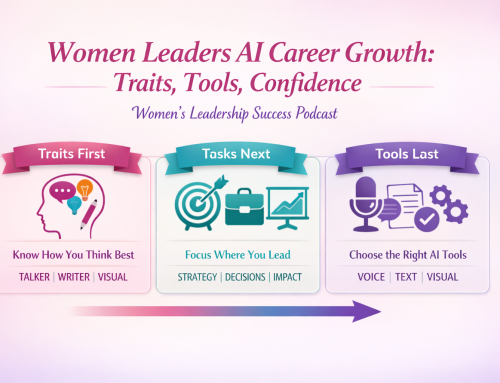
- Part 1: Leading Before You’re Ready — AI for Women Leaders Career Growth (Episode 163)
- AI Executive Productivity for Women Leaders (Episode 151)
- AI Executive Workflow Automation (Episode 152)
- Leadership Branding Blueprint Accelerator (Free Download)
- Impact Executive Leadership Mastermind
Please Help Me Help You. Share your opinion.
Confidential 30 Listener Survey