Podcast: Play in new window | Download
Subscribe: Apple Podcasts | Spotify | Android | Pandora | iHeartRadio | TuneIn | Deezer | RSS
Women Leaders Overcome Self-Doubt: The Power Quotient Framework That Changes Everything (2026)
Executive Summary: 68% of women in tech experience imposter syndrome, yet most have never been taught to fight it strategically. Former IBM VP Shelmina Babai Abji shares her Power Quotient (PQ) framework — a proven system for silencing the inner critic, amplifying your voice of courage, and advancing your leadership career.
Quick Takeaways:
- 68% of women in tech report imposter syndrome — tech is the most affected industry (Hays, 2025).
- Your “Power Quotient” (PQ) is the ability to intentionally choose an empowering response over a disempowering one.
- The voice of fear is doing its job — your job is to feed your voice of courage louder reasons to act.
- For every 100 men promoted to first manager, only 81 women make the same leap (McKinsey, 2025) — PQ is a competitive differentiator.
- Showing your worth is a continuous journey of competence, confidence, relationships, and personal branding — not a one-time event.

Sixty-eight percent of women in tech experience imposter syndrome. Let that number land.
That means more than two out of every three talented, qualified women sitting in engineering meetings, VP offices, and C-suite strategy sessions are secretly wondering if they belong there. And according to a KPMG survey of 750 female executives, 75% of senior women leaders have experienced imposter syndrome at some point in their careers — with 85% saying they believe it’s widespread in corporate America.
Yet almost no one teaches women what to do about it — strategically, systematically, and permanently.
I’m Sabrina Braham, MA, MFT, PCC — executive leadership coach with over 30 years of experience, and host of the Women’s Leadership Success Podcast, now with over 950,000 downloads and ranked in the top 1.5% of podcasts globally. In Episode 162, I sit down with Shelmina Babai Abji — TEDx speaker, former IBM Vice President, angel investor, and author of Show Your Worth — for one of the most powerful and practical conversations I’ve ever had on this podcast.
Shelmina grew up in poverty in Tanzania, put herself through school across three countries, walked into a room of 2,000 engineers where no one looked like her, and still became one of the highest-ranking women of color in IBM’s history — overseeing teams that generated over $1 billion in annual revenue. Her secret? A framework she calls the Power Quotient.
If you’re a woman leader in tech or any competitive industry who is battling negative mental chatter, fear of speaking up, or the relentless whisper that says you’re not qualified enough — this episode is for you.
Why Self-Doubt Is Hitting Women Leaders Harder Than Ever in 2026
The data tells a story that is urgent and personal. A 2025 Hays survey of more than 8,000 professionals found that 68% of women in tech experience imposter syndrome — 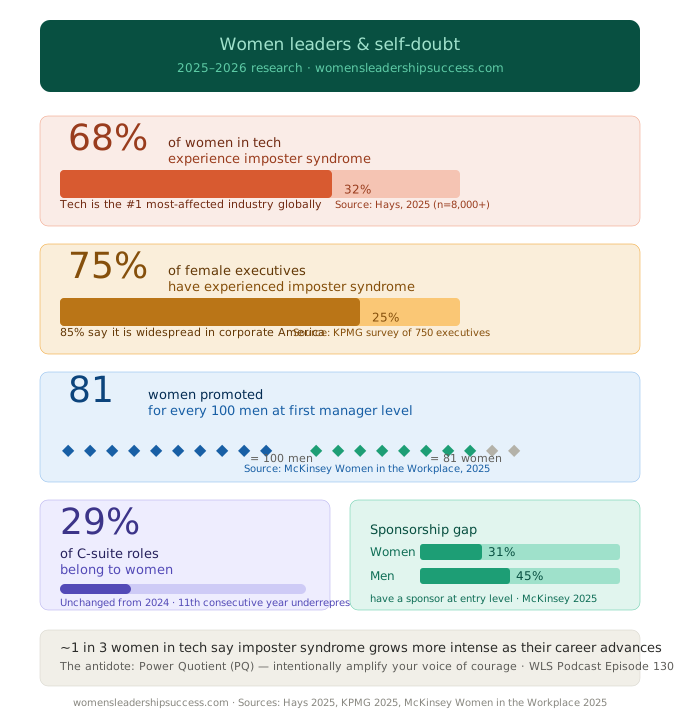 and that approximately one-third say these feelings grow more intense as their careers advance, not less. Tech is now the single most-affected industry in the entire workforce.
This is not a personal failing. It is a structural reality. As Shelmina describes it, when you look around a room and see no one who looks like you, no one who sounds like you, no one who grew up like you — your brain does exactly what it is designed to do: it searches for evidence that you belong, finds little, and generates doubt.
“I walked into a room of 2,000 engineers,” Shelmina recalls, “and I realized there was not one person that looked like me. Not one person that spoke like me. And I started undermining my own capabilities, underestimating my own worth.”
The compounding problem is this: according to the McKinsey Women in the Workplace 2025 report, women represent 49% of entry-level employees — yet by the time you reach the C-suite, fewer than 29% of those seats belong to women. For every 100 men promoted to their first manager role, only 81 women make the same leap. The “broken rung” is real, and self-doubt is one of the forces that keeps it broken.
The cost of unchecked self-doubt is not just personal — it is organizational. Women who silence themselves in meetings, decline stretch assignments, or step back from promotions because they do not feel “ready” are costing their companies their most strategic asset: authentic, experienced, high-EQ leadership.
The good news? Shelmina’s own career is proof that the cycle can be broken — and the tool she used is available to every woman listening right now.
Introducing the Power Quotient (PQ): Your Most Underused Leadership Asset
Most leaders are familiar with IQ (intellectual intelligence) and EQ (emotional intelligence). Shelmina introduces a third: PQ — Power Quotient.
“We own the power to intentionally pick an empowering response to a disempowering stimulus, whether that stimulus is internal or external. That’s your PQ. And the internal stimulus must be taken care of first, before we can fight the external.”
This is not a motivational concept. It is a cognitive framework with three operating principles:
PQ Principle 1: Recognize the Voice of Fear — Without Obeying It
The voice of fear is not your enemy. It is doing exactly what it evolved to do: keep you in your comfort zone. The moment you recognize that the whisper saying “they’ll find out you don’t belong” is just a voice — not a fact — you reclaim agency over it.
Shelmina’s turning point came during her first year at a major tech employer. She was sitting in a meeting, holding back an idea. Then she watched someone else state her exact idea — and receive praise for it. “That was the first time I recognized that my ideas do matter,” she says. “And once I had that inner victory, everything changed.”
Try This Now: The next time you catch yourself editing an idea before you say it, ask: “Is this my voice of fear or my voice of courage speaking?” Name it. That naming alone is the beginning of PQ.
PQ Principle 2: Feed Your Voice of Courage With Reasons
Courage is not the absence of fear. It is acting despite fear — and it grows when you actively give it ammunition. Shelmina calls this “feeding your voice of courage,” and it is a deliberate, intentional practice.
In her case, the reason was visceral: “If I didn’t speak up, they would not extend my visa. My dream of lifting my family out of poverty would be over.” That reason was more powerful than her fear. Your reason does not need to be that dramatic — but it does need to be real to you.
Effective reasons to feed your voice of courage include:
- The impact your idea could have on your team or clients
- The career advancement that depends on your visibility
- The women who will follow in your footsteps if you blaze this trail
- The competencies you will build only by speaking up and stretching
PQ Principle 3: Make Your Voice of Courage Louder Than Your Voice of Fear
This is the practice. Not silencing fear — but systematically amplifying courage until it drowns fear out. “I made my voice of courage louder than my voice of fear,” Shelmina says, “by feeding it reasons why I should do something, as opposed to reasons why I shouldn’t.”
This maps directly to what 2026 executive presence research identifies as the core of leadership gravitas: decisiveness under pressure and emotional self-regulation. Leaders who can redirect internal narratives in high-stakes moments are the ones who get promoted, trusted, and retained.
How to Show Your Worth Without Waiting to Be Noticed
One of the most actionable insights from Shelmina’s work is this: showing your worth is not self-promotion. It is a strategic practice of continuously positioning yourself to contribute higher and higher value — and then ensuring the right people have a front-row seat to that contribution.
“Show your worth, in the context of my book, is the value you contribute towards the success of your organization,” Shelmina explains. “The recognition that I have something to contribute is the beginning of understanding your worth. And then the journey is: how do I continuously position myself to contribute more?”
This has four dimensions that mirror 2026’s most sought-after leadership competencies:
- Competencies — continuously building the skills that drive organizational outcomes
- Confidence — the deep-seated self-trust that comes from doing hard things and surviving them
- Relationships — intentionally building the four key relationships (boss, peers, mentors, sponsors — covered in Part II)
- Personal branding — ensuring your value is visible, not just felt
Worth is not static. It is not something you either have or you don’t. “The more competent you become,” Shelmina says, “the higher the value you create.” It is a compounding cycle — and it begins the moment you decide your ideas matter.
Overcoming Negative Mental Chatter: A Framework for Women in Tech
Negative mental chatter — the constant inner voice of “I’m not smart enough, I’ll sound stupid, they’ll find out” — is the presenting symptom of an unchecked voice of fear. 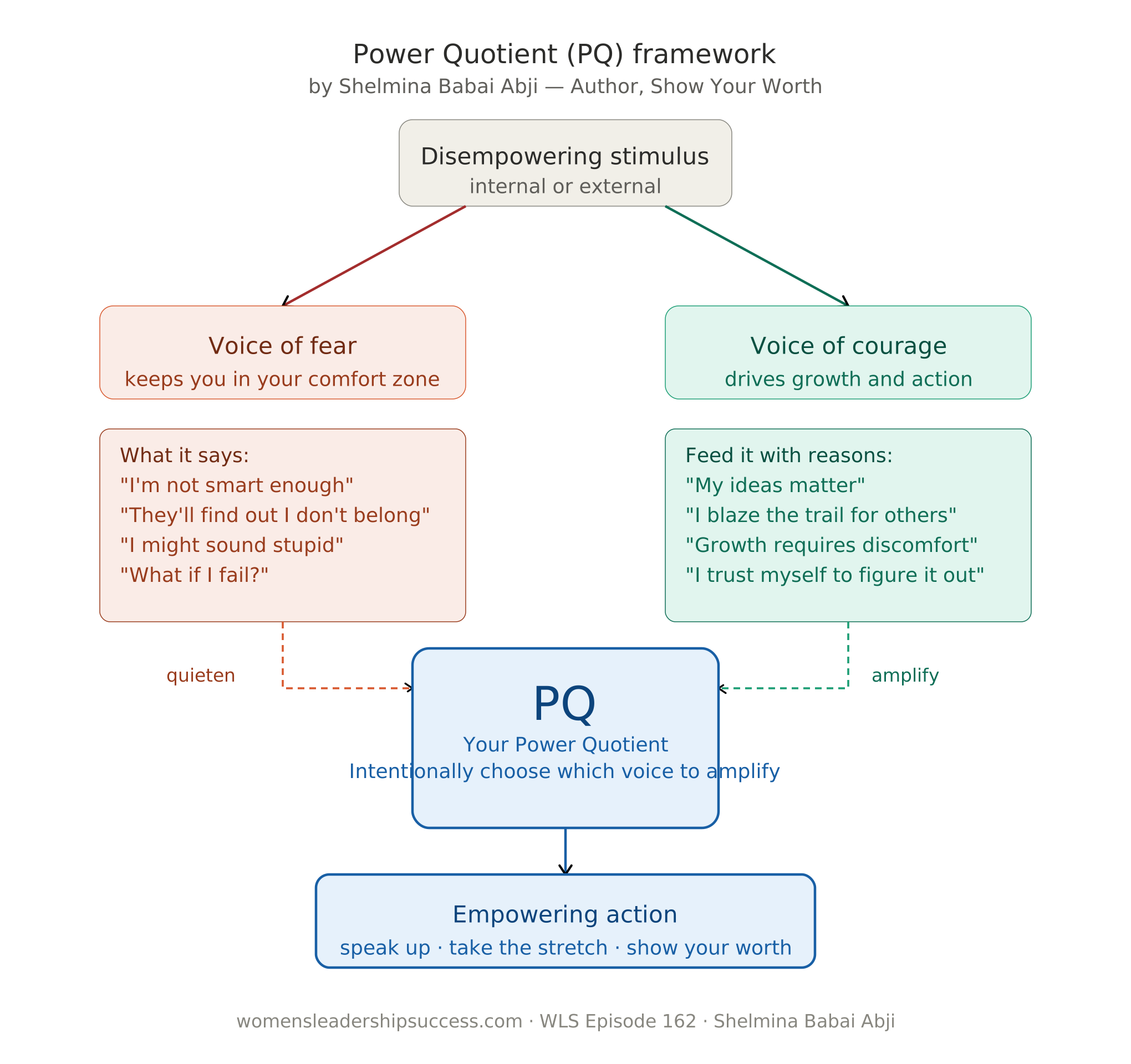 Shelmina identifies it as the single biggest barrier she sees in her work with women leaders, and she is specific about how to address it.
Step 1: Externalize It
Treat negative mental chatter the way you would treat a notification on your phone: notice it, acknowledge it, then decide whether to engage. The chatter loses power the moment you observe it rather than inhabit it.
Step 2: Name the Fear Underneath
Is it fear of failure? Fear of judgment? Fear of stepping outside your comfort zone? Fear of being seen as someone who doesn’t belong? Naming the specific fear collapses it from a fog into a manageable object. You can work with a named fear. You cannot work with a fog.
Step 3: Reframe the Outcome
“There is no such thing as failure,” Shelmina says. “There are only various degrees of success.” Every stretch assignment, every meeting where you spoke up and it didn’t land perfectly, every project that didn’t go as planned — these are data. They teach you something you did not know before, and that competence is part of your future worth.
Step 4: Act Anyway
Courage is a muscle. You build it by using it. The action does not have to be large — it has to be intentional. Speak one idea in the next meeting. Volunteer for one assignment that scares you. Ask one question you would have previously held back. Each small act of courage is a deposit into the confidence account that eventually makes speaking up feel natural.
What’s New in 2026: Why Self-Doubt Is a Strategic Issue, Not a Personal One
Three 2026 trends make Shelmina’s framework more urgent than ever:
- DEI rollbacks are increasing workplace isolation for women of color. Recent research confirms that bias in the workplace has intensified in the current geopolitical climate. For women of color especially, the absence of visible role models at the top is not just discouraging — it is a documented amplifier of imposter syndrome. Shelmina’s call to “blaze the trail” so the next woman gets the benefit of the doubt is both an act of leadership and a systemic repair strategy.
- AI-driven job disruption is triggering a new wave of self-doubt. As roles evolve rapidly and new technical skills become table stakes, many experienced women leaders are feeling like beginners again — triggering imposter syndrome even in those who had overcome it. The PQ framework applies directly: recognize the voice of fear (I don’t know enough about AI), feed the voice of courage (I have 20 years of leadership experience that AI tools will amplify, not replace).
- The “broken rung” is narrowing, but only for those who claim visibility. McKinsey’s 2025 data confirms women remain underrepresented at every pipeline level for the 11th consecutive year. The leaders who break through share one trait: they stopped waiting to be noticed and started systematically showing their worth. PQ is the internal engine that makes that possible.
People Also Ask: Women Leaders, Self-Doubt, and the Power Quotient
What is the Power Quotient (PQ) and how does it help women leaders?
The Power Quotient, coined by Shelmina Babai Abji, is your ability to intentionally choose an empowering response to a disempowering situation — whether that trigger is internal (negative self-talk) or external (bias, exclusion, a dismissive boss). It works by training you to recognize the voice of fear without obeying it, then actively feeding your voice of courage with evidence-based reasons to act. Unlike IQ and EQ, PQ is entirely within your control and can be developed at any career stage.
How do women in tech overcome imposter syndrome when they’re the only one in the room?
The most effective first step is reframing the isolation itself: rather than evidence that you don’t belong, being the only woman of color in a room means you are the trailblazer whose presence makes the path easier for the next person. Practically, Shelmina recommends building what she calls “an inner victory first” — identifying one concrete example where your idea or contribution made a measurable difference — and using that as the anchor when self-doubt resurfaces. Externally, building intentional relationships with mentors and sponsors accelerates the process significantly.
Why does imposter syndrome get worse as women advance in their careers?
Research from Hays (2025) confirms that approximately one-third of women in tech say their imposter syndrome intensifies as they progress — and the reason is structural, not personal. Each new level of leadership brings fewer women around you, less familiar territory, and higher stakes for any perceived mistake. The internal voice of fear registers this unfamiliarity as danger. The antidote is recognizing that this discomfort is a signal that you are growing, not failing — and deliberately building the relationships and competencies that create new confidence anchors at each new level.
What is the difference between the voice of fear and the voice of courage?
Both voices are always present. The voice of fear wants to keep you safe by keeping you still — it presents worst-case scenarios, reminds you of every past mistake, and emphasizes what you don’t know. The voice of courage focuses on what you can learn, contribute, and become. The key insight from Shelmina’s framework is that you don’t need to silence the voice of fear — you need to make the voice of courage louder by feeding it more reasons, more evidence, and more intentional action.
How can a woman show her worth without seeming like she’s self-promoting?
Shelmina reframes self-advocacy as “stating facts.” In performance reviews and regular conversations with your manager, describing what you have accomplished, what you have learned from stretch assignments, and where you need support is not bragging — it is giving your boss the information they need to champion you effectively. The key distinction: frame your contributions in terms of value created for the team, the client, or the organization, not in terms of personal achievement. Contribution-focused communication builds both credibility and the relationship.
Is imposter syndrome worse in tech than in other industries?
Yes, according to multiple 2025 studies. The Hays survey of 8,000+ professionals found tech to be the single most-affected industry, with 68% of women reporting imposter syndrome. The combination of rapid technical change (making everyone feel perpetually behind), male-dominated culture, and highly visible failure makes tech a perfect incubator for self-doubt. The structural underrepresentation of women — particularly women of color — at senior levels compounds the effect by removing the role models who would otherwise signal “you belong here.”
Implement This Week: 5 PQ-Building Actions for Women Leaders
- Start a “voice log” (10 minutes). For three days, write down every self-limiting thought you notice at work. Don’t argue with them — just document them. At the end of three days, read the list. You will immediately see the patterns, and you will recognize that these are recurring scripts, not facts. This awareness is the beginning of PQ.
- Build your voice of courage file (15 minutes). Create a document — a note on your phone works perfectly — titled “Evidence I Belong Here.” List every accomplishment, recognition, positive piece of feedback, or moment when your contribution made a difference. Add to it weekly. On hard days, read it before any high-stakes meeting.
- Speak one unedited idea in your next meeting (immediate). Before the meeting ends, commit to sharing one idea you would normally hold back. Don’t rehearse it to death. Say it. The goal is not perfection — it is the act of speaking. That act is a deposit into your voice of courage.
- Reframe one “failure” from the past month (20 minutes). Identify one situation from the last 30 days that you have privately labeled a failure. Write out: (a) what you learned, (b) what competence you built, and (c) how this experience makes you more capable for the next challenge. This is Shelmina’s reframe in practice — “various degrees of success.”
- Identify your PQ reason (10 minutes). Ask yourself: “What is my most compelling reason to speak up, stretch, and advance my career?” Make it personal, specific, and emotionally resonant. Write it down. This becomes your voice of courage’s most powerful fuel — the reason you act in spite of fear.
Common Mistakes Women Leaders Make When Battling Self-Doubt
Mistake 1: Waiting Until You Feel Confident to Act
Confidence does not precede action. It follows it. Shelmina did not feel confident before she spoke up in that Tuesday afternoon meeting — she spoke up in spite of fear, and confidence was the result. Waiting to feel ready before taking the stretch assignment, applying for the promotion, or speaking in the leadership meeting means waiting indefinitely.
Mistake 2: Competing With Your Colleagues Instead of Contributing With Them
Self-doubt often generates a competitive, zero-sum mindset: if they succeed, it proves I am less than. Shelmina’s framework inverts this entirely. Your worth is not relative to your peers’ success — it is absolute, tied to the unique value only you can contribute. Focusing on contribution rather than comparison dramatically reduces the social anxiety that feeds self-doubt.
Mistake 3: Treating Self-Advocacy as Self-Promotion
Many women avoid talking about their accomplishments because it feels like bragging. But your boss cannot champion you for a promotion they don’t know you deserve. Shelmina is direct: “It’s not even called self-advocacy. It’s just stating facts.” Giving your manager a front-row seat to your contributions is a professional responsibility, not a personality trait.
Mistake 4: Giving Your Power Away When Biases Surface
When a colleague or manager underestimates you, the instinct is to react — to prove them wrong loudly, or to shrink and accept their framing. Shelmina recommends neither: “Don’t react. When you react, you give your power away to them. You reinforce the negative biases. Instead, prove your worth and change their opinion slowly, but surely.” The compound effect of sustained excellent work changes minds. Reactions rarely do.
Traditional vs. PQ-Based Approach to Self-Doubt
| Traditional Approach | Power Quotient (PQ) Approach |
|---|---|
| Wait until confident to act | Act to build confidence |
| Try to eliminate fear | Coexist with fear; amplify courage |
| Dismiss negative self-talk | Name it, then redirect it |
| Hope your boss notices your work | Give your boss a front-row seat intentionally |
| Self-advocacy feels like bragging | Self-advocacy is stating facts |
| Failure means you don’t belong | Failure is a degree of success and a data point |
| Belong when others accept you | Belong because you decide you belong |
About Shelmina Babai Abji

Shelmina Babai Abji is a TEDx speaker, former IBM Vice President, angel investor, and author of Show Your Worth: 8 Intentional Strategies for Women to Emerge as Leaders at Work. Rising from humble beginnings in Tanzania, she became one of the highest-ranking women of color at IBM, leading teams that generated over $1 billion in annual revenue. She serves on the advisory board of Girl Up and speaks at global organizations including IBM, SAP, Dropbox, and Harvard. Learn more at shelmina.com.
About Sabrina Braham, MA, MFT, PCC
 Sabrina Braham is an executive leadership coach with 30+ years of experience and host of the Women’s Leadership Success Podcast — ranked in the top 1.5% globally with 950,000+ downloads since 2007. She has coached 250+ senior women leaders in tech, finance, and professional services, helping them advance to VP, C-suite, and founder roles. Sabrina specializes in executive presence, leadership branding, and career acceleration. Learn more about Sabrina.
Continue Your Journey: Don’t miss Part II of this interview — where Shelmina reveals the four relationships that accelerate your promotion, how to build influence with a boss who undervalues you, and her Personal Success Plan framework for climbing to the C-suite. Subscribe on Apple Podcasts so you never miss an episode.
Continue Your Leadership Journey
- Episode 131: Build Leadership Influence and Get Promoted — Shelmina Abji Part II
- Executive Leadership Confidence Development
- Free Leadership Branding Blueprint Accelerator
- Executive Coaching for Women