Podcast: Play in new window | Download
Subscribe: Apple Podcasts | Spotify | Android | Pandora | iHeartRadio | Blubrry | TuneIn | Deezer | RSS
Part 2 of 2 | Continued from: Continuous Improvement Leadership: Women’s Career Guide 2026
Executive Summary
Women leaders continuous improvement culture succeeds or fails based on one variable: the leader’s personal commitment. Olaf Boettger’s 27-year framework reveals the CEO’s 90-day launch plan, two fatal CI mistakes, women’s natural CI advantage, and the 10-minute personal Kaizen practice that compounds career results starting today.
Quick Takeaways
- 70% of CI initiatives fail — almost always due to leader behavior, not methodology (Olaf Boettger, 27 years P&G/Danaher)
- Women leaders continuous improvement culture succeeds because women’s natural humility and collaborative style align with CI requirements
- The CEO’s first 90 days: Gemba ? Top-10 Problem List ? 5 Whys ? Impact-Effort Matrix ? Daily Huddles
- Personal Kaizen takes less than 10 minutes per day and starts compounding career results immediately
- Laid-off women can apply CI directly to job search — turning a demoralizing process into a systematic, controllable one
In Part 1 of this conversation, Olaf Boettger revealed the foundations of women leaders continuous improvement culture — Kaizen philosophy, Gemba principles, and the three capabilities that make it work: courage, humility, and discipline. But knowing the philosophy is not the same as executing it.
Most organizations have heard of Kaizen. Most have tried it. Most have failed.
According to Olaf, who spent 27 years at Procter & Gamble and Danaher mastering this system, the failure is rarely about the methodology. It is almost always about the leader.
In Part 2 of our Women’s Leadership Success Podcast interview, Olaf reveals exactly what a successful women leaders continuous improvement culture launch looks like — the CEO’s first 90 days, the two fatal mistakes that kill every initiative, why women bring a genuinely underappreciated competitive advantage to this work, and the personal Kaizen practice that takes less than 10 minutes a day and starts compounding results immediately.
As an executive coach with over 30 years of experience (MA, MFT, PCC) and host of a podcast ranked in the top 1.5% globally with over 750,000 downloads, I have seen this framework transform the careers of women who stopped waiting to be recognized and started building systems that made them impossible to overlook. Building a women leaders continuous improvement culture is not only a leadership strategy — it is a career survival strategy in 2026.
Ready to make yourself the standout candidate in 2026’s competitive market?
Download our FREE Leadership Branding Blueprint Accelerator and discover:
- The exact 5-step system to position yourself as indispensable (not just competent)
- How to document CI results in a format that gets you promoted 3x faster
- The personal achievement tracker that turns invisible work into visible impact
- Scripts for self-advocacy conversations that feel natural, not pushy
The CEO’s First 90 Days: Your Continuous Improvement Culture Launch Plan
If you are stepping into a new leadership role — or finally ready to build a women leaders continuous improvement culture in your existing organization — the first 90 days set everything. Olaf’s approach is structured around a deceptively simple insight: the problems you can solve are already visible if you are willing to go look at them.
Step 1: Go to Gemba — The Real Place (Days 1–30)
 Gemba is the Japanese term for the real place — where the work actually happens. For a CEO or senior leader, Gemba might mean riding along with a salesperson, observing operations on a floor, sitting with engineers reviewing prototypes, or speaking directly with customers about how they use your product.
This is not a listening tour. It is a fact-gathering mission. The gap between what leadership believes is happening and what is actually happening is, in most organizations, enormous. The only way to close that gap is to go see for yourself.
For women building a women leaders continuous improvement culture, this Gemba-first approach is especially powerful: it signals humility and curiosity before authority — the exact combination that earns trust fast in new organizations.
Step 2: Build Your Top-10 Problem List (Days 15–30)
After Gemba, the next move is prioritization. A former Danaher colleague of Olaf’s — who became CEO of a large Anglo-American corporation — used exactly this method: he created a numbered top-10 problem list and began working through it methodically with his teams.
The discipline here is critical. You are not solving all problems. You are sequencing them. Problem 1 gets your full attention and resources until it is resolved. Then Problem 2. Then Problem 3. This focus prevents the scattered, multi-initiative paralysis that kills most CI attempts before they produce results.
Step 3: Apply the 5 Whys to Find Root Causes (Days 20–60)
Once you have your prioritized list, the next step is diagnosis. Olaf uses the 5 Whys — a Toyota-originated technique where you ask ‘why does this problem exist?’ and then ask ‘why?’ to each answer, five levels deep. By the fifth ‘why,’ you are nearly always at the systemic root cause rather than a surface symptom.
The difference is critical. Treating symptoms produces temporary fixes. Addressing root causes produces permanent improvement. This is why organizations that chase the first obvious solution — like a $50 million ERP system — often spend enormous resources only to discover the original problem persists.
Step 4: Use the Impact-Effort Matrix to Sequence Solutions (Days 30–60)
Not all solutions are equal. Olaf teaches leaders to categorize every potential solution across two dimensions: impact (does it actually solve the problem?) and effort (how much time, money, and energy does it require?).
| Solution Category | Priority Action |
|---|---|
| ? High Impact + Low Effort | Do these FIRST — quick wins that build momentum and credibility |
| ? High Impact + High Effort | Plan carefully — these are your strategic projects |
| ? Low Impact + Low Effort | Do only if capacity allows — don’t let these consume bandwidth |
| ? Low Impact + High Effort | Eliminate — these drain your CI culture before it starts |
Step 5: Run Daily Red/Green Huddles as Your Standard Management Meeting (Days 1–90)
As described in Part 1, the 15-minute daily red/green huddle is not a CI activity added on top of normal business. It IS the management meeting. Red means a problem is identified and being addressed. Green means performance is on track. Run without exception every day, it signals that the improvement culture is real — not a program that fades at the next crisis.
What Your Organization Sees by Day 90
When you execute this plan, three things happen simultaneously: your team sees you are committed enough to observe their actual work; they see the organization’s most painful problems being addressed systematically; and they begin to internalize what a good solution looks like. This is how women leaders continuous improvement culture takes root — through behavior modeling, not value announcements.
The 2 Fatal Mistakes That Kill Continuous Improvement Initiatives
Olaf estimates there is a graveyard of failed CI initiatives in nearly every large organization. The causes are almost never about the methodology. Here are the two patterns he sees repeatedly — and what women leaders can do differently.
Fatal Mistake #1: The Leader Who Wants Results Without Changing
In German, there is a phrase for this: ‘Wash my fur, but don’t make me wet.’ The leader wants the outcomes of CI — better numbers, more efficient teams, fewer crises — but is unwilling to personally change how they operate. They hire consultants, launch programs, run trainings. And then they return to their previous behavior.
This is fatal because culture follows behavior, not announcements. If the CEO does not go to Gemba, the SVP will not go to Gemba. If the SVP does not go, the VP will not go. By the time the directive reaches managers who are supposed to implement CI, it has been diluted into a program that nobody owns.
For women leaders specifically: the antidote is your natural advantage — the willingness to be publicly humble, to admit what you do not know, and to go see before you decide. A women leaders continuous improvement culture that the top leader personally models is one that spreads without a mandate.
Fatal Mistake #2: Treating CI as a Separate Activity
The second pattern is more subtle but equally deadly: organizations that run CI as a parallel track alongside their ‘normal’ business. Friday afternoon training. Quarterly workshops. A dedicated CI team that other leaders do not engage with.
This is the wrong model entirely. At Toyota, Danaher, GE, and every organization where CI works long-term, continuous improvement is not something you do in addition to running the business. It IS how you run the business. The 15-minute daily red/green huddle is not a CI activity — it is the operational meeting. The improvement system and the management system are the same system.
The practical implication: if your organization has a CI initiative that exists separately from how work is actually managed, advocate for integrating the two. That single structural change will determine whether your women leaders continuous improvement culture produces lasting results or joins the graveyard.
Why Women Leaders Build Continuous Improvement Culture Better
One of the most powerful moments in our conversation came when I asked Olaf directly: do women bring unique strengths to continuous improvement culture?
His answer was unequivocal — and grounded in 27 years of observing what actually works in organizations around the world.
“There is a lot less ego involved in a lot of women I’ve worked with. And if we look at the three capabilities for successful continuous improvement — courage, humility, and discipline — I’ve seen women bring more to the table, especially on the humility side. Being more open to say: let’s bring others in, let’s bring other ideas in, and learn from them, because what we have so far isn’t good enough.”
— Olaf Boettger, 27 years at P&G and Danaher
This is not a soft observation. It maps directly onto what McKinsey’s Women in the Workplace 2025 research confirms: inclusive, collaborative leadership behaviors — the willingness to invite diverse perspectives and create psychological safety — are associated with measurably higher organizational performance. The leadership style that comes more naturally to many women is, in fact, the leadership style that women leaders continuous improvement culture requires.
The Specific Advantages — and How to Leverage Them
| Women’s CI Strength | Why It Matters for Culture Building |
|---|---|
| Lower ego investment | Easier to admit ‘I don’t know’ — the essential starting point of CI |
| Collaborative orientation | Naturally invites diverse perspectives — CI’s core problem-solving method |
| Greater humility | More willing to observe and learn before deciding |
| Empathy and listening | Builds the psychological safety CI teams require |
| Discipline and follow-through | Sustains the daily practice — the ‘Sustain’ in 5S that kills most CI attempts |
The important caveat — one I reinforce in my coaching work — is that these natural strengths must be balanced with self-advocacy. McKinsey research shows women are frequently penalized for the same decisive, strategic behavior that earns men promotions. The goal is not to minimize your CI-aligned strengths. It is to document and communicate the results they produce so loudly that the outcome speaks for itself.
Personal Kaizen: The Daily Practice That Starts Compounding Today
CI is not only for organizations. It is a personal operating system that any women leaders continuous improvement culture practitioner can install starting this week — in less time than a podcast episode.
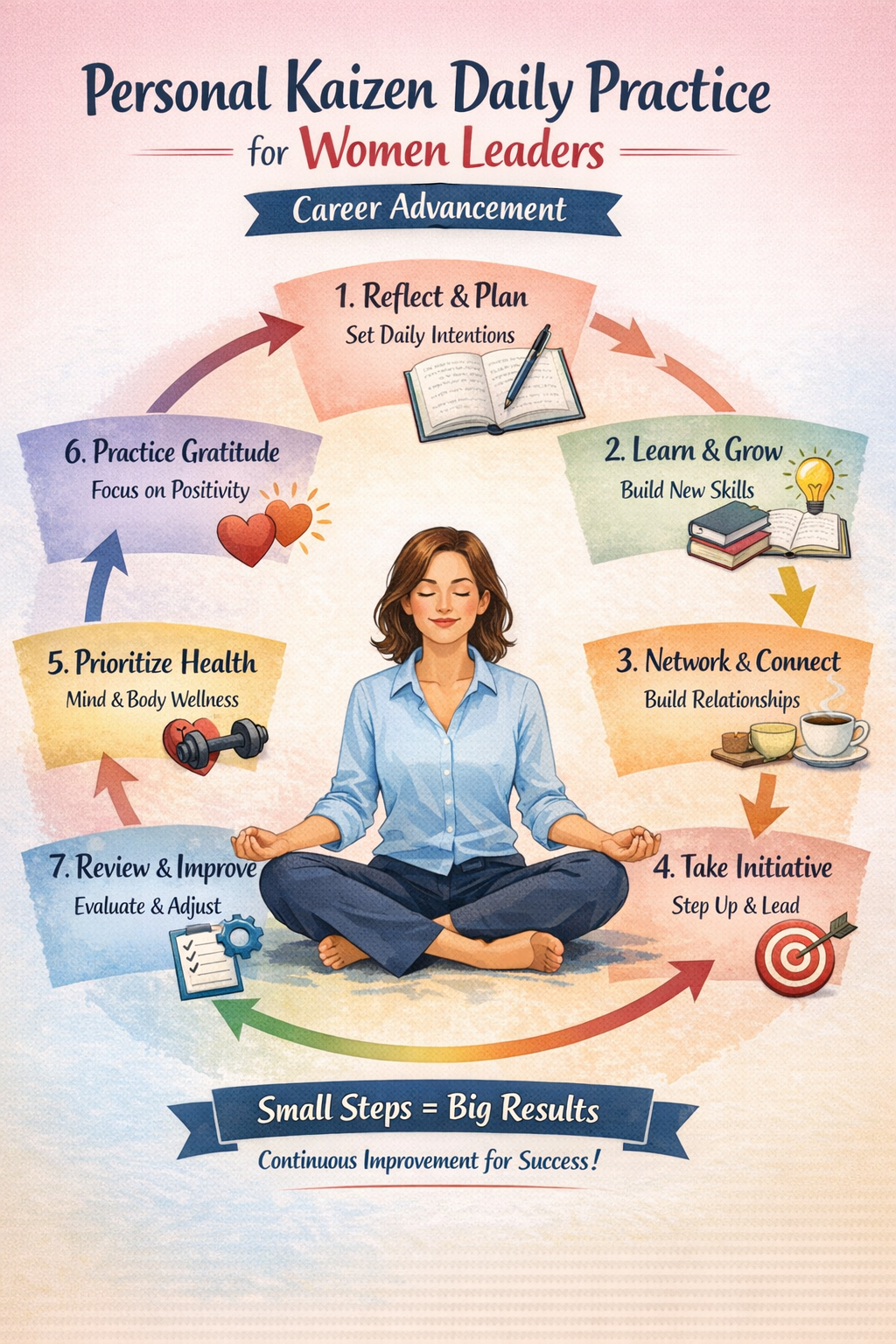
The 5S Method Applied to Your Home and Office
Olaf references the 5S methodology — a Toyota-originated workplace organization system — as one of the most accessible entry points for personal Kaizen:
- Sort — Remove everything you don’t need. Keep only what you use.
- Set in Order — Give every item a designated home. No ambiguity about where things belong.
- Shine — Clean your space. A clean environment makes abnormalities immediately visible.
- Standardize — Create simple rules for how the space is maintained. Checklists help.
- Sustain — The hardest S. Practice daily until the standard becomes automatic.
This is not just an organizational preference. It reduces what Olaf calls cognitive load — the mental energy spent searching, worrying about missing something, or managing visual chaos. David Allen’s Getting Things Done principle applies: ‘You either have an inbox, or your whole household is an inbox.’ When your environment is organized using CI principles, your brain can focus on the work that matters.
Sabrina’s 10-Minute Morning CI Practice
Nine months ago, after reading one of Olaf’s LinkedIn posts about office organization, I committed to a simple daily practice. Every morning, I take a photo of my office, then spend 10 minutes cleaning and organizing toward my target state. The result: a calmer, more focused mind before the first meeting of the day. By month three, the maintenance takes five minutes. The daily practice has migrated into how I manage email, client files, and my content calendar. One CI habit installed the others.
Use Checklists — Without Apology
One of Olaf’s most memorable points: when people challenged him about using checklists despite his PhD, he responded simply. The pilot flying you home tonight has an advanced aviation degree and uses a checklist. The checklist is not a sign of low capability. It is a sign of intellectual honesty about the limits of human memory under pressure.
For women leaders especially — who often feel they must perform competence without visible systems — this is liberating. Your checklist for the monthly financial review, your weekly achievement tracker, your daily red/green self-assessment: these are CI tools. They are the operating systems of high performers.
The CI Loop for Personal Growth
Olaf describes his personal CI practice as a continuous loop: learn something new, apply it, stabilize the improvement, then identify the next gap when conditions change. For career advancement, this loop looks like: identify a skill or visibility gap (your red), learn and practice deliberately, embed the new behavior into your standard operating procedure, then reassess as the competitive landscape shifts. This is exactly the growth mindset Carol Dweck’s research describes — made operational and measurable.
Apply CI to Your Career Right Now
Download the FREE Leadership Branding Blueprint Accelerator to get:
- Your personal red/green achievement tracker template (CI applied to your career)
- The 90-day visibility plan that gets women promoted 3x faster
- The self-advocacy framework for women who dislike self-promotion
- Research-backed strategies from Harvard, McKinsey, and 30+ years of coaching
What to Do When You’ve Tried CI Before and It Didn’t Stick
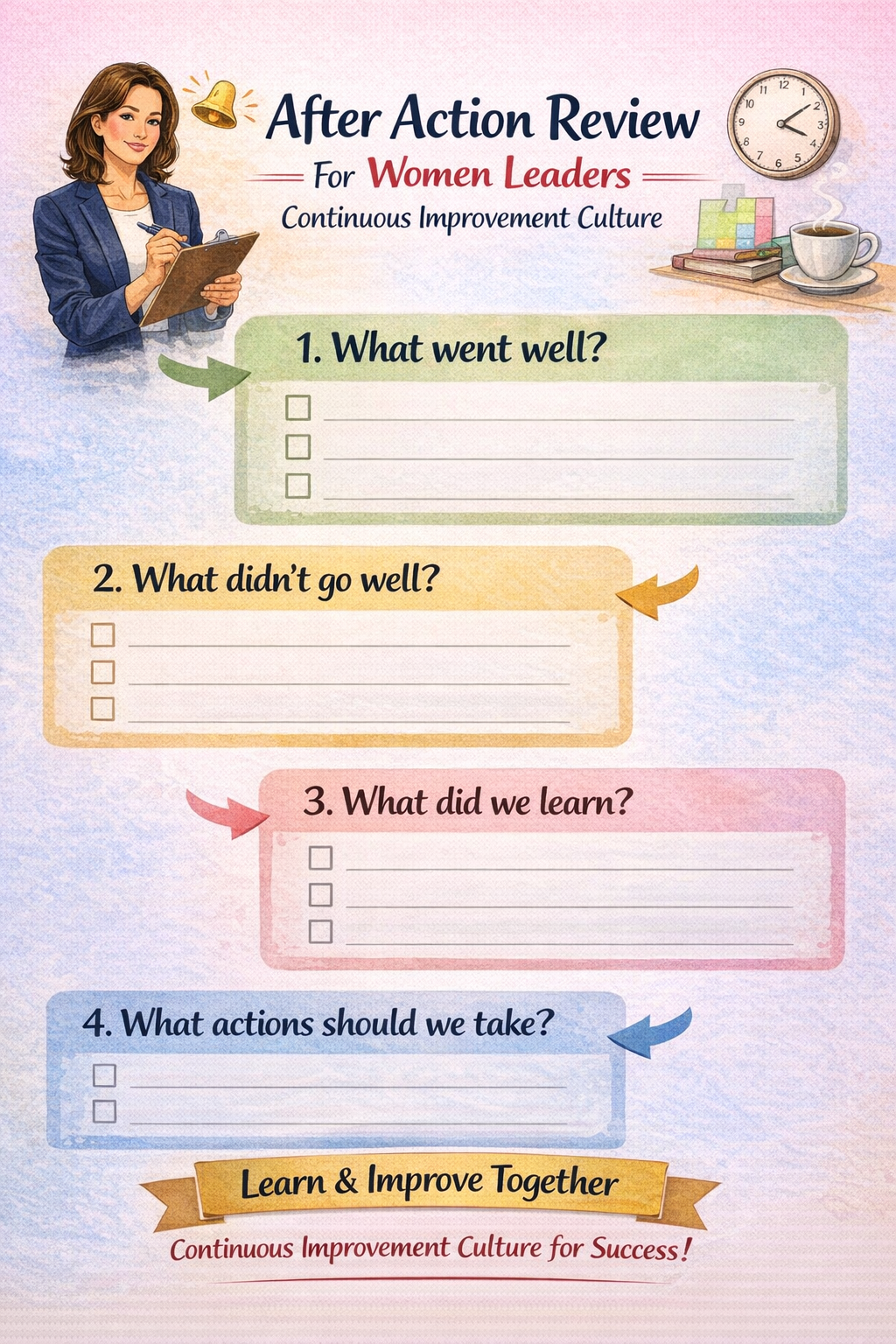
If you or your organization has a graveyard CI initiative in the past, Olaf’s prescription is the after-action review:
| After-Action Review | Question to Answer |
|---|---|
| Question 1 | What did we set out to do? (The plan) |
| Question 2 | What actually happened? (The honest reality) |
| Question 3 | What do we learn from this? (Root causes of the gap) |
| Question 4 | What will we do differently next time? (Countermeasures) |
After the after-action review, the critical step is sharing what you learned with your organization. Olaf is direct: if you simply redo what you did last time, you will get the same result. The willingness to say publicly, ‘Here is what we got wrong and here is what we will do differently,’ is itself an act of women leaders continuous improvement culture leadership — and one that distinguishes executives who build lasting cultures from those who cannot.
People Also Ask: Women Leaders Continuous Improvement Culture
What does the first 90 days of continuous improvement look like for a new CEO?
Start with Gemba — observing real operations, not reports. Build a prioritized top-10 problem list. Apply the 5 Whys to identify root causes. Use an impact-effort matrix to sequence solutions. Run daily 15-minute red/green huddles as your standard management meeting. By day 90, your team sees your commitment, problems are being solved, and women leaders continuous improvement culture is the operating system — not a separate initiative.
Why do most continuous improvement initiatives fail?
The two most common failure modes: (1) The CEO delegates CI instead of personally leading behavior change — if the top leader does not go to Gemba, no one will. (2) CI is treated as a parallel program rather than the core operating system. Companies like Toyota (90 years), Danaher (40 years), and Honda (60 years) succeed because CI is not something they do — it is how they run everything.
What natural strengths do women bring to continuous improvement culture?
Olaf Boettger — who spent 27 years at P&G and Danaher — identifies women leaders’ lower ego investment and greater humility as direct CI advantages. The willingness to invite others’ perspectives, admit gaps, and learn collaboratively aligns precisely with what women leaders continuous improvement culture requires. McKinsey’s Women in the Workplace 2025 research confirms that inclusive, collaborative leadership is associated with higher performance outcomes.
Should I hire a CI consultant or coach?
Yes — with an important caveat: a CI consultant cannot go to the gym for you. They can show you the machines and the sequence. They cannot provide the commitment. If your CEO is not personally committed to CI, even the best consultant will fail. GE and Danaher both used external experts from Shingijutsu (Toyota-trained consultants) — but Larry Culp and the leadership team personally embodied the change first.
How do I start personal Kaizen if I’ve never done continuous improvement?
Start with your physical environment. Take a photo of your workspace today — this is your ‘actual.’ Spend 10 minutes organizing it toward your desired ‘target’ state. Give every item a designated home. Repeat daily. This 5S practice builds the CI muscle — problem definition, gap measurement, countermeasures, daily discipline — in a low-stakes environment before you scale it to organizational challenges.
Can continuous improvement help women who have been laid off find their next role faster?
Absolutely. Apply CI directly to your job search: define your target role precisely, measure your actual progress weekly (applications, conversations, interviews, offers), color-code your gaps honestly, identify root causes of stalls, and apply targeted countermeasures. Women leaders continuous improvement culture applied to a job search turns a demoralizing process into a systematic one you control — and that confidence reads in every interview.
What’s New in 2026: CI Culture Trends Every Women Leader Should Know
Coaching Leadership Is Now a Core Expectation, Not a Style
Robert Half’s 2026 Salary Guide research confirms employers now explicitly define leadership expectations around coaching, ongoing feedback, and enabling team decisions. This is CI applied to human development. Women who build CI cultures are already practicing this model and are positioned ahead of the curve.
AI Is Creating a New CI Opportunity — and Risk
According to IMD’s 2026 workplace research, workers are saving an average of two hours per day using AI tools — but only 25% receive formal training on how to channel that time into business value. This is a CI opportunity: use Olaf’s problem-definition methodology to identify where AI-recovered time should flow. Women leaders continuous improvement culture practitioners who direct that capacity strategically will stand out.
Skills-Based Promotion Is Replacing Title-Based Advancement
The 2026 job market increasingly rewards demonstrated, documented skills over pedigree and job title. A CI-based achievement tracker — your running record of problems solved, results improved, and impact measured — is the portfolio that supports a skills-based career case. For women navigating the broken-rung promotion gap McKinsey identifies, this documentation is not optional.
The After-Action Review Is Going Mainstream
Military-origin reflection tools are being adopted rapidly in corporate leadership development as organizations struggle to learn from the layoff-heavy restructuring of 2024–2025. Women leaders who can facilitate honest after-action reviews — combining courage to name failures with the humility to learn from them — are becoming highly sought-after culture builders.
Old vs. New CI Leadership: What the Research Shows
| ? Old Model (Why CI Fails) | ? New Model (Women Leaders CI Culture) |
|---|---|
| CI launched by program announcement | CI launched by leader going to Gemba personally |
| Consultant does the improvement work | Leader models improvement behavior daily |
| CI = Friday afternoon training sessions | CI = how we run every meeting, every day |
| Problems solved by whoever is loudest | Problems solved by 5 Whys root cause method |
| Leaders manage by reports and decks | Leaders manage by observing actual work |
| CI initiative separate from operations | CI = the management system |
| Checklist = low competence signal | Checklist = high performance discipline |
| Results measured once per quarter | Results visible daily via red/green huddle |
Your Next Step: Build the Culture — and the Career — You Deserve
Continuous improvement culture does not begin with a budget or a program. It begins with a decision: am I committed to this, personally, with my own behavior — not just my words? Building women leaders continuous improvement culture starts with you.
Olaf has seen this question answered both ways. The leaders who say yes — who go to Gemba, who name the reds, who use checklists, who run the morning huddle without exception — build organizations that outperform for decades. The leaders who say yes with their lips and no with their calendars join the graveyard.
For women leaders in 2026, the choice is also a career strategy. In a market where the ‘forever layoff’ never fully stops, where AI is reshaping roles faster than most organizations can plan, and where only 29% of C-suite positions are held by women (McKinsey, 2025) — the leaders who build systems, document results, and model what improvement looks like every single day are the ones who are irreplaceable. Women leaders continuous improvement culture is not just a leadership philosophy. It is your competitive advantage.
Ready to Become the Standout Leader in Every Room?
Download the FREE Leadership Branding Blueprint Accelerator:
- The personal CI achievement tracker that documents your impact for promotion conversations
- The 90-day visibility system proven to accelerate advancement 3x faster
- The self-advocacy framework that feels natural — not pushy or self-promotional
- The exact language that positions your CI strengths as strategic assets in interviews
- Research-backed tools from Harvard, McKinsey, and 30+ years of executive coaching
Listen to Part 1: Continuous Improvement Leadership:
Women’s Career Guide 2026
In Part 1, Olaf reveals the Kaizen foundations, the red/green performance system, and the three capabilities every woman leader needs.
Listen now: womensleadershipsuccess.com/continuous-improvement-leadership-women
Subscribe to the Women’s Leadership Success Podcast — ranked top 1.5% globally — on:
- Apple Podcasts
- Spotify
- Youtube
or your favorite platform.
About the Experts

About Olaf Boettger is a global continuous improvement and operational excellence leader with 27 years of experience at Procter & Gamble and Danaher. His PhD research focuses on Carol Dweck’s growth mindset frameworks. Based in Germany, he shares daily CI insights, tools, and frameworks with an engaged LinkedIn following of 27,000+. Connect at linkedin.com/in/olaf-boettger.
About Sabrina Braham
 Sabrina Braham, MA, MFT, PCC is an executive leadership coach with over 30 years of experience advancing women leaders’ careers through strategic branding and proven frameworks. Her Women’s Leadership Success Podcast ranks in the top 1.5% globally with 750,000+ downloads. She has worked with 300+ executives across Fortune 500 companies. Free resources at womensleadershipsuccess.com.


















Leave A Comment