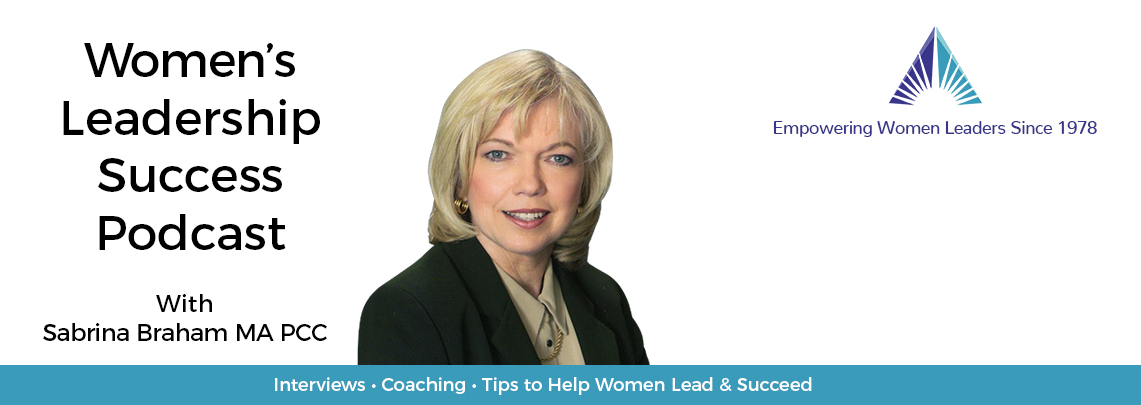
Welcome to the Women’s Leadership Podcast
Do you want to expand your potential and achieve great success? You have come to the right place. The Women’s Leadership podcast was created to help you. For over 30 years, I have been involved in research & cutting-edge practices that have helped thousands of people get promoted and become top leaders.
In this one-of-a-kind women’s leadership podcast, you will get actionable advice and tips and hear stories from over 144 top female (and men) thought leaders to help you be a better leader, advance your career, increase your income, help you have more influence and have a better quality of life in work and play.
This Women’s Leadership podcast is ideal for you if you are a new supervisor, manager, existing C-Suite, seasoned entrepreneur leader, or aspire to be one.
How to Use Women’s Leadership Podcast to Excel in Your Leadership, Career, and Income

Executive Leadership Coach Sabrina Braham MA MFT PCC
To find a specific topic to help you succeed, use the Women’s Leadership Podcast “Topics” category search on the right-hand sidebar, or the search magnifying glass on the top navigation bar. Also, on the lower right-hand sidebar, check out some of the “Most Popular Shows” of the Women’s Leadership Success podcasts, where we are some of the most popular authors, entrepreneurs, and thought leaders dedicated to helping you enhance your leadership.
The results I have had with my clients inspired me to launch and develop this Women’s Leadership podcast to give you that same opportunity to excel in your leadership & career by sharing my expertise and interviewing top leaders in business to discover the secrets to their great success.
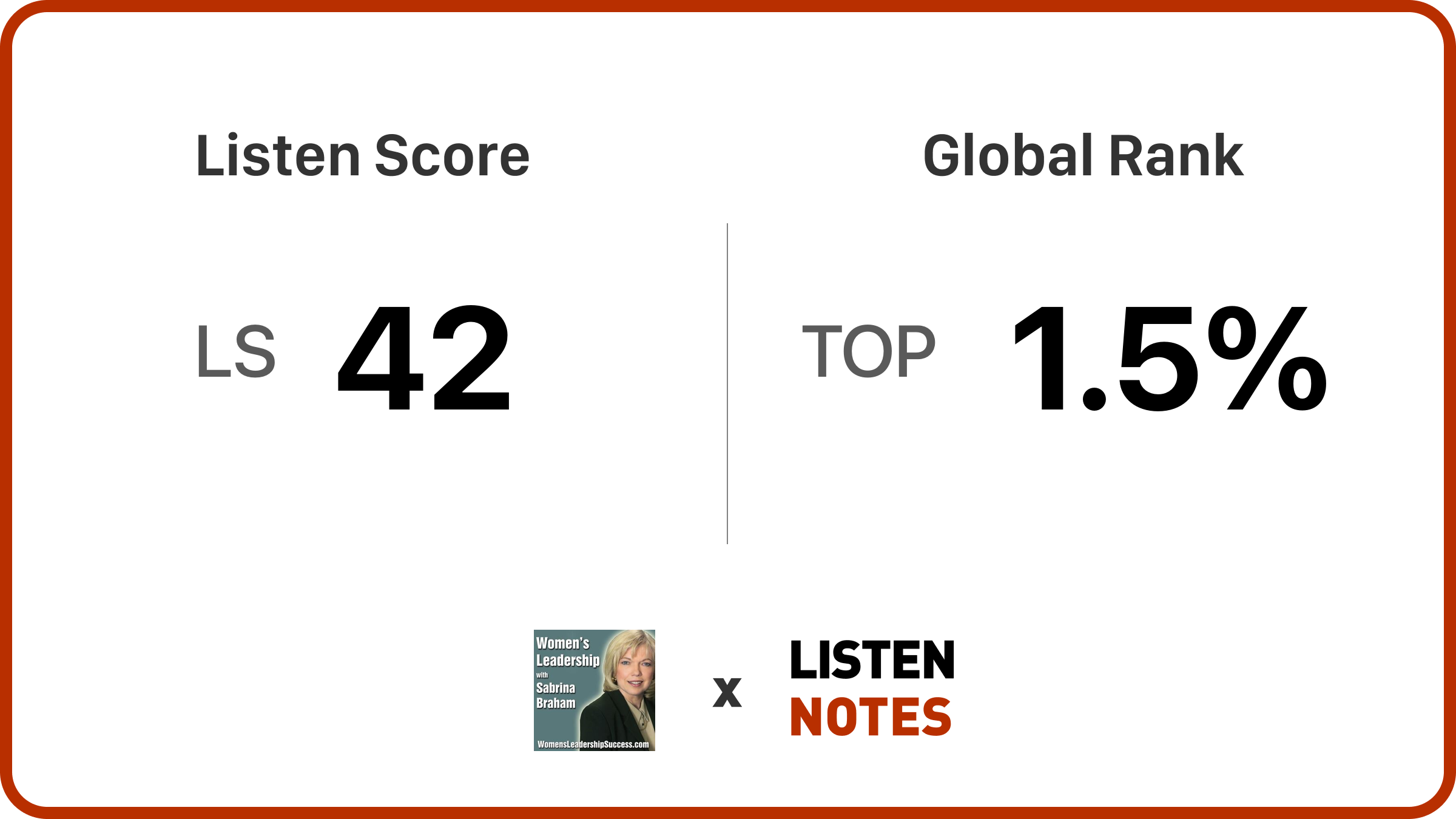
We have produced this Women’s Leadership Podcast since 2007, have had over 950,000 downloads, and have ranked in the top 1.5% of podcasts worldwide. We are so happy and excited to hear from many listeners that this podcast for women has helped them.
We know the advice and wisdom in this Women’s Leadership Podcast will change you…if you listen and implement the actions that are suggested in these programs.
May I Ask You a Favor?

Women’s Leadership Executive Coach Sabrina Braham MA MFT PCC
Thank you for listening to one of the first women’s leadership podcasts ever. May I ask you a favor?
Please give us a quick rating and review in Apple Podcasts or your favorite podcast platform and share this special leadership podcast for women with others so that we can help more women succeed together.
I want to hear from you too. Please post your thoughts and questions in the “Leave a Comment” box below each show.
Wishing you great success, Sabrina Braham MA MFT PCC
AI Executive Workflow Automation: Your Blueprint for Systematic Leadership Transformation (Part 2)
Podcast: Play in new window | Download
Subscribe: Apple Podcasts | Spotify | Android | Pandora | iHeartRadio | Blubrry | TuneIn | Deezer | RSS
From Novice Prompts to Expert Systems: How to Build AI Workflows That Run Your Routine Work While You Lead

In Part 1, we explored the foundational mindset for AI executive productivity—the shift from 80% routine work to 80% creative work. Now, in Part 2, Barry O’Reilly reveals the specific AI executive workflow automation systems that make this transformation real.
This isn’t theory. These are the exact workflows, prompts, and systems that Barry and leading executives use daily to reclaim their time and amplify their leadership impact.
What you’ll learn: The weekly business review system that takes 90 seconds instead of 30 minutes. How to audit your work with AI’s help. Building your personal prompt library. And why your unlearning rate must exceed your irrelevance rate.
The AI Executive Workflow Automation Philosophy: Creative Work + Automated Discipline
Before diving into specific systems, understand the core principle driving effective AI executive workflow automation:
Real-World AI Executive Workflow Automation Success Metrics

Let’s look at quantifiable results from implementing systematic AI executive workflow automation:
Barry O’Reilly’s Personal Metrics
Time Savings:
- Meeting follow-up: 20-25 minutes → 2-3 minutes (90% reduction)
- Weekly business review: 30+ minutes → 90 seconds (95% reduction)
- Coaching call documentation: 20 minutes → 2 minutes (90% reduction)
- Total weekly savings: 15-20 hours reclaimed
Work Quality Improvements:
- Response time: Next-day follow-ups → 5-minute follow-ups
- Completeness: Memory-based notes → 100% accurate transcripts
- Pattern recognition: Limited historical context → Months of synthesized data
- Team accountability: Vague action items → Clear ownership and tracking
Life Quality Transformation:
- Evening work: 2-3 hours → 0 hours
- Weekend stress: High → Minimal
- Family presence: Distracted → Fully engaged
- Work satisfaction: Exhausted → Energized
The Broader Organizational Impact
When leaders implement AI executive workflow automation systematically:
Team Benefits:
- Crystal-clear communication about priorities
- Improved accountability with perfect tracking
- Faster decision-making with comprehensive context
- Reduced meeting time as follow-ups are automated
- Enhanced psychological safety as all voices are captured
Business Benefits:
- Faster execution as routine work is automated
- Better strategic decisions with data-backed insights
- Improved client/stakeholder relationships through responsiveness
- Increased innovation as leaders have time for creative work
- Competitive advantage through human + machine approach
The Excitement Factor: Why This AI Time Management Transformation Matters
Barry’s most compelling point about AI executive workflow automation isn’t about efficiency—it’s about rediscovering joy in leadership work.
The Emotional Transformation
Before AI Executive Workflow Automation: “I never heard anyone go to work and say they were excited because they got Microsoft Word installed in their business.”
After AI Executive Workflow Automation: “I sit on these calls with executives, and they’re like, ‘I’ve never been more excited about going to work in a long time, because I’m actually doing more creative, interesting work, and it’s creative learning how to do that work.'”
What Leaders Report
“I’m winning back creative problem-solving capacity”
- Not just in daily work, but in experimenting with the tools themselves
- The process of learning AI executive workflow automation is itself engaging
- Finding new ways to automate routine work becomes a creative challenge
“I’m present with the people I care about”
- Brain isn’t stressed thinking about 10 emails to send
- Can sit down to dinner fully engaged
- Can pursue hobbies that replenish rather than deplete
- Sleep better without work anxiety
“I’m doing the best work of my life”
- More time on strategic thinking
- Better decisions with comprehensive data
- Higher quality outputs in less time
- Greater impact on team and organization
The Promise That Matters
As Barry powerfully summarizes: “People don’t want more AI tools, they want their lives back. They want to be present. They want to do the best work of their lives. And this is the opportunity for that.”
Workflow AI Automation for Solo Entrepreneurs
When asked about AI executive workflow automation for solo entrepreneurs (who often have even more routine tasks), Barry provided specific guidance.
The Solo Entrepreneur Time Audit
Common Time-Sinks for Solopreneurs:
- Business expense tracking and bookkeeping
- Client onboarding and follow-up
- Social media content creation and scheduling
- Email marketing and newsletter creation
- Invoice generation and payment tracking
- Calendar scheduling and rescheduling
- Customer service inquiries
- Content repurposing across platforms
The AI Executive Workflow Automation Opportunity
Example: Expense Tracking
Current State:
- 5 hours per week manually entering expenses
- Searching for paper receipts
- Categorizing transactions
- Emailing monthly reports to accountant
AI Executive Workflow Automation Solution:
- Photograph receipts immediately via app
- Automatic transcription to spreadsheet
- AI categorization based on patterns
- Automatic monthly report generation
- New time required: 30 seconds per week
The Process:
- Ask AI: “I spend 5 hours weekly on business expenses. How can I automate this?”
- AI recommends specific tools (Expensify, Receipt Bank, etc.)
- Set up the automated workflow
- AI generates monthly summaries for your accountant
- Use reclaimed 4.5 hours for business development
Building Your Solo Entrepreneur AI Executive Workflow Automation Stack
Client Management Workflow:
- AI copilot in all client calls
- Automatic follow-up email generation
- Action item tracking
- Project status updates
- Invoice reminders
Content Creation Workflow:
- One long-form piece (podcast, article, video)
- AI generates: Social posts, email newsletter, blog summary, quote graphics
- Schedule across platforms automatically
- Time saved: 80% of content repurposing work
Administrative Workflow:
- AI scheduling assistant
- Automatic meeting confirmations
- Template-based responses to common inquiries
- Invoice generation and tracking
Advanced AI Workflow Automation for Leaders: The Evolution of Your Prompts

As you progress in AI executive workflow automation sophistication, your prompts should become dramatically more effective.
The Prompt Evolution Framework
Beginner Mistakes:
- Being overly polite: “Please could you help me with…”
- Accepting first output without iteration
- Vague requests: “Make this better”
- No context provided
- Single-shot attempts
Intermediate Progress:
- Direct instructions without unnecessary pleasantries
- Requesting more information when needed
- Specific parameters: “I need this information, I need more of this”
- Providing relevant context
- Iterating 2-3 times
Expert Mastery:
- Highly specific, detailed prompts
- Multiple data sources included
- Request for multiple perspectives
- Ask for disconfirming evidence
- Chain multiple prompts together
- Build on conversation history
Example: Prompt Progression for Strategy Development
Beginner: “Help me create a strategy for growing my business.”
Intermediate: “I run a B2B SaaS company with 50 employees and $5M ARR. We’re considering expanding into the healthcare vertical. Based on our current capabilities in [X, Y, Z], what strategic options should we consider? Please outline pros and cons of each.”
Expert: “I run a B2B SaaS company with 50 employees and $5M ARR. We’re considering expanding into the healthcare vertical.
Context: [Upload 10 meeting transcripts from the past 2 months where we discussed this]
Please analyze these discussions and:
- Identify recurring themes and concerns about healthcare expansion
- Surface implicit assumptions our leadership team is making
- Generate 3 strategic options: conservative (low risk), moderate (balanced), and transformational (high risk/reward)
- For each option, provide:
- Resource requirements
- Timeline to market
- Expected ROI
- Key risks and mitigation strategies
- Success metrics
- Act as a skeptical board member and ask me 10 hard questions I must be able to answer before proceeding
- What perspectives from healthcare industry experts, compliance officers, or target customers might we be missing?
- Based on our conversation patterns, what blind spots should we be aware of?
- If we DON’T pursue this, what alternative growth strategies should we consider?”
The Refinement Conversation Pattern
Barry’s approach to AI executive workflow automation includes ongoing conversation refinement:
Initial Prompt: Ask your question or provide your task
AI Response: Review the output
Your Follow-up: “That’s helpful, but I need more detail on [X]. Also, can you provide [Y] perspective?”
AI Refinement: More targeted response
Your Iteration: “This section is good, but rework [Z] to focus on [specific angle]”
Final Output: Exactly what you need
As Barry noted about his own progression: “My prompts are very, very different than they were in the beginning. I’m getting a lot better information from the machine than I did to begin with.”
Your AI Executive Workflow Automation Implementation Roadmap

Here’s your step-by-step guide to implementing systematic AI executive workflow automation over the next 90 days.
Month 1: Foundation Building
Week 1: Self-Assessment
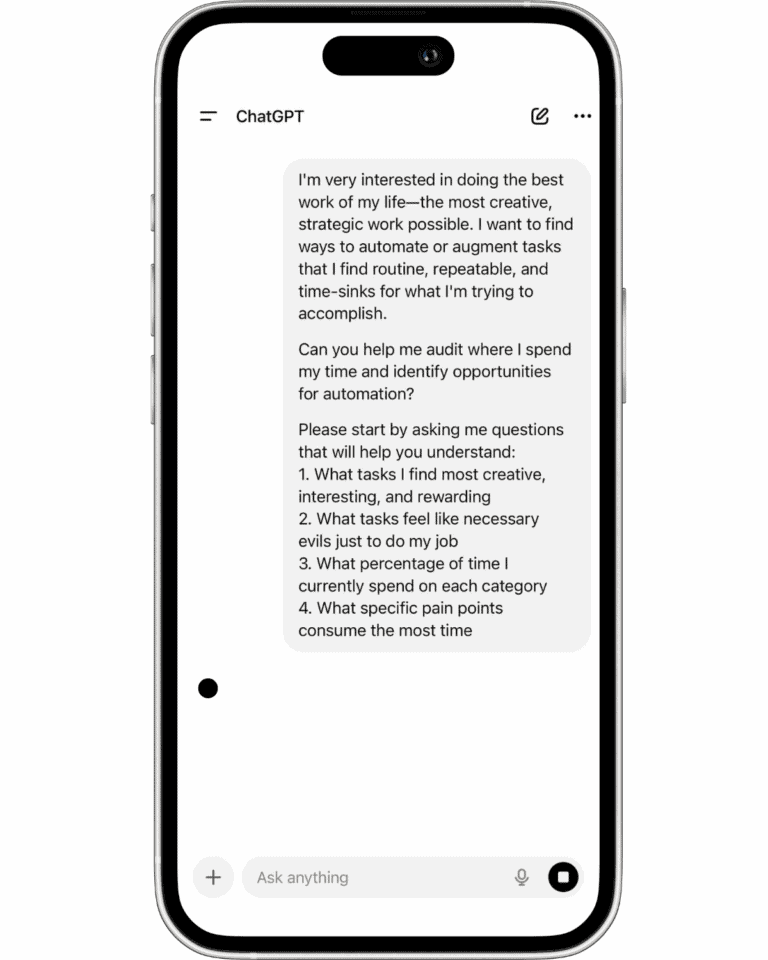
- Use the AI audit prompt to analyze your current time allocation
- Identify your top 5 time-sinking routine tasks
- Calculate hours spent weekly on creative vs. routine work
- Choose your AI copilot tool (Otter, Fireflies, Fathom, or Grain)
- Choose your LLM (ChatGPT, Claude, or Gemini)
Week 2: First Automation
- Deploy AI copilot in 5 meetings
- Practice the 2-minute follow-up process
- Create your first 3 prompt templates
- Document time saved vs. traditional approach
- Share one success with your team
Week 3: Expand Usage
- Add AI copilot to ALL meetings this week
- Build meeting follow-up prompts for different contexts
- Experiment with summary generation
- Try action item extraction
- Track quality and time savings
Week 4: Initial Prompt Library
- Document 10 prompts that work well
- Categorize by use case (meetings, emails, analysis)
- Note which prompts need refinement
- Share effective prompts with colleagues
- Measure total time saved this month
Month 2: System Development
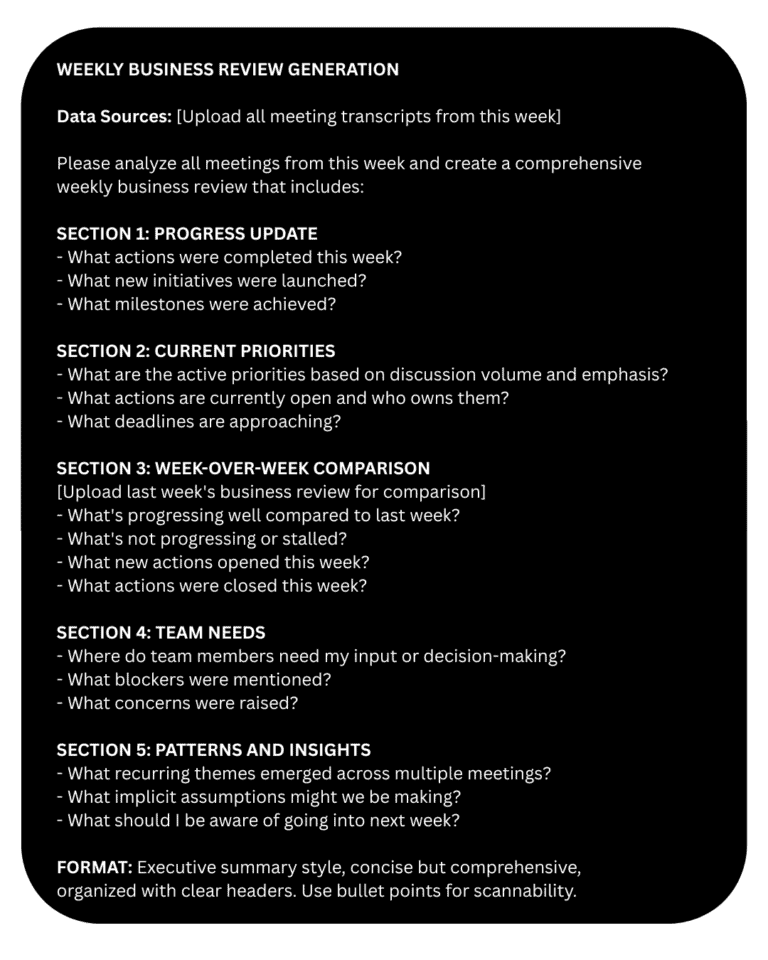
Week 5-6: Weekly Business Review
- Design your weekly review format
- Create the master prompt
- Run your first AI-generated review
- Gather team feedback
- Refine based on initial results
Week 7: Advanced Applications
- Use AI for strategic scenario planning
- Try pattern recognition across multiple meetings
- Ask for blind spot identification
- Test disconfirming question prompts
- Document insights gained
Week 8: Workflow Optimization
- Identify 3 additional routine tasks to automate
- Research and implement automation tools
- Connect multiple systems where possible
- Create standard operating procedures
- Train team members on your systems
Month 3: Mastery and Scale
Week 9-10: Prompt Sophistication
- Review all prompts for effectiveness
- Rewrite beginner prompts with expert specificity
- Build conversation chains for complex tasks
- Test multi-step automation workflows
- Document your prompt evolution
Week 11: Team Scaling
- Share your AI executive workflow automation systems with team
- Create team prompt library
- Establish team standards for AI usage
- Train team on effective prompting
- Implement team-wide workflows
Week 12: Measurement and Celebration
- Calculate total hours reclaimed over 90 days
- Measure percentage shift in creative vs. routine work
- Document qualitative improvements (stress, presence, satisfaction)
- Share success stories with broader organization
- Plan next quarter’s AI executive workflow automation goals
The 90-Day Success Metrics
By the end of 90 days, you should see:
✓ 60-80% reduction in time spent on routine administrative tasks
✓ 40-60% increase in time spent on creative strategic work
✓ Meeting follow-ups completed within 5 minutes instead of 25+ minutes
✓ Weekly business reviews taking 2 minutes instead of 30+ minutes
✓ Perfect capture and tracking of all meeting commitments
✓ Data-backed insights from patterns across months of meetings
✓ Improved team clarity and accountability
✓ Reduced evening and weekend work hours
✓ Enhanced presence with family and personal activities
✓ Renewed excitement about leadership work
Critical Success Factors for AI Executive Workflow Automation
Based on Barry’s experience coaching executives, here are the factors that separate successful AI executive workflow automation adoption from failed attempts:
Success Factor #1: Learning by Doing
What Works: Jump in and experiment immediately
What Fails: Reading endless articles without hands-on practice
Barry’s guidance: “The only way you can learn this stuff is by doing it. You can’t outsource it to somebody else, because you can only really understand it by doing it.”
Success Factor #2: Using AI to Teach You AI
What Works: Ask the tool itself how to use it better
What Fails: Only seeking human instruction
“You can ask the tool to help you. Unlike any other software tool I’ve used in my entire life, the help that this tool offers is actually valuable. The response is actually useful and actionable.”
Success Factor #3: Embracing Imperfection
What Works: Start with 80% solutions and iterate
What Fails: Waiting for perfect prompts before starting
Your first prompts will be rough. Barry’s early prompts asked AI to “formulate a strategy to take over the world.” Start messy, refine continuously.
Success Factor #4: Measuring Progress
What Works: Track time savings, quality improvements, and life satisfaction
What Fails: Implementing without measuring impact
Track: Time spent on tasks, percentage of creative vs. routine work, team feedback, personal stress levels, evening work hours.
Success Factor #5: Building Systems, Not Just Using Tools
What Works: Creating repeatable workflows and prompt libraries
What Fails: Ad-hoc tool usage without standardization
Barry’s weekly business review is a system, not a one-off task. Build systematic AI executive workflow automation that runs reliably.
Success Factor #6: Focusing on Routine Work First
What Works: Automate administrative tasks before complex strategic work
What Fails: Trying to replace creative problem-solving with AI
Start with meeting follow-ups, scheduling, summaries. Once those are systematized, move to strategic applications.
Overcoming Advanced AI Executive Workflow Automation Obstacles

As you progress in sophistication, you’ll encounter new challenges:
Obstacle: “My Prompts Aren’t Getting Better Results”
Diagnosis: You’re not iterating within conversations or learning from outputs
Solution:
- Don’t accept first responses—ask follow-up questions
- Request “What additional information would help you provide a better answer?”
- Compare outputs across different prompt variations
- Study which specific phrase changes yield better results
Obstacle: “I’m Not Sure If AI Output Is Accurate”
Diagnosis: You need verification workflows
Solution:
- Always review AI-generated content before sending
- Use AI for first drafts, add your expertise for final versions
- Cross-reference AI claims with your meeting memory
- Ask AI to cite specific moments from transcripts
- Build verification steps into your workflows
Obstacle: “My Team Is Resistant to AI Tools”
Diagnosis: Change management and trust issues
Solution:
- Start with your own workflows before requiring team adoption
- Share specific time savings and quality improvements
- Emphasize that AI augments, not replaces, their expertise
- Train team on effective usage
- Celebrate early wins publicly
Obstacle: “I’m Overwhelmed by New Tools and Features”
Diagnosis: Trying to keep up with every new release
Solution:
- Focus on mastering 2-3 core tools deeply
- Ignore new tool launches until you’ve systematized existing tools
- Remember: The most important capability is learning to prompt well, which transfers across tools
- New features are less important than consistent usage of foundational features
Obstacle: “AI Isn’t Capturing the Nuance I Need”
Diagnosis: Prompts lack sufficient context and specificity
Solution:
- Provide more background information in prompts
- Include examples of desired output
- Specify your leadership voice and values
- Request specific formats and structures
- Iterate: “This is close, but adjust [X] to focus on [Y]”
Barry’s Final Call to Action: Just Start

When asked what call to action he would give leaders, Barry’s response was both simple and profound:
The One-Week Experiment
“Put a meeting co-pilot in your meetings for a week. And then at the end of the week, put it all into an LLM—Claude, or ChatGPT, or whatever you choose—and just start asking it some questions, like:
- How did I perform in those meetings?
- How do you think I could be better next week?
- What are the trends that my team are telling me?
I guarantee you’re gonna have the most interesting coffee morning with a machine that you’ve probably ever had in your life. And you might even get a bit better as a result of it.”
Why This Matters
It’s not about the tools. It’s about reclaiming your life and doing your best work.
It’s not about efficiency. It’s about spending time on what matters most.
It’s not about replacing humans. It’s about augmenting human capabilities with machine precision.
The transformation Barry promises:
“People are winning more of this creative problem-solving capacity back—both in terms of their daily work and just experimenting with these tools and how they can help them. I’ve never been more excited about doing creative work AND creatively finding out how to get rid of the routine time-sink work. It’s making both of those realms fun things to do.”
Download Your Free Leadership Branding Blueprint Accelerator
Ready to amplify your leadership nrand impact  while mastering AI executive workflow automation?
Get instant access to our comprehensive Leadership Branding Blueprint Accelerator featuring:
✓ 90-Day Implementation Roadmap – Week-by-week guide with milestones
✓ Time Savings Calculator – Quantify your ROI from AI executive workflow automation
✓ Leadership Brand Development – Position yourself as an AI-forward leader
About Barry O’Reilly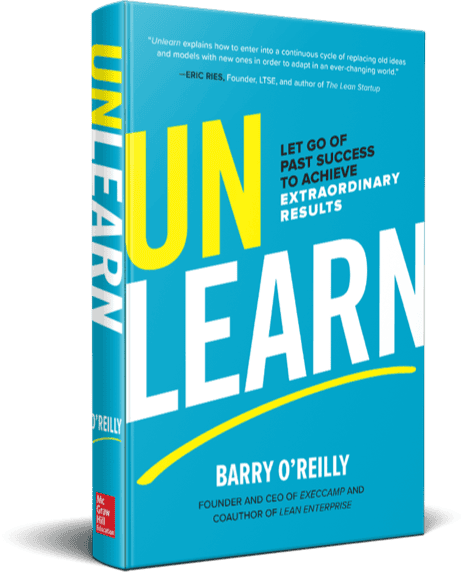
Barry O’Reilly is the bestselling author of “Unlearn” and co-founder of an AI venture studio building 100 companies in 5 years. He surveys thousands of executives on AI adoption and coaches C-suite leaders on AI executive workflow automation transformation. His weekly newsletter reaches 5,000+ executives. Visit BarryOReilly.com for free resources and tools.
About This Podcast
We interview world-class thought leaders and successful women executives to deliver actionable strategies for advancing your leadership career through AI executive workflow automation, strategic innovation, and executive presence. Our listeners include managers, directors, VPs, C-suite executives, and founders committed to doing the best work of their lives.




Women’s Leadership Podcast & Blog

Effective Leadership Productivity Strategies | WLS 132 – Road to Leadership Success Series
Welcome to the Road to Leadership Success, a resource for people who want effective leadership productivity strategies to learn faster and accomplish more. I'm Sabrina Braham, your Leadership coach. As your coach, I'm constantly looking [...]
 Develop Leadership Influence: Overcoming Barriers and Cultivating Impact | Women’s Leadership 131 Gallery
Develop Leadership Influence: Overcoming Barriers and Cultivating Impact | Women’s Leadership 131
Career Development, Confidence, Equality & Equity, How to Get Promoted, Leadership, Leadership & Women, Life Balance, Mindset, Networking, Parenting, Podcast, STEM
Develop Leadership Influence: Overcoming Barriers and Cultivating Impact | Women’s Leadership 131
Championing Gender Equality: Insights from Two Women Leaders In today's competitive business landscape, women, especially women of color, often face unique challenges on their path to develop leadership influence. Drawing from profound discussions, we delve [...]
 Overcome Leadership Self Doubt: A Tech Engineers Story to Inspire Inclusion Gallery
Overcome Leadership Self Doubt: A Tech Engineers Story to Inspire Inclusion
Career Development, Confidence, Equality & Equity, How to Get Promoted, Inspire Inclusion, Leadership, Leadership & Women, Life Balance, Mindset, Podcast, STEM
Overcome Leadership Self Doubt: A Tech Engineers Story to Inspire Inclusion
How did a woman of color who grew up in poverty in Tanzania overcome leadership self-doubt and go on to become a tech leader and Vice President at IBM, even though she was a single mother and battled imposter syndrome? A Women's Leadership Success Podcast interview with Sabrina Braham MA MFT PCC.
 Executive Leadership Confidence Development | Unlock Your Potential with ROAD TO LEADERSHIP SUCCESS Podcast Series with Sabrina Braham MA MFT PCC | WLS 129 Gallery
Executive Leadership Confidence Development | Unlock Your Potential with ROAD TO LEADERSHIP SUCCESS Podcast Series with Sabrina Braham MA MFT PCC | WLS 129
Executive Leadership Confidence Development | Unlock Your Potential with ROAD TO LEADERSHIP SUCCESS Podcast Series with Sabrina Braham MA MFT PCC | WLS 129
Are you ready to embark on a journey of personal and professional growth? Welcome to "ROAD TO Leadership SUCCESS," a transformative podcast series curated by Women's Leadership Success and presented by the seasoned coach and [...]

Mastering Leadership Career Negotiation Skills | WLS 128
Leadership career negotiation skills are essential for a thriving leadership career. Welcome to the Women's Leadership Success podcast #128, your go-to resource for learning crucial negotiation skills. In part one of this special two-part series, [...]