
Welcome to the Women’s Leadership Podcast
Do you want to expand your potential and achieve great success? You have come to the right place. The Women’s Leadership podcast was created to help you. For over 30 years, I have been involved in research & cutting-edge practices that have helped thousands of people get promoted and become top leaders.
In this one-of-a-kind women’s leadership podcast, you will get actionable advice and tips and hear stories from over 144 top female (and men) thought leaders to help you be a better leader, advance your career, increase your income, help you have more influence and have a better quality of life in work and play.
This Women’s Leadership podcast is ideal for you if you are a new supervisor, manager, existing C-Suite, seasoned entrepreneur leader, or aspire to be one.
How to Use Women’s Leadership Podcast to Excel in Your Leadership, Career, and Income

Executive Leadership Coach Sabrina Braham MA MFT PCC
To find a specific topic to help you succeed, use the Women’s Leadership Podcast “Topics” category search on the right-hand sidebar, or the search magnifying glass on the top navigation bar. Also, on the lower right-hand sidebar, check out some of the “Most Popular Shows” of the Women’s Leadership Success podcasts, where we are some of the most popular authors, entrepreneurs, and thought leaders dedicated to helping you enhance your leadership.
The results I have had with my clients inspired me to launch and develop this Women’s Leadership podcast to give you that same opportunity to excel in your leadership & career by sharing my expertise and interviewing top leaders in business to discover the secrets to their great success.
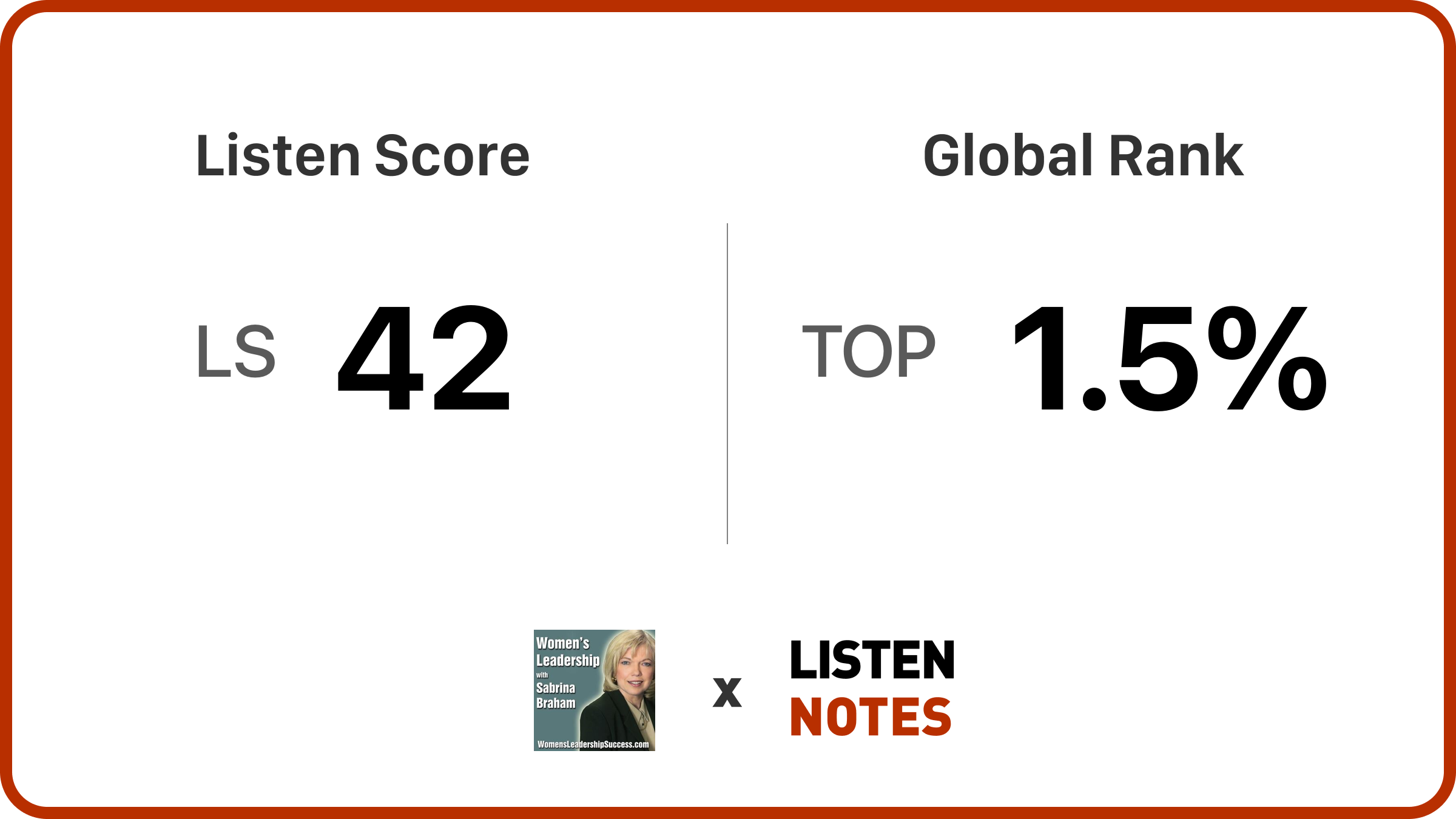
We have produced this Women’s Leadership Podcast since 2007, have had over 950,000 downloads, and have ranked in the top 1.5% of podcasts worldwide. We are so happy and excited to hear from many listeners that this podcast for women has helped them.
We know the advice and wisdom in this Women’s Leadership Podcast will change you…if you listen and implement the actions that are suggested in these programs.
May I Ask You a Favor?

Women’s Leadership Executive Coach Sabrina Braham MA MFT PCC
Thank you for listening to one of the first women’s leadership podcasts ever. May I ask you a favor?
Please give us a quick rating and review in Apple Podcasts or your favorite podcast platform and share this special leadership podcast for women with others so that we can help more women succeed together.
I want to hear from you too. Please post your thoughts and questions in the “Leave a Comment” box below each show.
Wishing you great success, Sabrina Braham MA MFT PCC
AI Leadership Framework: The OPEN and CARE Model for Ethical AI Implementation
Podcast: Play in new window | Download
Subscribe: Apple Podcasts | Spotify | Android | Pandora | iHeartRadio | Blubrry | TuneIn | Deezer | RSS
From Human Authenticity to Strategic Implementation: Part 2 of Our AI Leadership Series
 This is Part 2 of our exclusive two-part interview series with bestselling author and thought leader Faisal Hoque. In Part 1: “Women in Leadership AI: Preserving Human Authenticity While Harnessing Technology”, we explored what makes us uniquely human, the importance of leadership authenticity, and how to protect your agency while leveraging AI tools.
Now, in Part 2, we dive deep into the practical implementation side: How do you actually build an AI leadership framework that works? Faisal reveals his proprietary OPEN and CARE methodology—a systematic approach to AI governance framework that balances innovation with ethical responsibility.
The Hybrid World Reality: Why Traditional Leadership No Longer Works
The Death of Process-Performance-Structure Leadership
The old leadership paradigm is obsolete. As Hoque explains, “When I started my career, we used to think very much about process performance and organizational structure. Those kind of started to fade away. And we started talking about emotional intelligence, mindfulness, and inspiration and influence.”
But even that evolution isn’t enough for our current AI business strategy demands. Today’s leaders face an unprecedented challenge: managing hybrid workforces that include both human employees and AI agents.
What Hybrid Leadership Actually Means
Most people think “hybrid” refers to remote versus office work. That’s wrong. In the context of AI leadership framework development, hybrid means something far more complex:
Three Types of Hybrid Leadership:
- Hybrid Markets: Your customers interact with both human representatives and AI agents (like Netflix’s algorithm suggesting your next show)
- Hybrid Workforce: You manage both human resources and digital resources, working together and sometimes replacing each other
- Hybrid Leadership Decision-Making: As a leader, you’re not just saying “Faisal is going to do this and Sabrina is going to do that”—you’re also allocating: “My customer agent is going to do this, and my chatbot is going to do that”
The New Leadership Requirements
Modern leaders must be both emotionally intelligent AND systems thinkers. This used to be the job of IT or technology people, but that’s no longer true. In today’s AI governance framework, every leader at every level must understand how people and technology coexist.
The CARE Framework: Your AI Ethics Framework for Risk Prevention
Why Risk Planning Is Critical in AI Governance Framework
Most leaders are not prepared for AI’s potential negative consequences. They focus entirely on opportunity while ignoring catastrophic scenarios. The CARE framework forces leaders to think preventatively.
CARE: The Four-Step Risk Methodology
CARE is also an acronym that ensures responsible AI framework implementation:

C – Catastrophize Scenarios
- Identify the most catastrophic outcomes possible from your AI implementation
- Consider impacts on employees, customers, and society
- Think beyond immediate business metrics
A – Assess Impact
- Evaluate ripple effects across your ecosystem
- Consider job displacement consequences
- Analyze long-term societal implications
R – Risk Mitigation
- Develop guardrails and governance structures
- Create human oversight mechanisms
- Build in ethical decision-making checkpoints
E – Ethical Guidelines
- Establish clear principles for AI use
- Define boundaries for automation
- Protect human dignity and agency
The CARE Framework in Action: Preventing AI Disasters
Example: Continuing the Restaurant Scenario
Catastrophize: “What if we automate everything and lose all human connection? What if our laid-off workers can’t find new jobs? What if customers stop coming because they miss human interaction?”
Assess Impact: “If every restaurant automates, who has disposable income to dine out? Are we contributing to societal unemployment?”
Risk Mitigation: “Implement AI gradually, retrain staff for higher-value roles, maintain human touchpoints”
Ethical Guidelines: “Never fully automate customer-facing roles, always provide human override options, invest automation savings in employee development”
The OPEN Framework: Your AI Leadership Framework for Opportunity Exploration

Why Most AI Implementations Fail
Leaders jump into AI without systematic thinking. They see a shiny new tool, implement it quickly, and wonder why it doesn’t transform their business. The OPEN framework solves this by providing a step-by-step process for responsible AI framework development.
OPEN: The Four-Step Methodology
OPEN is an acronym that guides leaders through comprehensive opportunity assessment:
O – Outline Your Purpose
- Why do you exist as an organization?
- Who are you trying to serve?
- What problems are you solving?
This isn’t just philosophical thinking—it incorporates your business model, technology model, and people model. Every AI business strategy decision must ladder back to your core purpose.
P – Philosophical Foundation
- Integrate ethical considerations from day one
- Consider long-term societal impact, not just immediate efficiency
- Align AI implementation with organizational values
E – Experiment and Test
- Pilot AI solutions in controlled environments
- Measure both quantitative results and qualitative human impact
- Iterate based on real-world feedback
N – Navigate Implementation
- Scale successful pilots systematically
- Train teams on human-AI collaboration
- Continuously monitor and adjust based on outcomes
The OPEN Framework in Action: Real-World Application
Example: Restaurant Industry Transformation
Let’s say you run a restaurant and want to implement an AI leadership framework. Using OPEN:
Outline Purpose: “We exist to provide social dining experiences that bring people together”
Philosophical Foundation: “How does replacing waitstaff with robots align with our purpose of social connection?”
Experiment: “Test AI kiosks for ordering while maintaining human servers for interaction”
Navigate: “Scale based on customer satisfaction metrics, not just efficiency gains”
This systematic approach prevents the common mistake of implementing AI just because you can, without considering whether you should.
About Our Expert: Faisal Hoque’s Framework Development
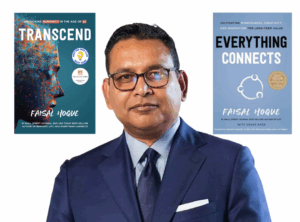
Faisal Hoque didn’t develop the OPEN and CARE frameworks in isolation. As a technology entrepreneur with decades of experience, he’s witnessed firsthand how organizations succeed and fail with technology adoption. His bestselling books “Transcend” and “Everything Connects” synthesize insights from philosophy, business strategy, and technology implementation.
What makes Hoque’s AI leadership framework unique:
- Combines Eastern and Western philosophical traditions
- Integrates practical business experience with ethical considerations
- Provides actionable frameworks rather than abstract principles
- Focuses on long-term sustainability over short-term gains
All proceeds from his books support cancer research, demonstrating his dedication to utilizing knowledge and technology for the greater good.
Building Your AI Business Strategy: The Integration Approach
Leaders Must Become Multidisciplinary
Single-expertise leadership is dead. Successful AI governance framework implementation requires leaders who can think across multiple dimensions:
Required Leadership Competencies:
- Technology Systems Thinking: Understanding how AI agents integrate with existing workflows
- Human Psychology: Managing the emotional impact of workforce changes
- Ethical Philosophy: Making principled decisions under uncertainty
- Business Strategy: Balancing innovation with profitability
- Risk Management: Preventing catastrophic outcomes
The Learning Pathway for AI Leadership Framework Mastery
Immediate Steps (Next 30 Days):
- Accept that you must become multidisciplinary
- Audit your current AI exposure and usage
- Organize your leadership team around hybrid thinking
- Document your organizational purpose clearly
Medium-Term Development (Next 90 Days):
- Implement the OPEN framework for one AI initiative
- Conduct CARE analysis for your highest-risk AI applications
- Train your management team on hybrid leadership concepts
- Establish AI ethics guidelines specific to your industry
Long-Term Transformation (Next 12 Months):
- Build organization-wide AI governance framework
- Develop internal expertise in both opportunity and risk assessment
- Create feedback loops for continuous framework improvement
- Mentor other leaders in responsible AI implementation
Preventing the Catastrophic Scenarios: Why CARE Matters
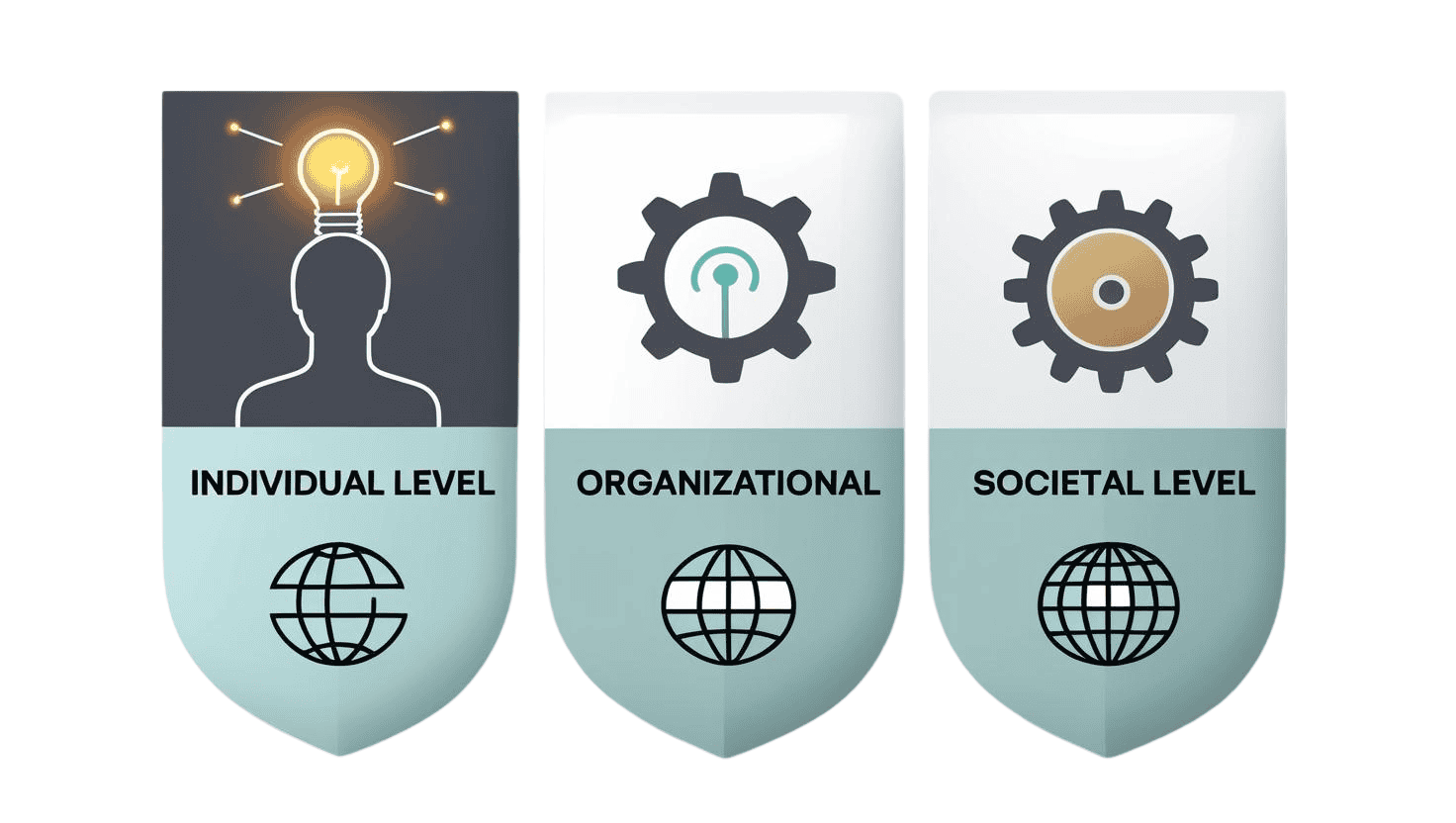
The Individual Level: Where It All Starts
Ethical AI implementation begins with personal choices. Every leader must examine their own behavior:
Daily Ethical Decisions:
- Should I write this email without understanding what AI generated?
- Should I share information I haven’t personally verified?
- Should I use AI research I don’t understand?
- Should I implement AI solutions without considering job displacement?
The Organizational Level: Systems Thinking
Scaling individual ethics requires systematic approaches:
Risk Assessment Questions:
- Are we making money at the expense of societal good?
- Are we laying off people without considering economic ripple effects?
- Are we using AI to manipulate rather than serve customers?
- Are we creating technology that amplifies human flaws rather than human strengths?
The Societal Level: Long-Term Thinking
The most dangerous AI implementations ignore broader consequences:
Societal Risk Factors:
- Job displacement without retraining opportunities
- AI systems that amplify existing biases
- Technology that reduces human agency and autonomy
- Solutions that benefit only wealthy organizations while harming communities
Current Trends Shaping AI Ethics Framework Development
The Governance Imperative
Almost all companies invest in AI, but just 1% believe they are at maturity, with the biggest barrier to success being leadership. This creates unprecedented opportunities for leaders who can master both OPEN and CARE frameworks.
The Risk Management Revolution
In 2025, company leaders will no longer have the luxury of addressing AI governance inconsistently or in pockets of the business. As AI becomes intrinsic to operations and market offerings, companies will need systematic, transparent approaches to ensure sustained value from AI investments.
The Ethics Integration Trend
A strong emphasis on human oversight, AI ethics, and responsible AI frameworks will shape governance discussions in 2025. Governments and businesses will integrate AI ethics frameworks into their AI governance strategies.
The Partnership Model: Human-AI Collaboration Done Right

Beyond Human vs. Machine Thinking

The question isn’t whether humans or machines are better—it’s how to create productive partnerships. Effective AI leadership framework implementation focuses on augmentation, not replacement.
Healthy AI Collaboration Principles
Human-First Approach:
- Use AI to enhance human capabilities, not replace human judgment
- Maintain human agency in critical decisions
- Design AI systems that respect human dignity
- Create guardrails that prevent AI overreach
Technology as Partner:
- Leverage AI for data processing and pattern recognition
- Use AI to free humans for higher-value creative work
- Implement AI to solve previously impossible problems
- Scale human empathy and decision-making through intelligent systems
What Good Partnership Looks Like
Example: Healthcare AI Implementation
Poor Implementation: AI makes medical diagnoses without doctor review Good Implementation: AI analyzes patient data and suggests areas for doctor investigation
Poor Implementation: AI chatbot replaces all patient interaction Good Implementation: AI handles routine questions while routing complex issues to humans
The difference is whether AI amplifies human expertise or attempts to replace human judgment entirely.
The Detachment Problem: Short-Term Thinking vs. Long-Term Strategy
Understanding Detachment in AI Leadership Framework
Detachment in Hoque’s framework refers to the dangerous tendency toward short-term convenience thinking that ignores long-term societal impact.
Examples of Detached Thinking:
- “If I can be profitable with 30 people instead of 100, I should automate immediately”
- “Efficiency gains justify any workforce disruption”
- “Our only responsibility is to shareholders, not to society”
- “AI problems will solve themselves through market forces”
The Empathetic Alternative
Attached leadership considers the full ecosystem impact:
Questions Attached Leaders Ask:
- Will customers value efficiency over human connection?
- Are we laying off our best people who could be retrained for higher-value work?
- How does our decision impact the broader community?
- Are we building the kind of world we want to live in?
This doesn’t mean avoiding AI—it means implementing AI thoughtfully with consideration for all stakeholders.
Transcending Through AI: The Ultimate Leadership Goal

What “Transcend” Really Means

Transcendence isn’t about technology replacing humanity—it’s about humanity transcending current limitations through technology partnership.
Faisal’s Definition: “Can you transcend yourself of your capability to doing good? Taking care of my community, taking care of my employees, taking care of my family, being more creative?”
The Transcendence Framework
How AI Leadership Framework Enables Transcendence:
Enhanced Capability:
- Use AI for research to make more informed decisions
- Leverage AI for outreach to serve more people effectively
- Deploy AI to bring diverse teams together across geographic boundaries
- Utilize AI to become a better communicator and leader
Expanded Impact:
- Solve problems previously impossible due to scale limitations
- Serve underserved communities through AI-powered solutions
- Create innovations that benefit society broadly
- Build more inclusive and effective organizations
The Growth Imperative
To effectively partner with AI, leaders must keep growing themselves. This means:
Continuous Development:
- Expanding your understanding of AI capabilities and limitations
- Developing deeper emotional intelligence as AI handles routine tasks
- Building stronger ethical reasoning capabilities
- Cultivating wisdom to make good decisions in uncertain situations
Becoming Your Future Self:
- Using AI to amplify your best human qualities
- Leveraging technology to serve others more effectively
- Creating positive change that wouldn’t be possible without AI partnership
- Building the kind of world you want to leave for future generations
Implementation Roadmap: Your 90-Day AI Leadership Framework Launch
Phase 1: Foundation (Days 1-30)
Leadership Team Preparation:
- Conduct OPEN assessment of current AI readiness
- Complete CARE analysis of existing AI implementations
- Define organizational purpose and values clearly
- Establish AI ethics committee with diverse representation
Systems Audit:
- Map all current AI and automation tools
- Identify human-AI interaction points
- Document decision-making processes that involve technology
- Assess team readiness for hybrid management
Phase 2: Framework Development (Days 31-60)
OPEN Implementation:
- Select one high-impact AI opportunity for pilot
- Outline purpose alignment for the pilot project
- Design experiment with clear success metrics
- Create navigation plan for scaling successful outcomes
CARE Implementation:
- Conduct catastrophic scenario planning session
- Assess potential negative impacts on all stakeholders
- Develop risk mitigation strategies and guardrails
- Establish ethical guidelines and oversight mechanisms
Phase 3: Integration and Scale (Days 61-90)
Organizational Integration:
- Train management team on hybrid leadership principles
- Implement feedback loops for continuous improvement
- Create communication plan for transparency about AI use
- Establish regular review cycles for framework effectiveness
Culture Development:
- Foster environment where humans and AI complement each other
- Reward decisions that balance innovation with responsibility
- Celebrate examples of successful human-AI collaboration
- Share learnings openly with industry peers
The Future of AI Leadership Framework: 2025 and Beyond

Why This Moment Is Critical
We’re at an inflection point. The decisions leaders make about AI implementation in the next 1-3 years will determine whether AI serves humanity or whether humanity serves AI.
Key Success Factors:
- Leaders who master both OPEN and CARE frameworks will have sustainable competitive advantages
- Organizations that balance innovation with responsibility will build stronger stakeholder trust
- Companies that invest in human development alongside AI development will attract top talent
- Leaders who think systemically about human-AI collaboration will create more innovative solutions
The Competitive Advantage of Ethical AI Business Strategy
Responsible AI implementation isn’t just morally right—it’s strategically smart:
Business Benefits:
- Higher employee engagement and retention
- Stronger customer loyalty and trust
- Lower regulatory risk and compliance costs
- More sustainable long-term growth
Better crisis resilience and stakeholder support
Preparing for an Uncertain Future
The AI landscape will continue evolving rapidly. Leaders who ground themselves in robust frameworks like OPEN and CARE will adapt more successfully to change because they have systematic approaches to opportunity assessment and risk management.
Future-Proofing Strategies:
- Build frameworks that adapt to new technologies rather than specific tools
- Develop organizational capabilities that transfer across AI applications
- Create cultures that balance innovation with responsibility
- Establish networks with other ethical AI leaders for shared learning
Feeling stuck in your career despite strong results?

In this no-cost, 50-minute, 90-Day Career Breakthrough Session, we’ll uncover what’s blocking your next promotion—and map out a 90-day strategy to elevate your leadership, visibility, and income by 20–50%.
Includes full recording, summary, and your personalized advancement roadmap.
Only for high-performing Directors & Senior Leaders ready to act. Limited availability.





Women’s Leadership Podcast & Blog
 What Do Great Women Leaders Have in Common? They Are Masters of Good Communication | Great Women leadership Communication Tips | Sabrina Braham MA MFT PCC Gallery
What Do Great Women Leaders Have in Common? They Are Masters of Good Communication | Great Women leadership Communication Tips | Sabrina Braham MA MFT PCC
What Do Great Women Leaders Have in Common? They Are Masters of Good Communication | Great Women leadership Communication Tips | Sabrina Braham MA MFT PCC
If you want to be successful in your present position or you are targeting your next promotion, these great women leadership communication tips are guaranteed to help you succeed If you become highly skilled at [...]
 Confident Girls Become Confident Women Leaders | Girls Without Limits | Critical Issues & Their Solutions | Future Women Leaders | Sabrina Braham MA PCC & Dr. Lisa Hinkelman Gallery
Confident Girls Become Confident Women Leaders | Girls Without Limits | Critical Issues & Their Solutions | Future Women Leaders | Sabrina Braham MA PCC & Dr. Lisa Hinkelman
Confident Girls Become Confident Women Leaders | Girls Without Limits | Critical Issues & Their Solutions | Future Women Leaders | Sabrina Braham MA PCC & Dr. Lisa Hinkelman
Do you know that confident girls become confident women leaders? Do you know bullying at a younger age impacts the way women treat each other in the workplace? Do you want to support confident empowered [...]

Professional Women LinkedIn Profile Optimization | Sabrina Braham & Donna Serdula – Part II | WLS113
This is part 2 of a special show on professional women LinkedIn profile optimization. If you haven’t listened to part 1, you can start here. But be sure to catch the great advice in part [...]
 Executive Women LinkedIn Optimization | How You Can Build Your Brand | Grow Your Network | Get Better Jobs | Part I – Donna Serdula & Sabrina Braham MA PCC Gallery
Executive Women LinkedIn Optimization | How You Can Build Your Brand | Grow Your Network | Get Better Jobs | Part I – Donna Serdula & Sabrina Braham MA PCC
Executive Women LinkedIn Optimization | How You Can Build Your Brand | Grow Your Network | Get Better Jobs | Part I – Donna Serdula & Sabrina Braham MA PCC
Do you have any of these LinkedIn profile questions below? LinkedIn has become the talk of the town, but don't worry as we're here to help you with executive women LinkedIn optimization for your profile. [...]


Women Reputation Management | The Female Executive’s Guide to Building, Pivoting and Repairing Your Reputation
Do you know why women reputation management is important, especially in your career? It can have a profound impact on your getting promoted, getting new business, how much you earn, and even your impact and [...]