
Podcast: Play in new window | Download
Subscribe: Apple Podcasts | Spotify | Android | Pandora | iHeartRadio | Blubrry | TuneIn | Deezer | RSS
 Do you avoid difficult conversations at work? Does the word “negotiation” make you uncomfortable? You’re not alone. Research from Cornell University reveals that many women would rather go to the dentist than negotiate for themselves—yet negotiation is one of the most critical leadership skills you must master to advance your career.
Here’s the surprising truth:
Women leaders actually possess natural strengths that lead to superior negotiation outcomes. New 2025 research from Columbia Business School shows that women’s relational negotiation approaches result in 23% fewer impasses and often achieve better deals than aggressive tactics—especially when alternatives are weak.
In this groundbreaking episode of the Women’s Leadership Success podcast, I sit down with Scott Walker, who spent 5 years at Scotland Yard supporting families whose loved ones had been kidnapped and helped secure their release. Now a keynote speaker and author of the Sunday Times bestseller “Order Out of Chaos,” Scott reveals how the same techniques he used to save lives can transform how women leaders navigate workplace negotiations, difficult conversations, and high-stakes decisions.
What Is Negotiation Really? (It’s Not What You Think)
Negotiation Skills for Women Leaders – Reframing Negotiation as a Conversation With Purpose
“Life is one big negotiation,” Scott explains. “We’re negotiating all day, every day. It’s simply a conversation with a purpose—whether you’re dealing with kidnappers in a boardroom or with your teenagers who just do not want to do what you want them to do.”
Most women run from negotiation because they’ve been taught it’s:
– Aggressive and confrontational
– A sleazy sales tactic
– A win-lose battle where someone gets hurt
– Incompatible with creating equity in relationships
But this outdated view keeps talented women leaders from asking for what they deserve and advocating effectively for their teams.
The New Definition of Negotiation for Women Leaders:
Negotiation is any conversation where you’re looking to:
– Influence or persuade others
– Bring about cooperation or collaboration
– Achieve a specific outcome
– Solve a shared problem
– Build understanding across different perspectives
When you reframe negotiation this way, it becomes less about combat and more about connection—which aligns perfectly with women’s documented strengths in relational communication.
Why Women’s Negotiation Skills Are Actually Superior in Leadership Roles
Contrary to persistent myths, recent research reveals that women’s negotiation approaches often produce better results:
Columbia Business School (September 2025): Women negotiators who use relational strategies achieve better outcomes than those using aggressive tactics, particularly when negotiating from positions with weak alternatives. Their approach of “asking for less but receiving more” avoids impasses that derail deals.
Darden Business School (2025): Women who secure leadership positions typically use “shaping strategies”—proposing creative solutions that go beyond the immediate scope of negotiation to create value for both parties. This approach generates better long-term outcomes than traditional positional bargaining.
Harvard Program on Negotiation (2025): While women still face backlash for negotiating assertively, those who frame their asks around mutual benefit and relationship preservation achieve similar or better outcomes than aggressive negotiators.
The bottom line? Your natural inclination toward relationship-building and creative problem-solving isn’t a weakness in negotiation—it’s a strategic advantage.
Scott Walker’s Background: From Scotland Yard to Business Boardrooms
The Making of a Master Negotiator

Scott Walker spent 16 years as a career detective at Scotland Yard, dealing with organized crime and counter-terrorism investigations. But the turning point came when a colleague returned from three days negotiating the release of a kidnapped child from a drug gang.
“I was drowning in paper cuts from all the crime reports I had to supervise,” Scott recalls. “When I heard about what my colleague was doing, I thought, ‘I want some of that.'”
After completing the rigorous selection process and training, Scott spent five years as a kidnap negotiator:
– Receiving calls at 2 AM to race across London
– Sitting with terrified families receiving calls from kidnappers
– Working with his team to secure hostage releases
– Negotiating in life-or-death situations where every word mattered
After leaving law enforcement, Scott spent another decade doing kidnap negotiation work in the private sector across every industry and continent imaginable.
Scott’s Own Negotiation Disaster (And What He Learned)
Even expert negotiators aren’t immune to emotional hijacking. Scott shares his humbling experience on his very first kidnapping case:
“I nearly had the shortest career as a negotiator. I’m advising this family whose son had been taken hostage, and they’re just not listening to me. I’m full of enthusiasm and ego and testosterone—I’m the savior! And I just blew up at them.”
His supervisor immediately pulled him out of the room with feedback that changed his career: “Scott, your job is not to tell people what to do. Your job is to seek first to understand them and where they’re coming from, and then you can look to influence them.”
The Behavioral Change Indicators (BCI) Method

Scott teaches a practical framework for recognizing when someone—including yourself—is heading toward emotional hijacking:
Physical Behavioral Change Indicators:
– Facial expressions shifting (jaw clenching, brow furrowing)
– Body posture changing (crossing arms, leaning back, leaning forward aggressively)
– Breathing patterns altering (rapid, shallow breaths)
– Voice characteristics shifting (tone, pitch, volume, speed)
– Physical tension increasing (fist clenching, fidgeting)
Verbal Behavioral Change Indicators:
– Vocabulary changes (suddenly using harsh or absolute language)
– Topic shifting (avoiding or obsessing over specific subjects)
– Repetition patterns (saying the same thing multiple times)
– Question patterns (asking more or fewer questions)
– Silence (withdrawing from conversation entirely)
The Power of Observation:
“If you can spot these behavioral change indicators in yourself or others, you can intervene before the emotional hijack takes over completely,” Scott explains. “It’s like seeing the train coming down the track—you still have time to step off the rails.”
Practical Exercise: Building Your Emotional Intelligence
Want to sharpen your ability to read emotions? Scott shares a brilliant practice technique I love recommending to my coaching clients:
The Silent TV Exercise:
- Turn on a TV show or movie with the sound completely off
- Watch the actors’ facial expressions and body language
- Try to identify what emotions they’re experiencing (angry, jealous, sad, excited)
- Turn the sound back on to see if you were correct
- Practice this regularly to build your emotional reading skills
“Most people would get it right,” Scott notes, “because we’re hardwired to negotiate, influence, and persuade. We just need to bring intentionality to it.”
You can also practice in daily life with lower-stakes situations: “It looks like you’re feeling sad right now—is that accurate?” Whether they confirm or correct you, you’re building the muscle memory for the high-stakes conversations.
The Power of Listening: Moving Beyond the Presenting Issue
Why Most Leaders Are Terrible Listeners (And Don’t Realize It)
“Most of us think we’re the world’s best listeners,” Scott admits with a laugh. “But I’m guilty of just going through the motions sometimes. And I’ve also been on the receiving end when I know the person in front of me is thinking about a million other things than what I’m actually saying—and it’s infuriating.”
Here’s a truth bomb every woman leader needs to hear: You cannot influence someone unless you already know what influences them. Trying to persuade without understanding is the height of arrogance and rarely succeeds long-term.
The 5 Levels of Listening Framework

Scott developed this powerful framework to help leaders understand where they actually are versus where they need to be:
Levels 1-3: Listening for Gist (Ineffective)
- Level 1: Distracted Listening
– You appear to be listening but you’re thinking about your Amazon delivery
– You’re mentally making your to-do list
– You’re physically present but mentally absent
– Impact: The speaker feels dismissed and undervalued
- Level 2: Rebuttal Listening
– You’re waiting for them to finish so you can give your side
– You’re preparing your counterargument while they speak
– You might not even wait for them to finish before cutting them off
– Impact: No actual understanding happens; positions become more entrenched
- Level 3: Logic-Only Listening
– You’re listening only for the facts and logical arguments
– You’re missing the emotional undercurrents
– You’re focused on “what” but not “why”
– Impact: You address surface issues while real concerns remain hidden
Levels 4-5: Listening for Transformation (Highly Effective)
- Level 4: Listening for Emotion**
– You’re attentive to the feelings beneath the words
– You notice when emotions shift during the conversation
– You recognize fear, frustration, excitement, or uncertainty
– Impact: You understand the emotional drivers of their position
- Level 5: Listening for Point of View
– You’re asking, “Why is this person telling me these specific words NOW?”
– You’re seeking the underlying human needs
– You recognize that the presenting issue usually isn’t the real issue
– You’re listening 2, 3, 4 levels deeper
– Impact: You can address root causes and create lasting solutions
Types of Questions That Build Negotiation Skills
- Open-Ended Questions (Begin conversations and gather information)


– “What matters most to you in this situation?”
– “How do you see this playing out?”
– “What concerns do you have about this approach?”
- Clarifying Questions (Deepen understanding)
– “When you say [X], what do you mean specifically?”
– “Can you help me understand why that’s important to you?”
– “What would success look like from your perspective?”
- Empathy Questions (Build connection)
– “How are you feeling about all of this?”
– “What’s been most challenging for you?”
– “It sounds like this is really frustrating—is that accurate?”
- Forward-Looking Questions (Create movement)
– “What would need to happen for you to feel comfortable with this?”
– “If we could solve [X concern], would you be willing to move forward?”
– “What’s one small step we could take right now?”
The Label Technique: Making the Invisible Visible
Scott teaches a powerful technique called “labeling” that I use constantly in my executive coaching:
How It Works:
- Observe a shift in emotion or behavior (using your BCI skills)
- Name what you’re noticing without judgment
- Pause and let them respond
- Listen to what they reveal
Examples:
– “It seems like this topic is uncomfortable for you…”
– “It sounds like you’re frustrated with how this is going…”
– “It feels like there’s something else on your mind…”
– “It appears this decision is weighing heavily on you…”
Why This Works:
Making the invisible visible gives the other person permission to share what’s really going on. Women leaders often excel at emotional attunement—this technique lets you leverage that strength strategically.
The Practice Principle: Low-Stakes Rehearsal for High-Stakes Success
“Life gives you plenty of opportunity to practice this,” Scott reminds us. “You don’t need to go too far. Practice on the low-stakes stuff, the low-risk things. When the big stuff comes along, you’re ready to go.”
Where to Practice Your Negotiation Skills:
✓ Coffee shop interactions (asking for modifications to your order)
✓ Family dinner planning (navigating preferences and logistics)
✓ Scheduling meetings (negotiating times that work for multiple people)
✓ Casual conversations with colleagues (practicing question techniques)
✓ Low-pressure vendor negotiations (returning items, requesting services)
Every interaction is a laboratory for developing the negotiation skills for women leaders that will serve you in boardrooms, compensation discussions, and career-defining moments.
The Real Issue Is Never the Presenting Issue: Negotiation Tactics
As both an executive coach and former therapist, I see this pattern constantly in my work with clients. Scott’s experience mirrors mine perfectly:
“Usually the presenting issue or topic is not the real issue,” Scott explains. “It’s usually 2, 3, 4, 5, 6 levels below that. It’s just presenting as something else.”
Example from Hostage Negotiation:
When Scott dealt with kidnappers, yes, they wanted money. But it wasn’t just about the money:
– They wanted to save face
– They wanted to feel in control
– They needed to maintain their reputation with their criminal associates
– They were driven by deeper needs for respect, power, or survival
“If we just negotiated about the money and ignored these deeper needs, we’d never succeed in getting the hostage released safely,” Scott notes.
Application for Women Leaders:
When your team member comes to you saying, “I need a raise,” the real issue might be:
– Feeling undervalued compared to peers
– Concern about supporting their family
– Fear that they’re falling behind in their career
– Desire for recognition of their contributions
– Worry that you don’t see their potential
When your boss pushes back on your proposal, the real issue might not be your idea but:
– Concerns about political implications
– Fear of failure affecting their reputation
– Budget constraints they haven’t disclosed
– Competing priorities you’re not aware of
– Past experiences with similar initiatives
The Breakthrough Question:
Train yourself to ask silently: “Why is this person telling me this specific message right now? What underlying human need are they trying to meet?”
This question transforms you from a transactional negotiator into a strategic influencer.
Asking Questions vs. Making Statements: The Influence Multiplier

Why Women Leaders Need to Ask More Questions
One of the most powerful negotiation skills for women leaders is mastering the art of asking questions instead of making statements. This approach aligns beautifully with research showing women’s collaborative communication styles produce superior outcomes.
The Psychology of Questions vs. Statements:
When you make a statement:
– You’re telling someone what to think
– You create potential resistance or defensiveness
– You position yourself as having all the answers
– You shut down exploration and discovery
When you ask a question:
– You invite the other person to think
– You create collaborative problem-solving
– You position yourself as curious and open
– You unlock new possibilities neither of you had considered
“Questions create space for influence,” Scott teaches. “Statements create walls.”
The “Bunch of Fives”: Preparing for Difficult Negotiations

Why Preparation Prevents Emotional Hijacking
Scott shares one of the most practical tools from his kidnap negotiation days—something they used before every single call with hostage takers. He calls it “The Bunch of Fives.”
The Framework:
Before any important conversation or negotiation, identify the top 5:
– Obstacles that could derail the conversation
– Challenges that might arise
– Threats to your desired outcome
– Demands the other party might make
– Issues that could trigger emotional hijacking
“If you can play devil’s advocate and understand what those top 5 likely things are, you’re forearmed, which is forewarned, which means you’re more prepared,” Scott explains. “When it does happen, rather than getting knocked off course and emotionally hijacked, you can go, ‘Yes, I knew this was gonna happen, and I’m prepared for it.'”
How to Build Your “Bunch of Fives”
Step 1: Define Your Desired Outcome
What does success look like for this conversation? Be specific.
Step 2: Brainstorm Obstacles
What could prevent you from achieving that outcome? Consider:
– Logical objections they might raise
– Emotional reactions they might have
– External constraints (budget, timing, politics)
– Hidden agendas or competing priorities
– Your own triggers and weak spots
Step 3: Prepare Your Response
For each of the top 5 obstacles, prepare:
– How you’ll recognize it if it shows up
– How you’ll stay emotionally regulated
– What questions you’ll ask to understand it better
– What alternative solutions you might propose
Step 4: Practice Out Loud
Don’t just think through your responses—actually practice saying them. This creates neural pathways that will activate under pressure.
Step 5: Build in Flexibility
Remember that preparation isn’t about scripting every word—it’s about building confidence and reducing anxiety so you can respond authentically in the moment.
Real-World Example: Salary Negotiation
Let’s say you’re preparing to negotiate a salary increase. Your “Bunch of Fives” obstacles might include:
- “The budget is tight right now”
– Anticipated response: “I understand budget constraints are real. What would need to change for this conversation to be possible in the next quarter? Are there other forms of compensation we could discuss now?”
- “Your performance hasn’t been strong enough”
– Anticipated response: “I appreciate that feedback. Can you be specific about what metrics you’re using? I’d like to understand the gap between where I am and where I need to be.”
- “Others in your role make less”
– Anticipated response: “I’m curious about what factors determine compensation differences. I’ve been comparing my responsibilities to market rates, and I’m seeing [X]. How does our structure account for [specific contributions]?”
- Emotional hijacking: You feel rejected and get defensive
– Anticipated response: Take a breath, pause, and say, “I need a moment to process this feedback. Can you give me some time to reflect and schedule a follow-up conversation?”
- They make a counteroffer that’s insultingly low
– Anticipated response: “Thank you for that offer. I’m wondering if there’s room for us to find something between that number and my request. What factors would influence your ability to move closer to [X]?”
Seeking Out Worthy Opponents: The Counterintuitive Path to Mastery
Reframing “Difficult” People as Training Opportunities
Scott shares advice that initially sounds counterintuitive but transforms how you approach challenging relationships:
“Always seek out worthy opponents. These are people we might label as difficult—the ones we try to avoid. But actually, they’ll give you all the practice, the best practice you can have in terms of influencing and persuading other people.”
Think about the people you actively avoid at work:
– The colleague who always disagrees in meetings
– The client who’s never satisfied
– The boss who shoots down every idea
– The stakeholder who asks impossible questions
– The direct report who resists feedback
These are your worthy opponents—your training partners in developing world-class negotiation skills.
Why This Matters for Women Leaders
Research from Harvard shows that women still face backlash for being assertive in negotiations. You need repeated practice managing pushback, resistance, and difficult dynamics to build both skills and resilience.
The Shift in Mindset:
Old perspective: “I dread dealing with [difficult person]. I’ll avoid them whenever possible.”
New perspective: “Every interaction with [challenging person] is a laboratory for developing skills I need for the C-suite. They’re making me better.”
This reframe transforms anxiety into curiosity and avoidance into intentional practice.
How to Leverage Worthy Opponents
1. Approach With Curiosity, Not Defensiveness
Ask yourself: “What can I learn from how this person thinks? What drives their perspective?”
2. Practice Your Techniques
Use worthy opponents to test your:
– Behavioral change indicator observations
– Level 4-5 listening skills
– Question-asking rather than statement-making
– Emotional regulation under pressure
3. Debrief After Every Interaction
Scott advises: “Always do a little debrief with yourself.” Ask:
– What worked? What didn’t?
– When did I get emotionally hijacked?
– What would I do differently next time?
– What did I learn about myself?
4. Celebrate Small Wins
Did you stay calm when previously you would have gotten defensive? That’s progress. Did you ask one good question instead of making a statement? That’s growth.
90-Day Executive Leadership and Career Breakthrough Session
With Sabrina Braham MA MFT PCC – Psychotherapist & Executive Coach
Delivering results—but not moving up? That ends here.

This no-cost 45-minute private coaching session with Sabrina reveals the real reason you’re stuck—and builds a step-by-step plan to land your next role with a 20–50% raise.
✔️ Identify the hidden blockers costing you promotions or getting hired
✔️ Get a 3-month strategy to elevate your leadership profile
✔️ Includes session recording, transcript & personalized action plan
Only for high-performing senior managers, directors and assistant vice presidents ready to act. Limited availability.
What to Expect After Booking:
I’m excited to connect. Here’s what happens next. Once you book, you’ll receive a confirmation email with a tailored agenda based on the objectives you share with me.

After our session, you’ll receive a personalized follow-up package, including:
- A full recording of the session to reference anytime
- A concise executive summary with your top 3 leadership action steps
- A customized 3-month roadmap for securing your next role or promotion
- A snapshot of your strengths across five critical leadership domains
- Strategic personalized insights you won’t find in public-facing content
This private 1 on 1 session is highly strategic and strictly confidential. I don’t share proprietary frameworks publicly, and I ask the same from you.
This no-pressure, no obligation session gives us both an opportunity to see if we are a good match and if appropriate, explore coaching options together.
Scott Walker’s “Order Out of Chaos” Negotiation Framework
The Book That Became a Sunday Times Bestseller
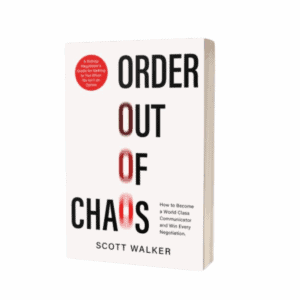
Scott’s book “Order Out of Chaos” has surprised everyone with its success, becoming a Sunday Times bestseller and reaching audiences globally. The framework Scott teaches in the book applies directly to the negotiation skills women leaders need most.
The Six Elements of Order Out of Chaos:
- Mindset and Emotions – Managing your internal state
- Preparation – Doing your homework before critical conversations
- Understanding Their World – Deep listening and perspective-taking
- Building Trust – Creating psychological safety
- Influence and Persuasion – Strategic communication
- Taking Action – Moving from conversation to results
Each element builds on the previous one, creating a systematic approach to handling even the most difficult negotiations and conversations.
Exclusive Offer for Our Listeners
Scott has generously offered Women’s Leadership Success listeners a special package:
What You Get:
– Free signed copy of “Order Out of Chaos” (just cover shipping)
– Workbooks to apply the concepts immediately
– Cheat sheets you can keep on your desk during conversations
– Access to Scott’s newsletter with ongoing insights and tools
These practical tools give you frameworks you can implement immediately—no theory, just actionable techniques used in the highest-stakes negotiations imaginable.
About Your Host: Sabrina Braham, MA, MFT, PCC

I’m Sabrina Braham, executive coach and host of the Women’s Leadership Success podcast—ranked in the top 1.5% of podcasts worldwide with over 950,000 downloads since 2007.
With over 30 years of experience and a background as a former therapist (MA, MFT), I’ve helped over 300 executives, managers, directors, VPs, C-Suite leaders and their teams:
– Navigate reputation management and executive presence challenges
– Break through leadership barriers that hold them back
– Develop the negotiation skills and confidence to ask for what they deserve
– Build personal brands that position them for C-suite opportunities
Sabrina offers:
– Executive Mastermind Groups: free session to see if you qualify
– 90-Day Career & Leadership Breakthrough Session – Complimentary
I created the Leadership Branding Blueprint Accelerator specifically for women leaders who are ready to step into their full power and advocate effectively for themselves and their teams.