Podcast: Play in new window | Download
Subscribe: Apple Podcasts | Spotify | Android | Pandora | iHeartRadio | TuneIn | Deezer | RSS
EXECUTIVE SUMMARY In 2026’s ‘forever layoff’ era, women leaders who master continuous improvement leadership outperform peers, reduce their layoff risk, and accelerate promotions. Olaf Boettger’s 27-year Kaizen framework — courage, humility, discipline — turns daily small improvements into extraordinary career results. Key stat: Toyota workers are 2x more productive than competitors using this same system. |
⚡ QUICK TAKEAWAYS • Continuous improvement leadership doubles your career productivity vs. peers who stop learning • The 3 capabilities every woman leader needs: courage to name problems, humility to keep learning, discipline to stay consistent • Kaizen’s daily 15-minute team meeting is directly applicable to your own career self-management • GE’s turnaround under Larry Culp proves CI works in any industry — finance, tech, healthcare, or your own career • In 2026’s ‘forever layoff’ climate, CI skills signal indispensable strategic value to any organization |
If you’re a woman leader in 2026, the job market has changed dramatically — and not in your favor. Glassdoor’s Worklife Trends report calls it the ‘forever layoff’: small, rolling cuts that never make headlines but keep talented executives in a constant state of anxiety. Meanwhile, AI is reshaping roles at every level, and the competition for standout positions has never been fiercer.
As an executive coach with over 30 years of experience (MA, MFT, PCC) and host of the Women’s Leadership Success Podcast — ranked in the top 1.5% globally with over 750,000 downloads — I’ve interviewed more than 144 of the world’s top leadership experts. When I heard Olaf Boettger’s approach to continuous improvement leadership, I immediately knew this was the missing framework most women leaders had never considered.
Olaf spent 27 years at Procter & Gamble and Danaher — two of the most operationally excellent companies on earth — mastering the Japanese Kaizen philosophy. What he discovered translates directly to career acceleration: the same system that doubled Toyota’s worker productivity and powered GE’s biggest turnaround in American history can supercharge your leadership brand and make you the candidate no one can afford to pass over.
The 2026 Career Reality: Why 'Working Hard' Is No Longer Enough
The data is sobering for women leaders right now. According to Glassdoor’s 2025 Workplace Trends report, small layoffs — under 50 people — now represent 51% of all job cuts, up from just 38% in 2015. These ‘forever layoffs’ create cultures of anxiety where talented women question their value daily.
At the same time, female manager engagement dropped seven percentage points in 2025 alone — the steepest decline of any group, according to Gallup research. Women leaders are being asked to do more with less, carrying teams through AI disruption and RTO mandates, while their own career advancement stalls.
The traditional answer — work harder, be more visible, volunteer for every high-profile project — simply isn’t scaling. In a market where 45% of employers rate the job outlook as ‘fair’ at best, you need a completely different strategy. You need continuous improvement leadership.
🎯 Ready to transform your career trajectory?
Download Leading Before You’re Ready for Free Today
What Is Continuous Improvement Leadership? The Kaizen Framework Explained
Continuous improvement — known in Japanese as Kaizen, meaning ‘change for the better’ — originated at Toyota nearly 90 years ago. After World War II, with limited resources and a need to compete globally, Toyota developed a system to extract maximum quality and efficiency from every process. That system, now called the Toyota Production System, became the foundation of what we know as Lean, Six Sigma, and the Danaher Business System.
For women leaders, continuous improvement leadership means applying these same principles to your career, your team, and your organization. It is not a one-time initiative or a January resolution. It is a daily practice — a permanent operating system.
The Three Foundation Principles
Olaf distills continuous improvement leadership into three core principles:
- Kaizen — The belief that there is always a better way. This is not about being self-critical; it is about being growth-oriented. Every interaction, presentation, and leadership decision is an opportunity to iterate and improve.
- Go to Gemba — Go to the real place. Stop relying on slide decks and secondhand reports. As a leader, this means visiting your stakeholders, understanding what your team actually experiences day-to-day, and staying close to the work that creates value.
- Customer focus — Always anchor to what your ‘customer’ values. In a career context, your customers are your executive stakeholders, your team, and the business outcomes you’re hired to deliver. Everything you do should be filtered through: does this add value for them?
The Three Capabilities That Determine Success
According to Olaf, your mindset determines everything. Leaders who succeed with continuous improvement possess three non-negotiable capabilities:
Capability | What It Looks Like in Practice | Why Women Leaders Need It Now |
COURAGE | Honestly naming when your performance or your team’s is ‘red’ — even when the culture rewards positivity over truth. | In 2026’s performance-pressured environment, leaders who surface problems first are seen as strategic — not weak. |
HUMILITY | Staying open to learning regardless of your experience level. As Olaf says: the best leaders he’s known, including P&G’s CEO A.G. Lafley, were the most humble. | Imposter syndrome tempts women to prove they already know everything. Humility is the counterintuitive superpower. |
DISCIPLINE | Showing up for improvement consistently — not just in January. Committing to the decade, not the quarter. | Career advancement compounds. The women who stand out in 2026 are those who have been quietly improving for years. |
The Business Case: What Continuous Improvement Leadership Actually Delivers
For skeptics — and Olaf acknowledges that many leaders initially resist this approach — the numbers make a compelling argument. Toyota, the originator of this system, generates roughly twice the revenue per employee compared to its nearest competitors. Danaher, where Olaf spent the bulk of his career, has sustained approximately 15–16% compound annual growth for 40 consecutive years.
The most visible example is GE’s transformation under Larry Culp — the former Danaher CEO who took over when GE was in deep financial trouble. Using continuous improvement as the operating backbone, Culp and his teams executed what many consider one of the greatest corporate turnarounds in American business history, eventually splitting GE into three highly successful independent companies.
On a practical level, Olaf shared a specific case study from a Danaher acquisition: a company delivering orders on time just 50% of the time. Using CI methodologies, that number rose to 95%. For context, if Amazon delivered your packages on time half the time, you’d stop using Amazon. A 45-percentage-point improvement is not incremental — it’s transformational.
Apply Olaf’s Red/Green method to your career right now:
|
 TRY THIS NOW (10 Minutes)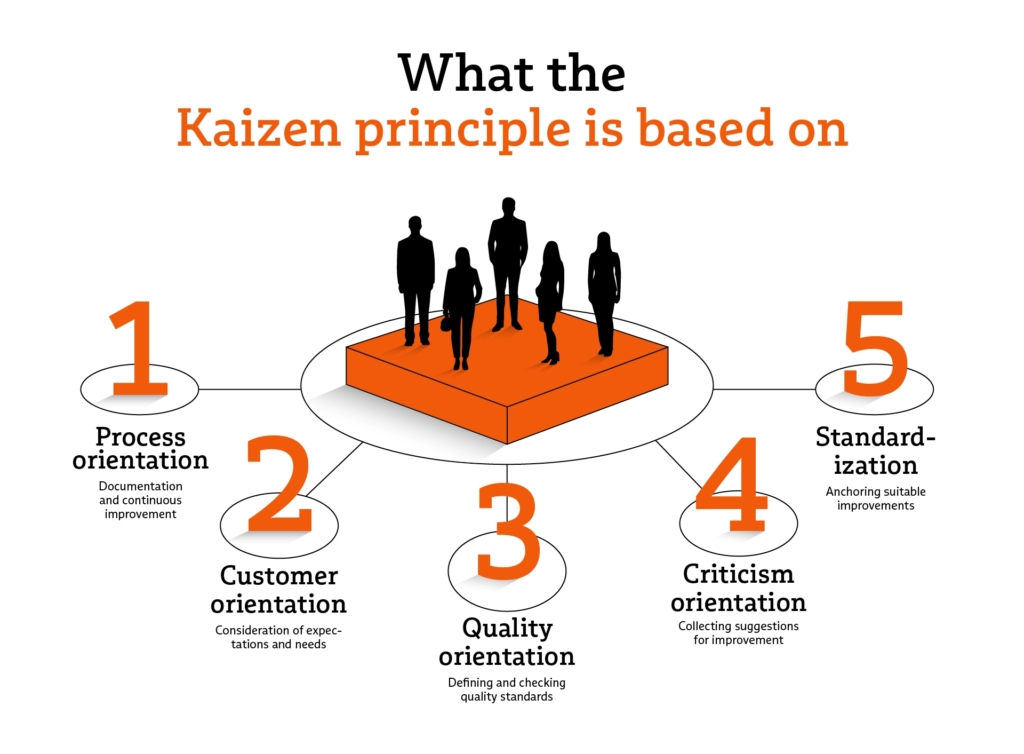
How to Apply Continuous Improvement Leadership to Your Career in 2026
The beauty of Kaizen is that it scales from a Toyota factory floor to your personal career strategy. Here’s how to translate Olaf’s framework into your daily leadership practice:
The 15-Minute Daily Leadership Huddle
At every Danaher facility, teams hold a 15-minute standing meeting every morning. They review five metrics — safety, quality, delivery, inventory, productivity — and ask: are we red or green? If red, why? Who does what by when?
For your career, your five metrics might be: stakeholder relationships, project delivery, skill development, visibility, and team performance. A daily or weekly 10-minute self-check asking those same questions creates the discipline of continuous improvement at the individual level.
Visual Management for Your Career
Olaf emphasizes making performance visible. In organizations, this means color-coded boards. For your career, this translates to maintaining a simple achievement tracker — a running document of your wins, metrics, and impact — that you review weekly. This directly feeds your Leadership Branding Blueprint and becomes the evidence base for promotion conversations.
The Growth Mindset + Kaizen Connection
Olaf’s PhD research connected him deeply to Carol Dweck’s work on fixed vs. growth mindsets. Dweck’s research demonstrates that individuals who believe abilities can be developed through dedication consistently outperform those who believe talent is fixed. Continuous improvement is the operational expression of growth mindset — it gives you the system that turns that belief into measurable career results.
Your 7-Step Continuous Improvement Career Action Plan
- Step 1 (10 min): Define your career target. What specific role, income level, or leadership metric do you want to achieve in the next 90 days? Be precise.
- Step 2 (10 min): Document your current actual. Where are you right now relative to that target? Don’t approximate — be specific and honest.
- Step 3 (5 min): Color-code your gap. Green if you’re on track. Red if you’re behind. Intellectual honesty here is a leadership act.
- Step 4 (15 min): Go to Gemba. Have one direct conversation this week with a key stakeholder asking: ‘What do you most need from me right now?’ Their answer may surprise you.
- Step 5 (30 min): Conduct a weekly ‘red review.’ Every Monday, review your red items: what caused them, what will you do differently, who needs to be involved.
- Step 6 (ongoing): Document wins in real time. Every significant result, stakeholder compliment, or project milestone goes into your achievement tracker immediately. Don’t wait for review season.
- Step 7 (30 min/month): Assess your three CI capabilities quarterly: How courageous was I in naming problems? How humble was I in seeking feedback? How disciplined was I in my commitments?
Traditional Career Thinking vs. Continuous Improvement Leadership
❌ Traditional Career Thinking | ✅ Continuous Improvement Leadership |
Work hard and hope to be noticed | Track impact metrics and make results visible proactively |
Avoid admitting gaps — look confident at all times | Name gaps with courage as a strategic leadership act |
Learn in formal training cycles | Learn every single day through iteration and feedback |
Wait for annual review to assess performance | Weekly 15-minute self-review: red or green? |
Expertise = knowing everything | Expertise = being the most committed to learning |
Layoff protection = being liked | Layoff protection = delivering measurable, documented results |
Career growth happens to you | Career growth is a system you design and operate |
AI is something to fear or ignore | AI is your continuous improvement accelerator |
5 Common Mistakes Women Leaders Make (And How CI Fixes Them)
MISTAKE 1: Proving competence by never admitting problems
This is the fixed mindset trap. It signals insecurity to executives who understand that surfacing problems early is a strategic skill. CI Fix: Practice naming one ‘red’ in every leadership conversation. Make it a strength, not a vulnerability.
MISTAKE 2: Waiting for perfect data before acting
In continuous improvement, you act on current information and correct as you learn. Analysis paralysis is the enemy of advancement. CI Fix: Adopt a ‘test and iterate’ mindset. Launch the imperfect version. Learn. Improve. Repeat.
MISTAKE 3: Learning only what’s needed for the current role
The moment you stop rowing, the current takes you backward. Your peers are improving. CI Fix: Block 30 minutes per week for deliberate learning — not social media, not catching up on email. Actual skill development.
MISTAKE 4: Ignoring AI tools because they feel overwhelming
As Olaf puts it, refusing to engage with AI is like refusing to go to the gym while competing in a race. You don’t need to master every tool. Start with one: use Perplexity or ChatGPT to research your next presentation topic. That’s CI applied to your workflow.
MISTAKE 5: Focusing on activity instead of outcomes
Continuous improvement is always anchored to measurable outcomes. Being busy is not the same as adding value. CI Fix: For every major initiative, define the metric that proves it’s working. Then track it weekly.
People Also Ask: Continuous Improvement Leadership for Women
What is continuous improvement leadership and how does it differ from regular leadership development?
Continuous improvement leadership applies the Kaizen philosophy — systematic, measurable, daily iteration — to your leadership practice, rather than treating development as episodic training events. Regular leadership development often happens in workshops or annual reviews. CI leadership is a daily operating system: you define targets, measure actuals, identify gaps, and take targeted action every week. The difference in career outcomes over 3–5 years is dramatic.

How can women leaders use continuous improvement to avoid layoffs in 2026?
The ‘forever layoff’ pattern — small, rolling cuts — targets leaders who cannot demonstrate measurable, documented impact. Women who practice CI maintain a real-time record of their contributions, proactively identify and solve organizational problems, and deliver consistent results that make them indispensable. Companies practicing CI also have significantly lower layoff rates historically, because problems are solved before they become crises requiring headcount cuts.
What are the three CI capabilities Olaf Boettger identifies for leadership success?
Courage (to name performance gaps honestly), humility (to keep learning regardless of experience level), and discipline (to apply improvement practices consistently over years, not weeks). Olaf emphasizes that these capabilities are a self-fulfilling prophecy — leaders who commit to CI with all three will succeed; those who approach it skeptically will find confirmation for their doubts.
How does Carol Dweck’s growth mindset connect to continuous improvement?
Carol Dweck’s research shows that believing abilities can be developed through effort — the growth mindset — leads to higher performance than believing talent is fixed. Continuous improvement is the operational framework that puts growth mindset into daily action. Where Dweck defines the belief, Kaizen provides the system: targets, actuals, gaps, countermeasures. Together, they create compounding career results.
How long does it take to see career results from continuous improvement?
Olaf describes CI as a long game — you’re committing to years and decades, not weeks. However, the daily meeting practice and weekly red/green review can produce measurable results in 30–90 days. Stakeholders notice when leaders become more accountable, more data-driven, and more proactive about surfacing and solving problems. Promotion conversations typically accelerate within 6–12 months of consistent CI practice.
Can I apply Kaizen to my job search if I’ve been laid off?
Absolutely. Define your target (specific role, company type, timeline). Measure your actual (applications sent, interviews booked, offers received). Color code your gap weekly. Identify why you’re getting stuck — is it the resume, the interview, your LinkedIn presence, your network? Then apply targeted countermeasures, one at a time. CI transforms a demoralizing job search into a systematic, evidence-based process you control.
What's New in 2026: Continuous Improvement Leadership Trends
The ‘Forever Layoff’ Changes the Leadership Calculus
Glassdoor’s research confirms that small, rolling layoffs now account for more than half of all job cuts. Leaders who can demonstrate continuous, measurable improvement in their area — not just a good quarter — are far more protected. CI is becoming a job security strategy, not just a business practice.
AI Is the New Continuous Improvement Accelerator
Olaf himself uses tools like Perplexity for faster research and deeper analysis. For women leaders, AI is the most powerful CI tool available: use it to identify skill gaps, research competitors, polish presentations, and accelerate learning. Leaders who combine domain expertise with AI fluency are commanding premium positioning in 2026.
Learning Cultures Are Becoming Talent Strategy
According to the Center for Leadership Studies, 71% of companies now say it’s more critical than ever for leaders to function during constant change — up from 58% in 2024. Organizations are embedding learning into daily work, not separating it from operations. Women who can model and lead this cultural shift are in extraordinary demand.
Coaching Mindset Is the New Leadership Expectation
Robert Half’s 2026 Salary Guide research confirms employers now expect leaders at every level to coach their teams continuously — giving ongoing feedback rather than waiting for formal reviews. This is Kaizen applied to human development: daily, targeted, iterative.
Skills-Based Leadership Is Overtaking Title-Based Leadership
Hiring in 2026 increasingly rewards demonstrable skills and outcomes over pedigree and job titles. Continuous improvement documentation — your achievement tracker, your impact metrics, your CI leadership record — becomes the portfolio that differentiates you.
Your Next Step: Make Continuous Improvement Your Competitive Advantage
The women who will stand out in 2026’s challenging job market are not the ones who work hardest or hope hardest. They are the ones who build systems — who apply the same rigor to their career that Toyota applies to manufacturing excellence and that Danaher applies to every acquisition. Courage to name the truth. Humility to keep learning. Discipline to show up every day.
That is continuous improvement leadership. And it is available to you, starting this week, with a simple 10-minute exercise and a piece of paper.
CHANGE THIS TO PROMO FOR COACHING CALL WITH SABRINA
Designed specifically for women directors, VPs, C-suite executives, and founders who are ready to accelerate their career in 2026. You’ll discover: • ✅ A systematic impact documentation method proven to accelerate promotions 3x faster • ✅ How to build a leadership brand that makes you the obvious choice — internally AND externally • ✅ A measurable framework for stakeholder influence that works in any organization or interview • ✅ The exact tools Sabrina uses with Fortune 500 executives to close the leadership gap • ✅ How to position your continuous improvement leadership as a competitive differentiator → Download FREE at: womensleadershipsuccess.com/leadershipbrandblueprint Results in as little as 30 days. No fluff. Just a proven system. |
🎙️ Listen to the Full Interview with Olaf Boettger Subscribe to the Women’s Leadership Success Podcast on Apple Podcasts, Spotify, Youtube or your favorite platform. Connect with Olaf Boettger on LinkedIn at linkedin.com/in/olaf-boettger for his daily continuous improvement posts — and tell him Sabrina sent you. Related episodes: Leadership Brand Building (WLS #142) | |
About the Expert
Olaf Boettger is a global continuous improvement and operational excellence leader with 27 years of experience at Procter & Gamble and Danaher. He holds advanced degrees in business, computer studies, and organizational analysis and behavior, and completed his PhD research focused on Carol Dweck’s growth mindset frameworks. Based in Germany, he posts daily continuous improvement insights on LinkedIn.
Connect with him at LinkedIn here.

About Sabrina Braham MA MFT PCC

Sabrina Braham is an executive leadership coach with over 30 years of experience helping women leaders advance their careers through strategic leadership branding and proven performance frameworks.
Her Women’s Leadership Success Podcast ranks in the top 1.5% globally with 750,000+ downloads.
She has coached 300+ executives and leaders in Fortune 500 companies and specializes in helping executives advance their leadership and careers.
Connect with Sabrina in LinkedIn and access her free resources at womensleadershipsuccess.com.
Still Getting Passed Over for VP? Here's What's Really Holding You Back.
One focused session reveals the hidden leadership gaps — and builds your step-by-step plan to advance with a 20–50% salary increase.
If you’re a high-performing director who’s doing everything right but still not moving up, the problem probably isn’t your technical skills or your work ethic.
After 30 years of coaching 300+ senior leaders, I’ve seen the same pattern again and again: the directors who get passed over for VP aren’t lacking results — they’re lacking visibility, executive presence, and the strategic soft skills that top leadership actually promotes.
You may be the most capable person in the room and still be invisible to the people making promotion decisions. That changes when you know how to articulate your strategic value, build influence across the organization, and position yourself as the obvious choice — not just a strong contributor.
In my 90-Day Career & Leadership Breakthrough Session, we get to the root of what’s blocking your advancement and build a concrete, personalized plan to move you forward — in just one hour.
Here’s what you’ll receive:
After our session with me (Sabrina Braham MA MFT PCC), you’ll walk away with a full recording and transcript, a 3-month roadmap for securing your next role or promotion, your top 3 leadership action steps, a strengths snapshot across five critical leadership domains, and strategic insights tailored specifically to your situation and industry.
This session is $499 — and if we’re a good fit for continued coaching, that fee is credited back to you in full.
Spots are limited and this is only for directors and senior managers who are genuinely ready to act.